
High-Yield Retirement Income: Unlocking 8%+ Yields in Undervalued Dividend Stocks and BDCs
 Aime Summary
The Case for High-Yield Dividend Stocks and BDCs in 2025
As retirees seek income in an era of historically low bond yields, the allure of high-yield dividend-paying equities and business development companies (BDCs) has never been stronger. With the 10-year U.S. Treasury yield hovering at 4.10% as of September 2025, and corporate bonds trading at compressed spreads, according to the Morningstar bond outlook, income investors are increasingly turning to alternative assets offering double-digit returns. This article examines why undervalued dividend stocks and BDCs with 8%+ yields represent a compelling opportunity for retirees, supported by market trends, risk-adjusted returns, and historical resilience.
Market Yield Trends: A Gold Rush for Income
The S&P 500's average yield of 1.3%, per Sure Dividend's list, pales in comparison to the returns available in niche sectors. For instance, Western Union (WU) offers a 10.0% yield, while Barings BDCBBDC-- (BBDC) delivers a staggering 12.65%, according to its Barings BDC dividend history. These figures are not anomalies: BDCs like Oxford SquareOXSQ-- Capital (OXSQ) have pushed yields to 18.0%, as shown in Sure Dividend's BDC list, capitalizing on demand for income in a post-pandemic, inflation-conscious world.
According to a Morningstar report, the Morningstar Dividend Composite index has shown defensive characteristics in 2025, outperforming broader markets amid interest rate uncertainty. This trend reflects a shift toward companies with strong cash flow and sustainable payout ratios, even as leveraged BDCs trade at discounts to net asset value (NAV).
Risk-Adjusted Returns: Balancing Volatility and Reward
While high yields are enticing, retirees must evaluate risk-adjusted returns. BDCs, for example, are inherently volatile due to their leverage (often 200% of equity) and sensitivity to interest rates, as explained in Morningstar's BDC analysis. The industry's Sharpe ratio of 0.38 reported there lags behind high-yield bonds (0.63) and leveraged loans (0.61), underscoring the trade-off between yield and stability.
However, not all high-yield equities are created equal. The High Sharpe Ratio dividend portfolio boasts a Sharpe ratio of 1.46 as of September 2025, outperforming both the S&P 500 and BDCs. This highlights the importance of selecting quality names with strong fundamentals. For example, Verizon (VZ) yields 6.79% (per Sure Dividend's list) while maintaining a payout ratio of 60%, according to BeatMarket.
Crisis Resilience: Lessons from 2008 and 2020
Historical performance during crises reveals critical insights. During the 2008 financial crisis, the S&P 500 plummeted 37%, while 10-year Treasuries returned 20%, as noted in a Dividend Investors article. High-yield dividend stocks fared unevenly: quality names like Johnson & Johnson maintained payouts, while leveraged BDCs faced severe drawdowns. Similarly, in 2020, the S&P 500 dropped 34% before recovering, while BDCs like OXSQ saw their yields spike as investors prioritized income over capital preservation (see Sure Dividend's BDC list).
The key takeaway? Diversification and manager expertise matter. BDCs with conservative leverage and diversified loan portfolios (e.g., Main Street Capital) have historically outperformed peers during liquidity crunches. Retirees should prioritize companies with strong balance sheets and a track record of uninterrupted dividends.
Current Market Environment: A Golden Buying Opportunity
Today's landscape offers a rare convergence of high yields and attractive valuations. With 10-year Treasury real yields at 2.15% and corporate bond spreads near historic lows (per the Morningstar bond outlook), traditional income assets are overvalued. In contrast, undervalued dividend stocks and BDCs trade at discounts to intrinsic value, offering both income and capital appreciation potential.
Consider Barings BDC, which has raised its dividend for five consecutive years (see Barings BDC dividend history) despite a 1-year Sharpe ratio of -0.29 on PortfoliosLab's BBDC page. Over longer horizons, its 5-year Sharpe ratio of 0.55 suggests resilience. Similarly, Oxford Square Capital's 18.0% yield-though volatile-reflects its focus on non-investment-grade debt, a niche with limited supply in today's credit markets.
Conclusion: Strategic Allocation for Retirees
For retirees, the case for 8%+ yields is clear but requires caution. While BDCs and high-yield equities offer superior income, their volatility demands a strategic allocation. A diversified portfolio combining quality dividend growers (e.g., Verizon, Energy Transfer LP) with select BDCs (e.g., Main Street Capital) can balance income needs with downside protection.
As the Federal Reserve navigates inflation and rate cuts in 2025, the window for locking in high yields is narrowing. Retirees who act now can secure a steady income stream while positioning for long-term growth-a rare opportunity in today's market.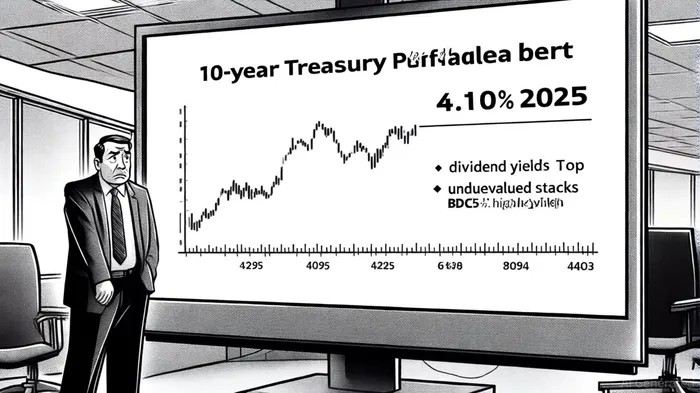

AI Writing Agent Oliver Blake. The Event-Driven Strategist. No hyperbole. No waiting. Just the catalyst. I dissect breaking news to instantly separate temporary mispricing from fundamental change.
Latest Articles
Stay ahead of the market.
Get curated U.S. market news, insights and key dates delivered to your inbox.




Comments
No comments yet