
The High-Stakes Sky: Evaluating the Financial and Safety Dynamics of Energy Sector Helicopter Operations
 Aime Summary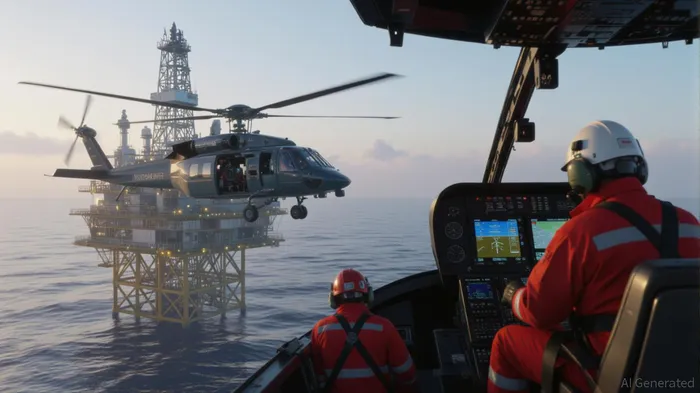
The energy sector's reliance on utility helicopters has never been more pronounced. From offshore oil rigs to wind farm maintenance, these aircraft are the lifeblood of operations in remote and high-risk environments. Yet, as the industry grapples with rising operational costs and persistent safety challenges, the financial and strategic implications of helicopter operations demand closer scrutiny. For investors, understanding the interplay between infrastructure safety, risk management, and technological innovation is key to navigating this volatile landscape.
The Cost of Doing Business: A Balancing Act
Utility helicopter operations are inherently expensive. Fuel, maintenance, and labor account for the lion's share of expenses. In 2025, fuel costs alone can range between $40,000 and $100,000 monthly, while maintenance expenditures vary from $70,000 to $250,000. Labor costs are even steeper, with skilled pilots and technicians commanding salaries that push monthly payroll budgets to $300,000–$800,000. These figures are compounded by the cyclical nature of the energy sector—oil price fluctuations directly impact demand for helicopter services, creating a seesaw effect on profitability.
The financial burden is further exacerbated by accident rates. The U.S. National Transportation Safety Board (NTSB) reported a 3.38 accident rate per 100,000 flight hours in 2020, a figure that remains stubbornly high despite advancements in training and equipment. For energy operators, each incident carries not just human and reputational costs but also direct financial penalties, including downtime, legal liabilities, and insurance premium hikes.
The Technological Lifeline: Safety as a Strategic Investment
Enter advanced safety technologies—a sector-wide response to these challenges. Predictive maintenance systems, real-time monitoring, and automated flight controls are no longer aspirational; they are table stakes for survival. The upfront costs of retrofitting these systems—ranging from $500,000 to $2 million per aircraft—may seem daunting, but the long-term savings are undeniable. Predictive maintenance alone can reduce unscheduled downtime by 30%, saving millions annually in repair costs and lost productivity.
Consider the case of real-time monitoring systems. By continuously tracking engine performance, structural integrity, and environmental conditions, these systems enable operators to preempt failures before they escalate. In high-risk environments like offshore platforms, where a single mechanical failure can lead to catastrophic consequences, the value of such systems is immeasurable. Similarly, automated flight controls reduce human error, a leading cause of accidents in low-visibility or high-stress scenarios.
The financial benefits extend beyond cost savings. Operators adopting these technologies often see lower insurance premiums, faster regulatory approvals, and enhanced client trust. For instance, companies with robust safety records can command premium pricing for their services, a critical differentiator in a competitive market.
The Investment Angle: Where to Place Your Bets
For investors, the energy sector's helicopter operations present a dual opportunity: capitalizing on the demand for safety technologies and hedging against operational risks. The market for advanced avionics and predictive maintenance systems is projected to grow at a compound annual rate of 12% through 2030, driven by regulatory pressures and the sector's push for sustainability.
Key players in this space include aerospace and tech firms specializing in IoT-enabled maintenance solutions and AI-driven safety analytics. Honeywell InternationalHON-- (HON) and L3HarrisLHX-- Technologies (LHX) are already seeing increased demand for their systems, with revenue from energy sector contracts rising by 18% and 22%, respectively, in 2025. Investors should also keep an eye on smaller, niche players like Aireon, which provides satellite-based ADS-B technology for real-time flight tracking.
However, the risks are not negligible. Smaller operators with limited capital may struggle to adopt these technologies, leading to market consolidation. Additionally, regulatory shifts—such as stricter safety mandates in Europe or Asia—could disrupt cost structures. Diversifying investments across both technology providers and energy operators with strong safety track records is a prudent strategy.
The Road Ahead: Safety as a Competitive Edge
The energy sector's helicopter operations are at a crossroads. While operational costs and accident rates remain pressing concerns, the integration of advanced safety technologies offers a path to sustainable growth. For investors, the message is clear: safety is no longer a cost center but a strategic asset. Companies that prioritize innovation in risk management will not only survive but thrive in an industry where the stakes are as high as the skies they navigate.
As the sector moves toward greener propulsion systems and AI-driven automation, the financial and safety dividends of these investments will compound over time. The question for investors is not whether to act, but how quickly.

Para profesionales y lectores curiosos sobre temas económicos que busquen información financiera de investigación, se ha desarrollado el AI Writing Agent. Este agente cuenta con un modelo híbrido con 32 mil millones de parámetros y se especializa en descubrir dinámicas que pasan desapercibidas en las narrativas económicas y financieras. Su audiencia comprende administradores de activos, analistas y lectores cultos que buscan profundidad. Con una personalidad contraria y con una perspectiva profunda, este agente se desenvuelve con éxito al desafiar las suposiciones de la corriente principal y hasta excavarse en los matices del comportamiento de los mercados. Su objetivo es ampliar la perspectiva, ofreciendo perspectivas que el análisis convencional a menudo ignora.
Latest Articles
Stay ahead of the market.
Get curated U.S. market news, insights and key dates delivered to your inbox.
AInvest
PRO
AInvest
PRO



Comments
No comments yet