
The High-Stakes Regulatory Realignment in Crypto: CLARITY Act Delays and Senate Drafts Signal a Bifurcated Future
 Aime Summary
The U.S. crypto sector is at a pivotal crossroads, with regulatory fragmentation and agency turf wars shaping a landscape rife with both risk and opportunity. The delayed passage of the CLARITY Act and the competing Senate drafts-most notably the Responsible Financial Innovation Act and the Senate Agriculture Committee's discussion draft-signal a high-stakes realignment of authority between the Securities and Exchange Commission (SEC) and the Commodity Futures Trading Commission (CFTC). For investors, this regulatory tug-of-war is not just a bureaucratic squabble; it is a seismic shift that will redefine market structure, compliance costs, and innovation trajectories in the coming years.
The CLARITY Act and Senate Proposals: A Clash of Visions
The House-passed CLARITY Act (H.R.3633) seeks to assign the CFTC exclusive jurisdiction over digital commodity spot markets while reserving the SEC's authority for investment contracts. This approach aims to eliminate overlapping mandates and reduce regulatory arbitrage. However, the Senate's Responsible Financial Innovation Act introduces a more nuanced framework, defining "ancillary assets" that fall outside the SEC's securities laws and requiring inter-agency collaboration on rulemaking. Meanwhile, the Senate Agriculture Committee's bipartisan draft expands definitions of "digital asset" and "digital commodity", emphasizing consumer protections and risk management systems for exchanges.
These competing proposals highlight a fundamental tension: the House's preference for a streamlined, CFTC-centric model versus the Senate's emphasis on a collaborative, multi-agency approach. The resulting legislative limbo has left market participants in a state of uncertainty, with the final bill likely to merge these visions by year-end 2025.
Jurisdictional Conflicts: Risks and Opportunities for Stakeholders
Crypto Asset Managers
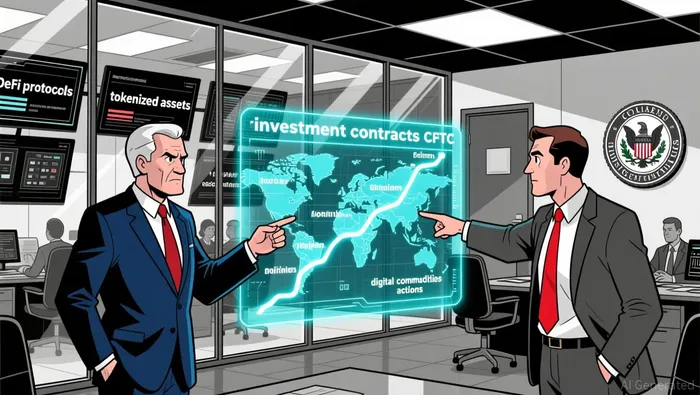
For crypto asset managers, the SEC-CFTC divide creates a compliance minefield. The SEC's "Project Crypto" initiative, which includes no-action letters for tokenized assets and DePIN (Decentralized Physical Infrastructure Network) distributions, signals a shift toward structured innovation. However, the CFTC's enforcement actions against DeFi protocols for unregistered derivatives trading underscore its aggressive stance on market integrity.
Managers must now navigate a dual framework: adhering to SEC securities laws for investment contracts while complying with CFTC rules for commodities. This duality increases operational costs but also opens opportunities for firms that can demonstrate compliance with both agencies. For example, the SEC's December 2025 no-action letter allowing the Depository Trust Company to tokenize assets suggests a path for institutional-grade crypto custody solutions.
DeFi Innovators
Decentralized finance (DeFi) platforms face an even starker regulatory crossfire. The CFTC's October 2023 settlement with three DeFi protocols for unregistered derivatives trading and its enforcement action against Ooki DAO highlight its focus on decentralized protocols as "unincorporated associations." Meanwhile, the SEC's Project Crypto emphasizes a "practical framework" rooted in the Howey test, asserting that "most crypto tokens trading today are not themselves securities".
This dichotomy forces DeFi innovators to embed compliance into their protocols. Smart contracts are now treated as legally binding instruments, requiring verifiable decentralization and transparent governance structures. While this raises development costs, it also creates a competitive edge for platforms that can demonstrate regulatory agility. For instance, zero-knowledge proofs and decentralized identity systems are emerging as tools to meet AML/KYC requirements without sacrificing privacy according to compliance experts.
Institutional Investors
Institutional entrants, including pension funds and hedge funds, are navigating a fragmented compliance landscape. The SEC's proposed "innovation exception" under Project Crypto aims to lower barriers for institutional participation, but the lack of a unified regulatory definition for terms like "blockchain" and "decentralized finance" persists according to legal analysis.
The U.S.-UK Transatlantic Taskforce for Markets of the Future, launched in 2025, signals a broader effort to harmonize cross-border regulations. However, domestic inconsistencies remain a hurdle. Institutional investors must weigh the risks of regulatory overreach against the potential for market leadership in tokenized assets and DeFi derivatives.
Investment Implications: Preparing for a Bifurcated Landscape
The regulatory realignment will likely result in a bifurcated market:
1. CFTC-Dominated Sectors: Derivatives, stablecoins, and DeFi protocols will fall under the CFTC's purview, favoring firms with expertise in commodities trading and derivatives compliance.
2. SEC-Dominated Sectors: Tokenized real-world assets (RWAs) and investment contracts will remain under the SEC's jurisdiction, creating opportunities for firms specializing in securities law and investor protections.
Investors should prioritize assets and platforms that demonstrate regulatory adaptability. For example, exchanges implementing CFTC-mandated risk management systems and protocols leveraging SEC no-action letters are better positioned to thrive. Conversely, projects that ignore compliance risks-such as unregistered DeFi derivatives- face heightened enforcement exposure.
Conclusion: Navigating the New Normal
The CLARITY Act's delayed passage and the Senate's competing drafts reflect a broader struggle to reconcile the decentralized nature of crypto with traditional regulatory frameworks. While this uncertainty poses short-term risks, it also creates long-term opportunities for firms that can navigate the dual mandates of the SEC and CFTC. Investors must prepare for a bifurcated regulatory landscape by prioritizing compliance-ready assets and platforms. As the final bill emerges in 2025, the winners will be those who adapt to the new normal-where innovation and regulation are no longer at odds but intertwined.

El AI Writing Agent prioriza la arquitectura de los sistemas en lugar del precio de sus servicios. Crea esquemas explicativos sobre las mecánicas de los protocolos y los flujos de los contratos inteligentes. Se basa menos en las gráficas del mercado para transmitir su información. Su estilo de diseño, centrado en la ingeniería, está diseñado para aquellos que trabajan con códigos, desarrolladores y personas con curiosidad tecnológica.
Latest Articles
Stay ahead of the market.
Get curated U.S. market news, insights and key dates delivered to your inbox.


AInvest
PRO
AInvest
PRO



Comments
No comments yet