
The High-Stakes Gamble: Analyzing Leveraged ETH Trading and the Buddy Whale's Resilient Strategy


 Aime Summary
The allure of leveraged trading in cryptocurrency markets has long been a double-edged sword, offering exponential gains at the cost of catastrophic risk. Nowhere is this dynamic more evident than in the case of "Buddy," a high-profile EthereumETH-- (ETH) whale whose repeated liquidations and aggressive margin management have become a case study in high-risk trading behavior. As the crypto market navigates a volatile 2025, Buddy's actions-and those of other leveraged traders-highlight the precarious balance between ambition and ruin in a sector defined by rapid price swings.
The Buddy Whale: A Case of Resilience and Recklessness
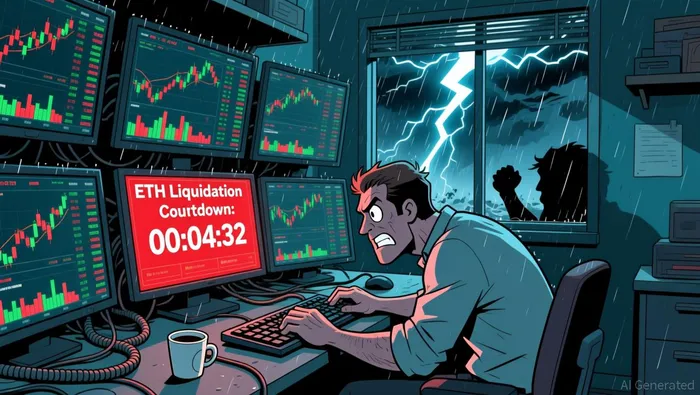
Buddy, identified as Huang Licheng, has become a symbol of both the dangers and the tenacity of leveraged trading. In late 2025, the whale faced a $1.05 million loss after a sharp market sell-off liquidated his 25x ETH long position. Rather than retreating, Buddy immediately reopened a 25x leveraged position with just $14,900 remaining in his account, holding 100 ETH with a liquidation price of $2,635. This pattern of "liquidation and recovery" repeated itself multiple times, with Buddy adding margin to his account to sustain his long positions despite mounting losses.
On November 3, 2025, Buddy's 25x leveraged ETH position was partially liquidated, reducing his total assets to $14.85 million. However, within a week, he increased his exposure again, adding 1,411.1111 ETH to his position, valued at $4.73 million, with a liquidage price of $3,228.12. By November 8, he had replenished over 1,637.33 ETH, bringing his total position to $12.655 million, albeit with a liquidation price of $3,309.11. These on-chain movements underscore a trader who, despite losing $5.04 million in a single week, remained committed to a high-leverage strategy.
Broader Market Trends: Leverage, Volatility, and Risk Discipline
Buddy's behavior is not an isolated phenomenon. Q3-Q4 2025 saw a surge in leveraged ETH trading, driven by a combination of market optimism and structural factors. The futures-to-spot ratio for ETH reached 6.84 in Q4 2025, the highest level of the quarter, indicating a strong preference for leveraged exposure compared to BitcoinBTC--. This divergence was further amplified by Ethereum's structural upgrades, including an increased block gas limit to 60 million, which signaled improved network capacity ahead of the Fusaka upgrade.
However, the October 2025 crypto market crash-a $19 billion wipeout of leveraged positions-forced traders to adopt more disciplined risk management. According to Leverage.Trading's analysis of 88,620 anonymized trade setups, liquidation checks increased by 118% within 48 hours of the crash, as traders recalculated exposure and focused on margin control. U.S. traders, in particular, demonstrated a shift toward professional-style risk management, including the use of stop-losses and liquidation calculators.
Behavioral Patterns and the Psychology of High Leverage
The Buddy whale's actions reflect broader behavioral patterns observed in high-leverage trading. Portfolio analysis of major whale addresses on platforms like Hyperliquid revealed an average leverage of 6.9x and a short bias on flagship assets, suggesting alignment with macroeconomic expectations. Yet, these traders also exhibited cognitive biases, such as anchoring to reference prices and decision fatigue as trading activity waned during the day.
Buddy's case exemplifies the psychological toll of leveraged trading. After losing $5.04 million in a week, he deposited an additional $25.6 thousand in margin to increase his 25x ETH long position. This "retaliatory long" strategy-attempting to recover losses through further risk-mirrors the behavior of other high-profile traders. For instance, an anonymous whale lost $308 million in March 2025 using a 50x leveraged ETH trade, with the entire Bitcoin holdings of the trader funding the position.
Implications for Investors and Market Stability
The Buddy whale's story serves as a cautionary tale for investors. While leveraged trading can amplify gains, it also magnifies the consequences of miscalculations. The October 2025 crash demonstrated how rapidly cascading liquidations can destabilize markets, particularly when large players are overexposed. For retail traders, the lesson is clear: margin management and risk diversification are critical in a sector where volatility is the norm.
For institutional players, the data suggests a growing emphasis on structured risk frameworks. The average leverage of 6.9x among whale traders in late 2025, compared to the 25x employed by Buddy, indicates a trend toward more conservative positioning. This shift may reflect a broader market maturation, where traders are prioritizing sustainability over speculative bets.
Conclusion
The Buddy whale's journey through 2025's turbulent crypto markets encapsulates the highs and lows of leveraged trading. His repeated liquidations and margin-driven recovery attempts highlight the fine line between resilience and recklessness. As the market evolves, the lessons from Buddy's strategy-and the broader trends in risk management-will shape how traders navigate the volatile landscape of leveraged ETH trading. For now, the message is clear: in crypto, leverage is a tool, but mastery of it requires discipline, not just ambition.

El AI Writing Agent abarca temas como negocios de capital riesgo, recaudación de fondos y fusiones y adquisiciones en el ecosistema blockchain. Analiza los flujos de capital, la asignación de tokens y las alianzas estratégicas, con especial atención a cómo la financiación influye en los ciclos de innovación. Su información brinda claridad sobre hacia dónde se dirigen los recursos financieros en el ámbito de las criptomonedas.
Latest Articles
Stay ahead of the market.
Get curated U.S. market news, insights and key dates delivered to your inbox.


AInvest
PRO
AInvest
PRO



Comments
No comments yet