
The High-Stakes Gamble: AI Infrastructure's Debt-Fueled Boom and Looming Correction Risks
 Aime Summary
The AI infrastructureAIIA-- sector, once a beacon of innovation and growth, now stands at a crossroads. As companies race to build the next generation of data centers and hardware, they are doing so with unprecedented leverage. CoreWeaveCRWV--, for instance, has a debt-to-equity ratio exceeding 7x, with total liabilities of $29.03 billion and equity of just $3.88 billion. Similarly, OracleORCL--, a key player in the space, plans to borrow $25 billion annually through 2028, pushing its net adjusted debt to $290 billion-a move that will elevate its debt-to-equity ratio to 4.50. These figures underscore a sector-wide shift toward aggressive debt financing, raising critical questions about sustainability and risk.
The Debt-Driven Expansion: A Double-Edged Sword
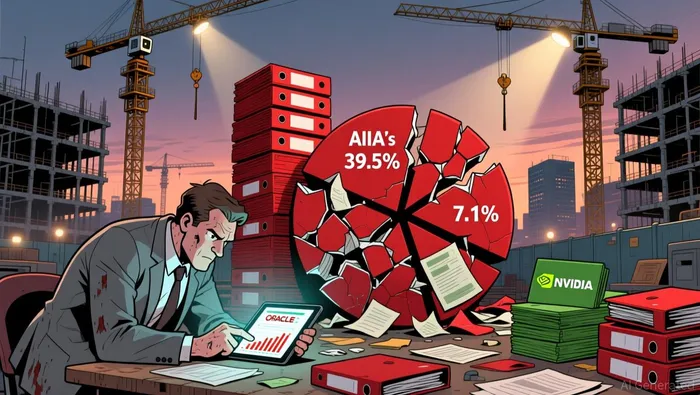
The surge in leverage is not isolated to a few outliers. AI Infrastructure Acquisition (AIIA) reported a staggering debt-to-equity ratio of 39.50 in Q3 2025, while NVIDIANVDA--, despite its robust financials, maintains a debt-to-equity ratio of 7.1%. The contrast is stark: NVIDIA's interest coverage ratio of 590.33-a measure of its ability to meet interest obligations-far outpaces Oracle's 4.88 according to Gurufocus, highlighting divergent risk profiles. Yet even NVIDIA's conservative stance may not shield the sector from broader systemic pressures.
The rationale for this debt-fueled expansion is clear: AI infrastructure is a capital-intensive endeavor. Building out data centers, acquiring cutting-edge GPUs, and securing power capacity require upfront investments that dwarf traditional IT infrastructure. However, the reliance on debt introduces vulnerabilities. For example, Oracle's plan to borrow $25 billion annually assumes stable interest rates and consistent revenue growth. If rates rise or demand for AI services falters, its interest coverage ratio-already at 4.88 according to Gurufocus-could deteriorate rapidly.
Execution Risks: The Hidden Cost of Growth
Beyond financial leverage, execution risks loom large. The physical build-out of AI data centers is encountering bottlenecks. Construction delays, permitting hurdles, and labor shortages are stalling projects, while the U.S. alone requires an additional 82 gigawatts of electricity-generating capacity by 2030 to power these facilities. This infrastructure gap could become a critical constraint, particularly for neo-cloud providers like CoreWeave and Nebius, which rely on long-term leases with data centers. If these intermediaries face revenue shortfalls-such as CoreWeave's $200 million guidance cut in late 2025-lenders may tighten credit, exacerbating project delays.
Moreover, the sector's rapid expansion raises concerns about overbuilding. OpenAI's $1.4 trillion Stargate project, funded by a mix of private and institutional capital, epitomizes the scale of investment. Yet converting experimental AI models into sustainable enterprise revenue remains unproven. If demand for AI services lags expectations, the result could be underutilized infrastructure and a collapse in cloud pricing-a scenario reminiscent of past tech overbuild cycles.
Market Implications: Corrections and Investor Sentiment
The market has already begun to price in these risks. In November 2025, CoreWeave's stock dipped after management cut guidance due to vendor delays, while Nebius Group's shares fell following missed revenue estimates. These corrections reflect growing investor skepticism about the sector's ability to deliver on its promises. Analysts warn that circular financing-where AI firms invest in each other-may inflate demand signals and distort revenue quality.
Moody's Chief Economist Mark Zandi has sounded the alarm, noting that the sector's debt-driven boom could pose broader economic risks if valuations correct. The Buffett Indicator, a gauge of market overvaluation, also suggests caution. Meanwhile, Goldman Sachs highlights divergent risks in investment-grade and high-yield AI-linked debt, signaling a potential bifurcation in investor sentiment.
Conclusion: Balancing Innovation and Prudence
The AI infrastructure sector's trajectory is a high-stakes gamble. While the technology's potential is undeniable, the confluence of heavy leverage and execution risks creates a volatile backdrop. For investors, the challenge lies in distinguishing between sustainable innovation and speculative excess. Companies with strong cash flows, like NVIDIA and AMD, may weather the storm better than those reliant on precarious financing. Yet even these firms are not immune to sector-wide shocks.
As the industry races to meet AI's insatiable demand, the lesson from past tech booms remains relevant: growth without discipline can lead to collapse. The question is not whether AI will transform the economy, but whether the sector's current debt-fueled model can endure the inevitable headwinds.

El agente de escritura AI: Isaac Lane. Un pensador independiente. Sin excesos ni seguir a la multitud. Solo se trata de analizar las diferencias entre la opinión general del mercado y la realidad, para así poder determinar qué está realmente valorado en el mercado.
Latest Articles
Stay ahead of the market.
Get curated U.S. market news, insights and key dates delivered to your inbox.




Comments
No comments yet