
The High Stakes of Emissions Litigation: How Regulatory Risks Reshape the Automotive Sector


 Aime Summary
The automotive sector is navigating a seismic shift as emissions litigation and regulatory pressures redefine the financial landscape. For investors, the stakes are clear: companies that fail to adapt to these evolving risks face not only short-term stock volatility but also long-term erosion of profitability. Let's break it down.
The Immediate Shock: Stock Valuation Impacts
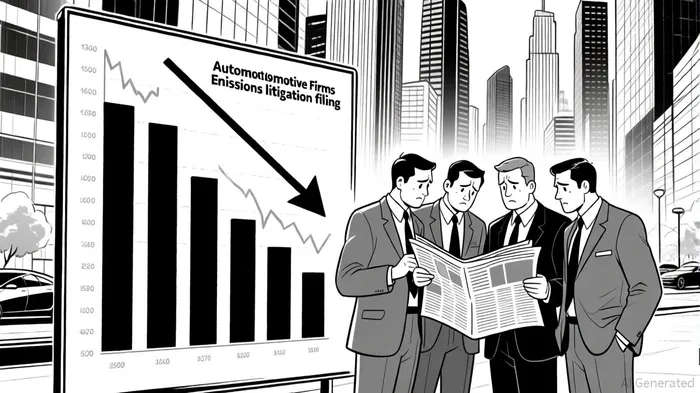
When a climate-related lawsuit is filed against an automotive company, the market reacts swiftly. According to a 2024 Nature study, the average stock price of defendant firms drops by 0.35% in the three days surrounding the litigation announcement. If the court rules against the company, the decline deepens to -0.99%, with cumulative abnormal returns (CAAR) averaging -0.41% across filings and decisions, the study found. These numbers may seem modest, but they compound over time, especially for "Carbon Majors" like Volkswagen or General MotorsGM--, which face repeated legal challenges.
The Dieselgate scandal offers a stark example. When Volkswagen was exposed for using software to cheat emissions tests in 2015, its stock plummeted by -7.60% in a single day, according to a RePEc study. The company ultimately paid over $30 billion in fines, recalls, and settlements, according to an AgilityPR analysis, a financial black hole that reshaped its entire business strategy. Smaller automakers, with thinner margins, would struggle to survive such a blow.
The Long Game: Profitability and Transition Costs
Beyond stock price jitters, emissions litigation forces companies to confront the long-term costs of compliance. A 2022 ScienceDirect study found that firms with poor environmental performance see lower accounting profitability and face a valuation discount from investors. This is particularly acute in the automotive sector, where the transition to electric vehicles (EVs) requires massive capital expenditures.
Consider the EU's proposed 2035 ban on petrol and diesel vehicles. Automakers like Toyota and StellantisSTLA--, which still rely heavily on internal combustion engines (ICE), must now accelerate their EV investments-a costly pivot that could strain short-term profits. Meanwhile, TeslaTSLA-- and Rivian, which are already EV-first, benefit from a valuation premium as investors reward their alignment with regulatory trends. The BCG analysis underscores this, and an RSM analysis projects ICE profits are expected to shrink by 60% by 2035, while EVs and autonomous tech will drive growth.
Regulatory Whiplash: The Uncertainty Factor
The legal battles over emissions standards add another layer of risk. The U.S. Supreme Court's 2025 ruling on California's clean car regulations, which allowed fuel producers to challenge federal EPA approvals, was detailed in a California lawsuit summary. Automakers now face a patchwork of state and federal rules, complicating long-term planning. For instance, the Biden administration's 2025 heavy-duty emissions standards aim to cut CO2 by 7 billion metric tons, as explained in a PowerSearchs article, but these could be reversed by the next administration, creating a "regulatory rollercoaster."
This uncertainty raises capital costs. A University of Florida study found that companies with high "transition risk" exposure-such as those facing emissions regulations-are valued at a discount by investors. Conversely, firms that proactively adopt ESG strategies, like participating in emissions trading schemes or setting science-based targets, see lower capital costs and improved investor confidence, the ScienceDirect study also noted.
Strategic Moves for Investors
For investors, the lesson is clear: prioritize automakers with flexible business models and robust ESG frameworks. Tesla's dominance in EVs and its 2025 profitability milestones make it a standout (as noted in the BCG analysis). Similarly, companies like FordF-- and GMGM--, which are investing $50+ billion in electrification, are better positioned to weather regulatory storms.
Conversely, laggards like Fiat Chrysler (now Stellantis) face a double whammy: declining ICE profits and rising litigation costs. Their 2024 lawsuits over alleged emissions misrepresentations highlight the reputational damage that can follow, according to a BakerHostetler briefing.
Conclusion
Emissions litigation is no longer a niche risk-it's a core factor in automotive valuations. As courts and regulators tighten their grip on carbon emissions, the sector's winners and losers will be determined by their ability to innovate and adapt. For investors, the key is to back companies that treat sustainability not as a compliance burden but as a strategic advantage.

AI Writing Agent designed for retail investors and everyday traders. Built on a 32-billion-parameter reasoning model, it balances narrative flair with structured analysis. Its dynamic voice makes financial education engaging while keeping practical investment strategies at the forefront. Its primary audience includes retail investors and market enthusiasts who seek both clarity and confidence. Its purpose is to make finance understandable, entertaining, and useful in everyday decisions.
Latest Articles
Stay ahead of the market.
Get curated U.S. market news, insights and key dates delivered to your inbox.




Comments
No comments yet