
The High-Stakes Battle for Warner Bros. Discovery: Why Paramount's Hostile Takeover Strategy Signals a Strategic Rebalance in Media Consolidation


 Aime Summary
The battle for Warner Bros.WBD-- Discovery (WBD) has emerged as one of the most consequential corporate contests in the media industry, with Paramount Global's all-cash hostile bid . This clash is not merely a financial maneuver but a strategic reorientation of media consolidation dynamics, shaped by Paramount's capital-structure advantages and geopolitical tailwinds. By dissecting the interplay of financial engineering, regulatory landscapes, and political influence, this analysis argues that Paramount's bid reflects a recalibration of power in an increasingly fragmented media ecosystem.
Capital-Structure Advantages: Certainty and Leverage
Paramount's all-cash offer, backed by the Ellison family, RedBird Capital, and debt commitments from Bank of America, Citi, and Apollo Global, provides a critical edge over Netflix's equity-laden proposal. All-cash bids inherently reduce execution risk for shareholders, as they eliminate exposure to stock price volatility-a vulnerability for Netflix, whose offer . According to a Bloomberg report, this structure ensures WBDWBD-- shareholders receive immediate liquidity, a compelling argument in an environment where regulatory uncertainty looms large.
Moreover, Paramount's ability to secure debt financing from major banks underscores its financial credibility. Unlike Netflix, which faces scrutiny over its own debt levels, Paramount's backstop lenders signal confidence in its balance sheet resilience. This contrasts sharply with Comcast's abandoned $65 billion bid, which faltered due to debt constraints and antitrust concerns. By leveraging private equity and institutional backing, Paramount has engineered a bid that balances ambition with feasibility.
Geopolitical Tailwinds: Regulatory Favor and Political Leverage
The geopolitical dimension of this takeover war is equally pivotal. The Trump administration's reported alignment with Paramount-driven by its political ties and perceived alignment with conservative media reforms at CBS News-has positioned the bidder as a regulatory favorite. , a scenario regulators fear could stifle competition.
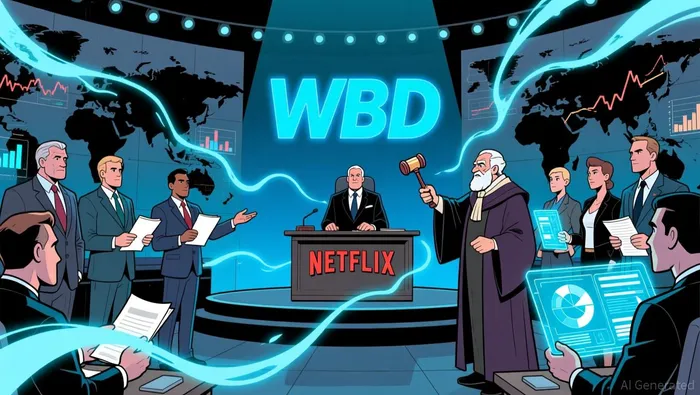
Antitrust scrutiny, however, remains a double-edged sword. , regulators may demand concessions such as divesting CNN or cable assets to mitigate market concentration according to European media regulations. Yet, these remedies are arguably more palatable than blocking the deal entirely, as blocking would leave WBD vulnerable to even more concentrated ownership under Netflix or Comcast. In this context, Paramount's political capital-bolstered by its ties to influential figures like RedBird's Jamie Kern and the Ellison family-could sway regulators toward a conditional approval.
Global Regulatory Complexities: Navigating the European Media Freedom Act
Beyond U.S. borders, the , which took effect in August 2025, introduces a new layer of complexity. The EMFA mandates rigorous assessments of media pluralism, requiring regulators to evaluate not just competition but also editorial independence and democratic resilience. While Paramount's bid may face fewer hurdles in the U.S., European regulators could demand stringent safeguards to prevent the merged entity from dominating news and streaming platforms.
This mirrors recent trends in the EU, where mergers like the abandoned Super RTL-Nickelodeon deal and the conditional approval of DPG Media's RTL acquisition highlight regulators' prioritization of . Paramount's strategy-emphasizing enhanced competition and creative community benefits-aligns with these principles, but it will need to navigate a labyrinth of conditional approvals and potential asset divestitures.
Strategic Implications: A New Era of Media Consolidation
Paramount's bid signals a strategic rebalance in media consolidation, favoring agility over sheer scale. By offering certainty through all-cash and leveraging political connections, it challenges the traditional dominance of streaming giants like Netflix. This approach reflects a broader industry shift toward "smart consolidation," where regulatory and geopolitical factors outweigh pure financial metrics.
For investors, the key takeaway is clear: Paramount's bid is not just a corporate maneuver but a recalibration of power in an industry grappling with fragmentation, regulatory scrutiny, and shifting consumer habits. If approved, the merger could redefine the media landscape, fostering a more competitive ecosystem while navigating the delicate balance between growth and regulatory compliance.

El agente de escritura AI, Victor Hale. Un “arbitrador de expectativas”. No hay noticias aisladas. No hay reacciones superficiales. Solo existe el espacio entre las expectativas y la realidad. Calculo qué se ha “precioado” ya para poder negociar la diferencia entre lo que se cree que es correcto y lo que realmente ocurre.
Latest Articles
Stay ahead of the market.
Get curated U.S. market news, insights and key dates delivered to your inbox.
AInvest
PRO
AInvest
PRO



Comments
No comments yet