
High Prices, Angry Partners: Why Nvidia Gave Up Cloud Business


Nvidia is gradually exiting its fledgling cloud computing business, which had once placed it in quasi-competition with AmazonAMZN-- AWS.
According to The Information, citing people familiar with the matter, NvidiaNVDA-- no longer encourages or promotes external companies to use its DGX Cloud service. DGX Cloud will instead be used mainly by Nvidia’s own researchers to help design new chips, develop AI models, and support employees.
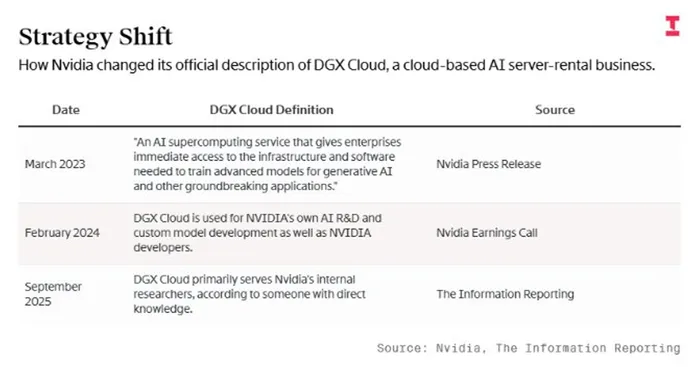
Why did Nvidia suddenly abandon the push for DGX Cloud?
The first reason is pricing. According to a person who assisted multiple companies in negotiating cloud contracts, some AI developers balked at DGX Cloud’s pricing—its costs were often much higher than similar products from traditional cloud providers. The excessive pricing severely limited demand.
Second, Nvidia’s promotion of DGX Cloud angered large cloud providers. DGX Cloud’s success came at the expense of Amazon AWS, Google Cloud, and MicrosoftMSFT-- Azure—companies that together contribute roughly half of Nvidia’s revenue.
If Nvidia could enter the cloud industry and take a slice of the pie, then Amazon, Google, and Microsoft also had incentive to design their own AI chips, reducing reliance on Nvidia. This posed a threat to Nvidia’s dominance. To avoid jeopardizing its core GPU business, Jensen Huang was forced to make concessions in cloud computing.
Even smaller cloud firms worried that Nvidia would steal their customers. Earlier this summer, Nvidia launched DGX Cloud Lepton, essentially a “cloud marketplace” where companies could source GPU resources through a network of providers. Cloud providers could list available GPU capacity instead of committing to long-term leases with Nvidia, as was the case with DGX Cloud.
The marketplace has not taken off quickly. Several executives at cloud companies participating in Nvidia’s Lepton said they saw the service as competitive with their own business, as it allowed a chip designer to directly access their customers.
Among nearly 20 providers listed on the Lepton marketplace, two representatives said they joined only because Nvidia required their participation as part of joint marketing campaigns, not because they volunteered.
According to people familiar with the matter, DGX Cloud customers typically sign short-term contracts—less than a year—before switching to Amazon, Google, or Microsoft to lease GPU servers.
How much revenue can cloud bring to Nvidia?
Nvidia has pledged $13 billion to repurchase AI chips it originally sold to major cloud providers, including Amazon AWS. The company then subleased some of these chips to enterprises like AmgenAMGN-- and ServiceNowNOW-- that wanted to build their own AI applications. Nvidia once believed the cloud business could eventually generate $150 billion in revenue.
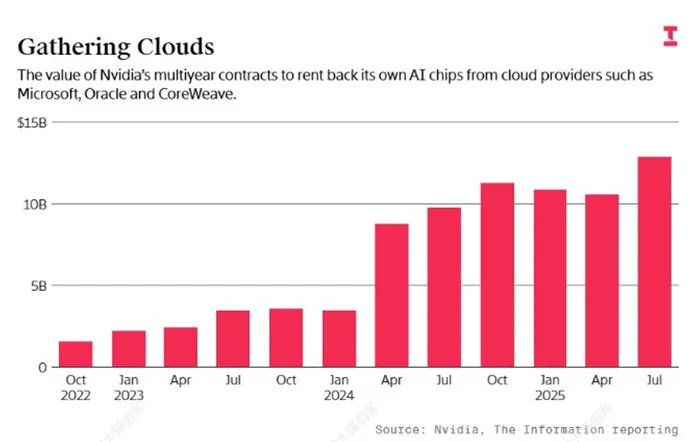
When setting up DGX Cloud, Jensen Huang envisioned more than just selling chips and data center hardware. He imagined that banks, pharmaceutical companies, and other large enterprises would rent Nvidia’s AI chip-powered servers just as they rent servers from Amazon and Microsoft.
Nvidia’s DGX Cloud chip rental agreements had a dual purpose: ensuring large companies had “no wait time” for access to GPUs, while supporting emerging cloud providers like CoreWeaveCRWV-- and Lambda, which also supplied AI chip servers for DGX Cloud. Recently, Nvidia announced that quantum and AI startup SandboxAQ (in which Nvidia has invested) would use DGX Cloud.
Nvidia hoped to strengthen the competitive landscape of the cloud market through cooperation with these up-and-coming providers. As of August 2023, Huang told investors that DGX Cloud had achieved “tremendous success.” By late 2024, CFO Colette Kress said that the software segment (which included DGX Cloud) had reached an annualized revenue run rate of $2 billion.

Expert analysis on U.S. markets and macro trends, delivering clear perspectives behind major market moves.
Latest Articles
Stay ahead of the market.
Get curated U.S. market news, insights and key dates delivered to your inbox.
AInvest
PRO
AInvest
PRO



Comments
No comments yet