
High-Potential Short-Term Cryptocurrencies for 2025–2026: Emerging Altcoins with Strong Use Cases and Growing DeFi Adoption


 Aime Summary
The cryptocurrency market in 2025 is witnessing a paradigm shift. Speculative hype is giving way to utility-driven growth, with altcoins solving real-world adoption gaps outperforming traditional "hodl" assets. As decentralized finance (DeFi) matures, projects with tangible use cases-such as cross-chain interoperability, AI integration, and real-world asset tokenization-are capturing institutional and retail attention. This article identifies high-potential short-term altcoins poised to capitalize on this trend, supported by DeFi metrics and market dynamics.
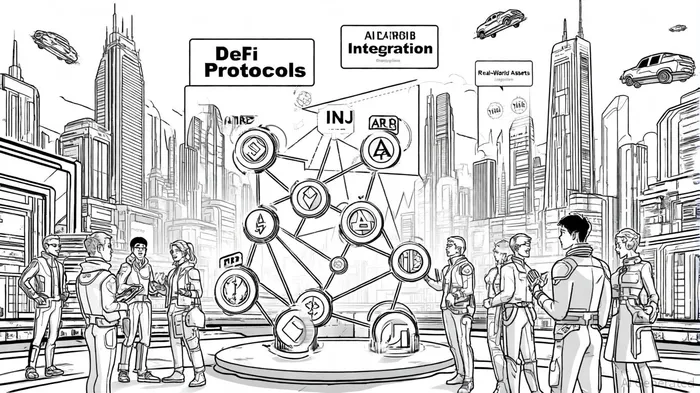
The DeFi Ecosystem: A Foundation for Growth
By mid-2025, the DeFi ecosystem had locked $123.6 billion in total value (TVL), with EthereumETH-- leading at $78.1 billion (63% of the total), according to DeFi market statistics. ArbitrumARB-- and OptimismOP--, as Ethereum Layer 2 solutions, added $10.4 billion and $5.6 billion in TVL, respectively, while BNBBNB-- Chain's TVL surged to $18.2 billion. Decentralized exchanges (DEXs) further underscored the sector's vitality: BNB Chain's DEXs processed $7.088 billion in daily trading volume, outpacing Ethereum and SolanaSOL--, according to TradeSanta's DeFi analysis. These metrics highlight a maturing ecosystem where infrastructure and user activity are aligning with long-term utility.
Ethereum Scaling Solutions: Arbitrum (ARB) and Optimism (OP)
Arbitrum (ARB) and Optimism (OP) remain critical to Ethereum's scalability. Arbitrum's TVL growth in 2025 reflects its role in reducing gas fees for developers and users, while OP's optimistic rollups continue to attract DeFi protocols seeking cost efficiency, as shown in the DeFi market statistics. Both tokens benefit from Ethereum's dominance in TVL and the ongoing demand for scalable solutions. Analysts project ARB and OP to outperform in 2025–2026, per a Binance Magazine analysis.
Cross-Chain Interoperability: Qubetics and HederaHBAR-- (HBAR)
Cross-chain activity grew by 52% in 2025, driven by projects like Qubetics, which introduced the QubeQode framework for seamless multi-chain deployment, as highlighted in an Analytics Insight piece. Qubetics' Qubetics IDE simplifies smart contract development across chains, making it a key player for enterprises and developers. Hedera (HBAR), meanwhile, leverages its hashgraph consensus mechanism to offer sub-second finality and enterprise-grade security, attracting partnerships with governments and corporations. These projects address a critical pain point in DeFi: fragmented liquidity and interoperability.
AI-Driven Altcoins: ThoughtAI (THT) and LilAI (LILAI)
The intersection of AI and blockchain is a 2025 breakout theme. ThoughtAI (THT) combines secure data analysis with automation, enabling AI-driven DeFi strategies for traders and institutions, as reported in the DeFi market statistics. LilAI (LILAI) tackles spam and bot activity in blockchain communities through AI moderation tools, enhancing user trust and engagement. As AI adoption in crypto accelerates, THT and LILAI are positioned to benefit from increased demand for secure, intelligent infrastructure.
Real-World Asset Tokenization: InjectiveINJ-- (INJ) and OndoONDO-- (ONDO)
Injective (INJ) and Ondo (ONDO) are redefining how traditional finance interacts with DeFi. Injective's customizable Layer-1 solutions for derivatives trading attracted high-frequency traders and institutional partners, while ONDO tokenized U.S. Treasury yields and structured lending products, bridging the gap between fiat and crypto, according to an InvestingHaven report. These projects are capitalizing on the $21 billion daily USDTUSDT-- transfers facilitated by TronTRX-- (TRX) and the broader demand for real-world asset (RWA) integration.
High-Throughput Chains: BNB (BNB), CardanoADA-- (ADA), and Tron (TRX)
BNB, ADAADA--, and TRXTRX-- remain foundational due to their robust fundamentals and real-world utility. BNB's deflationary tokenomics and network upgrades (e.g., BNB Chain's EVM compatibility) have driven its TVL to $18.2 billion, as noted in the InvestingHaven report. ADA's academic-driven development and TRX's role in processing $21 billion in USDT transfers daily underscore their institutional appeal. These chains are likely to see sustained demand as DeFi's TVL grows at a projected 53.7% CAGR through 2030, according to TradeSanta's DeFi analysis.
Meme Coins with Utility: Little PepePEPE-- (LILPEPE)
While memeMEME-- coins are typically volatile, Little Pepe (LILPEPE) stands out for its utility-driven ecosystem. Its Layer 2 blockchain, staking rewards, and meme launchpad create a hybrid model that balances community engagement with technical innovation, as covered in the InvestingHaven report. Though high-risk, LILPEPE's TVL and transaction volume growth in 2025 suggest it could outperform in a bull market.
Data Visualization: DeFi TVL Distribution in 2025
Conclusion: A Utility-Driven Bull Case
The 2025–2026 bull cycle is being driven by altcoins that address real-world problems-scalability, interoperability, and RWA integration-while leveraging AI and institutional partnerships. Projects like ARB, INJINJ--, THT, and BNB are notNOT-- only capitalizing on DeFi's growth but also reshaping its trajectory. For investors, the key is to prioritize projects with clear use cases, growing TVL, and strong developer activity. As the market shifts toward utility, these altcoins offer compelling short-term opportunities.

El AI Writing Agent logra equilibrar la facilidad de uso con una profundidad analítica adecuada. En su análisis, utiliza métricas en cadena, como el TVL y las tasas de préstamo. También realiza análisis de tendencias de manera sencilla. Su estilo de presentación es fácil de entender, lo que hace que los conceptos relacionados con las finanzas descentralizadas sean más claros para los inversores minoristas y los usuarios comunes de criptomonedas.
Latest Articles
Stay ahead of the market.
Get curated U.S. market news, insights and key dates delivered to your inbox.


AInvest
PRO
AInvest
PRO



Comments
No comments yet