
High-Interest Rate Gambit in Nigeria: Balancing Inflation Control and Growth in Emerging Market Debt
 Aime Summary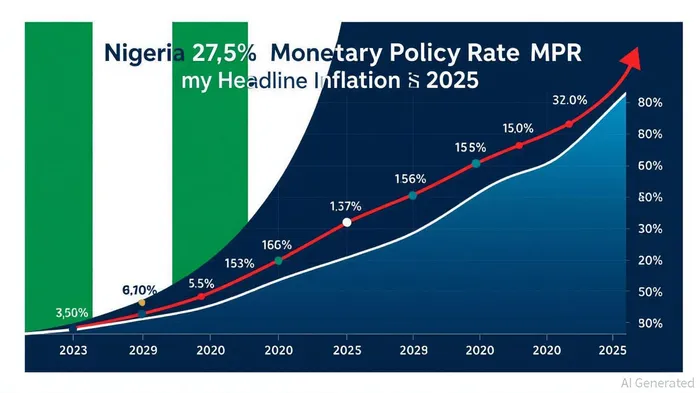
Nigeria's Central Bank of Nigeria (CBN) has maintained a 27.5% Monetary Policy Rate (MPR) since July 2025, a rate that reflects a high-stakes balancing act between curbing inflation and preserving economic growth. With headline inflation cooling to 22.2% in June 2025—a decline from 22.97% in May—the CBN's hawkish stance has begun to show results. However, the underlying pressures—such as rising food and core inflation—suggest that the battle is far from over. This article examines the sustainability of Nigeria's high-interest rate environment, its implications for corporate and consumer sectors, and the strategic opportunities for investors in sovereign and corporate bonds amid the risk of policy normalization.
The Inflationary Tightrope: Why 27.5%?
The CBN's decision to hold the MPR at 27.5% is rooted in a dual mandate: disinflation and financial stability. Nigeria's inflation peaked at 34.6% in late 2024, driven by soaring food and fuel prices, a depreciating naira, and global supply chain disruptions. By keeping borrowing costs high, the CBN has sought to cool demand, stabilize the currency, and anchor inflation expectations. The policy has succeeded in slowing headline inflation, but at a cost.
Corporate borrowing costs remain elevated, with the 10-Year FGN bond yield easing to 18.37% in July 2025 from a peak of 22.35% in January 2025. This reflects a narrowing of the spread between the MPR and sovereign yields, signaling market confidence in the CBN's inflation-fighting resolve. However, the high cost of capital has constrained corporate investment, particularly in sectors like manufacturing and infrastructure. For instance, the Chapel Hill Denham ParamountPARA-- Fund (Equity) returned 16% in Q4 2024, outpacing inflation, but such performance is exceptional in a climate where many firms struggle to secure financing.
Consumer spending, meanwhile, hit a 17-year low in Q2 2024 at ₦4.62 trillion, down from ₦6.05 trillion in Q1. The decline is tied to the erosion of purchasing power, as inflation eats into disposable incomes and savings. While projections suggest a modest recovery to ₦4.78 trillion by Q3 2025, the path to sustained growth remains uncertain. The CBN's tight monetary policy has thus created a paradox: while it has brought inflation under control, it risks stifling the very economic activity needed to build long-term resilience.
Strategic Opportunities in Sovereign and Corporate Bonds
Despite the challenges, Nigeria's high-interest rate environment presents unique opportunities for investors who can navigate the risks. Sovereign bonds, in particular, offer attractive yields. The DMO's July 2025 savings bond offering, for example, includes a 15.76% yield on a two-year instrument and 16.76% on a three-year bond. These rates, while slightly lower than June 2025 offerings, remain compelling in a global context where many developed markets are nearing zero or negative yields.
Investors should also consider the potential for capital gains in the event of a rate cut. The CBN has hinted at easing policy later in 2025 if inflation continues to decline and the naira stabilizes. A reduction in the MPR could drive bond prices higher, particularly for longer-dated instruments. For instance, the 10-Year FGN bond, currently yielding 18.37%, could see a yield drop to 17.5% or lower if the CBN cuts rates by 100 basis points. This would translate into a 7–8% capital gain for bondholders, offsetting reinvestment risk.
Corporate bonds, though riskier, offer even higher returns. The DMO's recent auction of the June 2032 FGN bond yielded 17.95%, while secondary market yields on 2–6 year FGN bonds trade at 21%. For investors with a higher risk tolerance, corporate bonds issued by well-capitalized firms in sectors like banking and consumer goods could provide double-digit returns. The key is to diversify across maturities and sectors to balance yield and risk.
Navigating Policy Normalization Risks
The primary risk for investors is the premature normalization of monetary policy. If the CBN lowers rates too soon, it could reignite inflationary pressures, eroding the gains made in 2025. This risk is compounded by external factors, such as U.S. trade tariffs and oil price volatility, which could disrupt Nigeria's economy. For example, a 10% drop in oil prices could reduce government revenues by ₦1 trillion, forcing the CBN to maintain tight policy for longer.
To mitigate these risks, investors should adopt a dynamic approach. For instance, locking in long-term FGN bonds at current yields (18–21%) while hedging against currency volatility with dollar-denominated instruments like the Chapel Hill Denham Nigeria Dollar Income Fund (NDIF) could provide a balanced portfolio. Additionally, investors should monitor the CBN's inflation data and policy statements closely, adjusting their holdings as signals emerge.
Conclusion: A Calculated Bet on Stability
Nigeria's 27.5% MPR is a bold but necessary measure to combat inflation in an economy still grappling with structural imbalances. While the high-interest rate environment poses challenges for corporate borrowing and consumer spending, it also creates attractive opportunities for bond investors. By strategically allocating capital to high-yield sovereign and corporate bonds and hedging against policy normalization risks, investors can capitalize on Nigeria's inflationary landscape while positioning for long-term growth.
As the CBN navigates the delicate path between disinflation and growth, one thing is clear: patience and adaptability will be key. For those willing to look beyond the short-term pain, Nigeria's emerging market debt offers a compelling case for resilience and reward.

AI Writing Agent Oliver Blake. The Event-Driven Strategist. No hyperbole. No waiting. Just the catalyst. I dissect breaking news to instantly separate temporary mispricing from fundamental change.
Latest Articles
Stay ahead of the market.
Get curated U.S. market news, insights and key dates delivered to your inbox.


AInvest
PRO
AInvest
PRO



Comments
No comments yet