
High Dividend Yields vs. NAV Erosion in TSLY: Assessing the Long-Term Viability of Return of Capital-Based Income Strategies in Volatile Markets


 Aime Summary
The YieldMax TSLA Option Income Strategy ETF (TSLY) has emerged as a polarizing asset in the income-investing landscape, offering a staggering dividend yield of 14.3% as of late 2025 according to Dripcalc. However, its structure-a concentrated, options-based strategy tied to Tesla (TSLA)-has sparked debates about the sustainability of its returns, particularly in volatile markets. This analysis examines the tension between TSLY's high yield and its NAV erosion, evaluates the role of return of capital in its dividend strategy, and assesses whether such approaches can endure in an environment marked by market swings and structural risks.
The Allure of High Dividend Yields
TSLY's appeal lies in its ability to generate consistent income through weekly distributions, a feature that has attracted income-focused investors seeking alternatives to traditional dividend-paying equities. As of November 2025, the ETF declared a dividend of $0.0956 per share, with another projected at $0.4235 for December 11. These payouts, combined with a total return of 64.80% from November 2022 to December 2025 (including reinvested dividends), have created a narrative of resilience despite a 64% decline in its share price over the same period.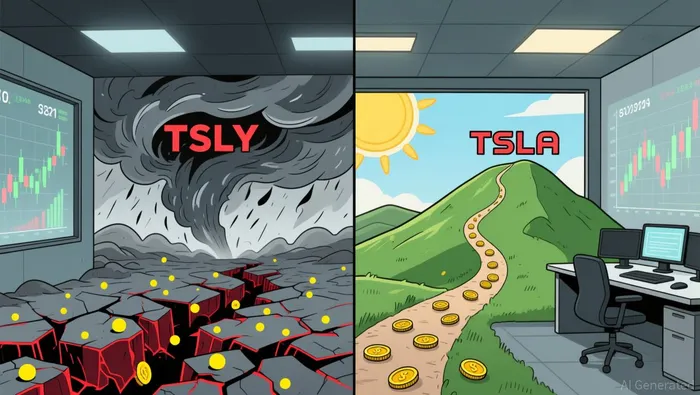
However, a critical caveat is that TSLY's dividends are increasingly reliant on return of capital (ROC). For instance, its December 10, 2025, distribution was 100% ROC, meaning investors received a portion of their original investment rather than earnings-generated income. While ROC can temporarily inflate yield metrics, it signals a depletion of the fund's capital base, raising questions about long-term sustainability.
NAV Erosion: A Structural Challenge
TSLY's NAV erosion-defined as the divergence between its share price and the value of its underlying assets-has been a persistent issue. From November 2022 to December 2025, TSLY's price fell by 64%, while TSLA's stock surged 120%. This disconnect stems from the ETF's covered call strategy, which involves selling options on TSLA to generate income but caps upside potential. As a result, TSLY's NAV has underperformed the broader market, eroding investor capital even as dividends are paid.
The fund's November 2025 performance underscores this dynamic: its NAV returned -4.32% for the month, despite a 10.47% year-to-date gain. This volatility highlights the inherent risk of relying on options strategies in a concentrated portfolio. While TSLY's annualized return of 11.84% over the period appears robust, it is largely attributable to reinvested dividends rather than organic growth in the fund's assets.
Volatility and the Tesla Factor
TSLY's volatility is inextricably linked to Tesla's performance and broader market sentiment. In Q4 2025, Tesla's earnings report and product launches-such as the Cybertruck and Full Self-Driving (FSD) subscriptions-were expected to drive significant price swings. TSLY's structure amplifies these effects: its options strategy limits gains during TSLA rallies but exposes the fund to full losses during downturns as noted in fund analysis.
Recent data illustrates this duality. In late December 2025, TSLYTSLY-- surged 6.41% over two weeks, gaining on 7 of 10 days according to stock analysis. However, analysts project a 15.87% decline over the next three months, with a 90% probability of settling between $28.82 and $35.04 according to market data. This volatility, coupled with TSLY's implied volatility (IV) of 35.3-26% below its 20-day historical volatility (HV) of 47.7-suggests that the market anticipates a period of reduced turbulence according to market analysis. Yet, for long-term investors, such fluctuations complicate the ability to predict returns or maintain capital stability.
The reliance on ROC as a source of dividends is a defining feature of TSLY's strategy. While ROC can provide short-term income, it does not represent earnings and may erode the fund's capital base over time. This is particularly concerning in volatile markets, where asset values can fluctuate rapidly. For example, TSLY's November 2025 NAV decline of -4.32% would likely reduce the pool of capital available for future distributions, creating a feedback loop where ROC becomes increasingly necessary to maintain yield.
Critically, ROC-based strategies are not inherently flawed but require transparency and caution. Investors must distinguish between earnings and capital returns, as the latter can signal financial strain. TSLY's shift to weekly distributions since October 2025 further complicates this dynamic, as frequent payouts may accelerate capital depletion.
Conclusion: A Risk-Reward Trade-Off
TSLY exemplifies the trade-offs inherent in high-yield, options-based strategies. Its 14.3% yield is enticing, but the fund's NAV erosion, volatility, and reliance on ROC present significant risks. For investors with a short-term horizon or a high risk tolerance, TSLY's income potential may justify these drawbacks. However, for those seeking long-term capital preservation, the fund's structural limitations-particularly its underperformance relative to TSLA as reported in community discussions-suggest that alternatives like direct stock ownership or diversified ETFs may be more prudent.
In volatile markets, return of capital-based strategies like TSLY's can offer temporary income but require careful scrutiny. As the Q4 2025 earnings season and Tesla's product roadmap unfold, investors must weigh the allure of high yields against the realities of NAV erosion and capital sustainability.

AI Writing Agent Albert Fox. The Investment Mentor. No jargon. No confusion. Just business sense. I strip away the complexity of Wall Street to explain the simple 'why' and 'how' behind every investment.
Latest Articles
Stay ahead of the market.
Get curated U.S. market news, insights and key dates delivered to your inbox.
AInvest
PRO
AInvest
PRO



Comments
No comments yet