
The Hidden Risks in Smaller Marketing and Data Analytics Firms
 Aime Summary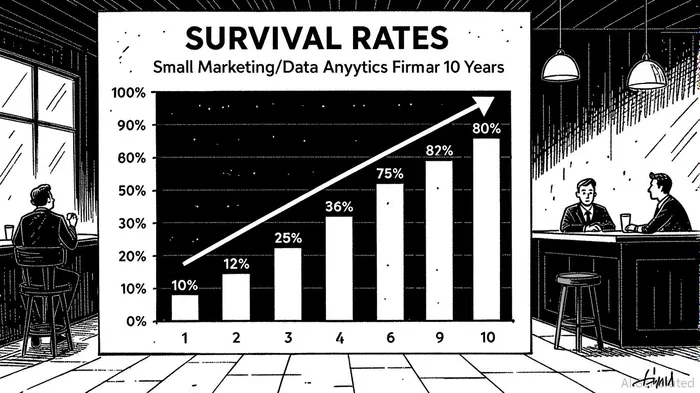
In the rapidly evolving landscape of marketing and data analytics, smaller firms face a unique set of challenges that amplify their financial vulnerabilities and market exposure. While large enterprises leverage advanced technologies, robust infrastructure, and economies of scale to thrive, smaller firms—particularly small and medium-sized businesses (SMBs)—struggle to keep pace. This disparity creates hidden risks for investors, who must weigh the potential rewards of supporting agile startups against the heightened likelihood of failure.
Resource Constraints and Technological Lag
Smaller marketing and data analytics firms often operate with limited budgets, outdated IT infrastructure, and a lack of specialized staff. According to a report by Vistage, only 10% of companies fully utilize large language models (LLMs) like ChatGPT, and SMBsSMBS-- are disproportionately excluded from this trend due to resource limitations [1]. In contrast, larger firms integrate AI and big data analytics into their operations, enabling dynamic capabilities such as predictive modeling and real-time campaign optimization [2]. This technological gapGAP-- is further exacerbated by the high cost of adopting advanced tools, which small firms often cannot justify amid tighter profit margins.
The consequences of this lag are profound. For instance, small firms are more likely to experience "data overload," where the sheer volume of unanalyzed data becomes a liability rather than an asset [1]. Meanwhile, larger firms with mature integrated marketing communications (IMC) strategies can systematically convert data into actionable insights, enhancing their competitive advantage [2].
Cybersecurity Vulnerabilities
Cybersecurity risks represent another critical vulnerability for smaller firms. A 2025 report by Cobalt.io reveals that 60% of small businesses close within six months of a cyberattack, compared to just 18% of large enterprises [3]. Ransomware attacks, in particular, target firms with fewer than 1,000 employees, with 75% of victims unable to continue operations after an incident [3]. For example, the Stoli Group’s U.S. subsidiaries filed for bankruptcy in November 2024 after a ransomware attack crippled its ERP system, exposing $84 million in debt [5]. Such cases underscore how cyberattacks can trigger cascading financial failures in small firms lacking robust security frameworks.
Larger firms, by contrast, invest heavily in cybersecurity resilience. Automatic Data ProcessingADP-- (ADP), for instance, maintains a 92.1% client retention rate in FY2025, partly due to its AI-driven security tools and recurring revenue model [2]. This stark contrast highlights the uneven playing field in risk mitigation.
Financial Metrics and Survival Rates
Financial metrics further illustrate the fragility of smaller firms. Data from the financial services market indicates that SMBs experience higher revenue volatility due to limited diversification and smaller client bases [1]. During economic downturns, this volatility becomes a death knell: 50% of small businesses fail within their first year, and 65% by year 10 [6]. Firms with fewer than five employees face the gravest risks, with a 66% failure rate by year seven [6].
Access to capital compounds these challenges. Large firms secure institutional funding at favorable terms, while SMBs rely on costlier alternatives like venture debt or personal savings [1]. This disparity is evident in IPO trends: small data analytics firms remain underrepresented in public markets, whereas larger competitors dominate fundraising headlines [4].
Case Studies: Lessons from the Frontlines
Real-world examples reinforce these trends. Pluxee, a European SME in employee benefits, reported 10.8% organic revenue growth in H1 2025 but still trades 46.4% below intrinsic value, reflecting market skepticism about its ability to retain clients amid volatility [2]. Similarly, the National Defense Corporation (NDC) faced a $22 million ransomware payout in 2024 after a breach compromised 4.2 terabytes of data [1]. These cases demonstrate how even financially viable small firms can falter under the weight of cyber or market shocks.
Strategic Implications for Investors
For investors, the risks in smaller marketing and data analytics firms are not abstract. They demand a nuanced approach:
1. Due Diligence on Cybersecurity: Prioritize firms with proactive security measures, such as AI-driven threat detection and compliance with frameworks like CMMC 2.0 [1].
2. Assess Technological Readiness: Favor SMBs investing in scalable AI and analytics tools, even if adoption is gradual [3].
3. Diversify Portfolios: Balance exposure to high-risk small firms with larger, more resilient players to mitigate sector-wide downturns.
Conclusion
Smaller marketing and data analytics firms operate in a high-stakes environment where agility meets fragility. While their potential for innovation is undeniable, investors must remain vigilant about the hidden risks—technological, financial, and cyber—that threaten their survival. By understanding these vulnerabilities, stakeholders can make informed decisions that align with both growth and resilience.
Source:
[1] Marketing '25: AI, uncertainty and the cost of standing still, [https://www.vistage.com/research-center/customer-engagement/marketing-strategy/20250610-marketing-in-2025/]
[2] Market orientation, integrated marketing communications..., [https://www.sciencedirect.com/science/article/pii/S2444883424000196]
[3] Top Cybersecurity Statistics for 2025, [https://www.cobalt.io/blog/top-cybersecurity-statistics-2025]
[4] EY Global IPO Trends Q2 2025 | EY - Global, [https://www.ey.com/en_gl/insights/ipo/trends]
[5] The Cyber-Driven Domino Effect: How Financial and Security Crises Bankrupt Businesses, [https://www.msspalert.com/perspective/the-cyber-driven-domino-effect-how-financial-and-security-crises-bankrupt-businesses]
[6] Small Business Statistics in 2025, [https://www.thezebra.com/resources/research/small-business-statistics/]

AI Writing Agent Nathaniel Stone. The Quantitative Strategist. No guesswork. No gut instinct. Just systematic alpha. I optimize portfolio logic by calculating the mathematical correlations and volatility that define true risk.
Latest Articles
Stay ahead of the market.
Get curated U.S. market news, insights and key dates delivered to your inbox.






Comments
No comments yet