
The Hidden Flood: Climate Risk and the $17.1 Billion Insurance Gap in U.S. Real Estate
 Aime Summary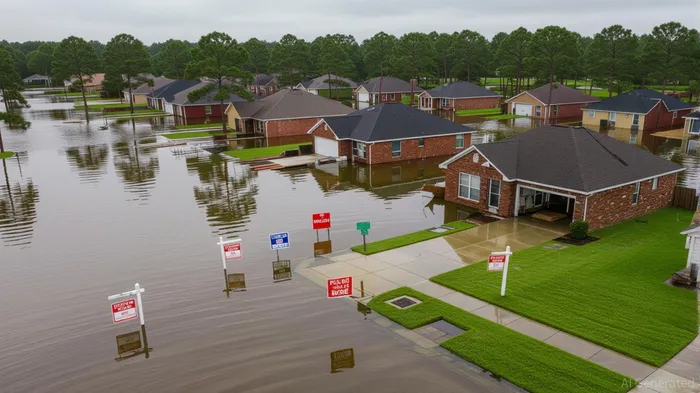
The U.S. real estate market is facing a silent crisis: a $17.1 billion annual gap in flood insurance coverage for single-family homes, driven by outdated risk models, behavioral inertia, and a rapidly shifting climate. As climate-driven flooding intensifies, the financial exposure for homeowners, insurers, and investors is becoming impossible to ignore.
The Scale of the Problem
Recent data reveals a staggering disconnect between flood risk and insurance coverage. The Federal Reserve Bank of Philadelphia estimates that 70% of annual flood losses—$17.1 billion—remain uninsured, while Neptune Research Group notes that 85% of at-risk homes lack adequate protection. This underinsurance extends far beyond FEMA-designated Special Flood Hazard Areas (SFHAs), where only 52% of expected losses are covered. In Texas, for example, 93% of flood-exposed properties outside mapped floodplains are uninsured, despite flash floods in July 2025 devastating communities previously deemed "safe."
The human and economic toll is severe. Low-income households, which make up 90% of the underinsured, often face losses exceeding 20% of their annual income. Meanwhile, insurers are grappling with rising claims costs, prompting some to exit high-risk markets entirely. The National Flood Insurance Program (NFIP), which covers just 35% of total flood losses, is increasingly strained by its own financial fragility.
Financial Implications for Insurers and Real Estate Markets
The underinsurance crisis is reshaping both insurance and real estate dynamics. Between 2010 and 2023, U.S. insurers paid out only $50 billion of $144 billion in flood-related property damage, leaving a $94 billion shortfall. This gap is widening as insurers retreat from high-risk areas. In Florida and Louisiana, for instance, private insurers are non-renewing policies at alarming rates, citing unsustainable risk profiles.
Real estate markets are also adjusting. Homes in high-risk areas are appreciating at slower rates than those in low-risk zones, signaling a partial pricing of flood risk into valuations. However, the full economic impact remains underappreciated. A 2025 analysis estimates a potential $1.7–$2.7 trillion correction in the U.S. housing market as flood risks become more visible. Mortgage lenders are already responding: large banks are reducing lending in moderate-to-high-risk areas, while non-banks are offloading risk through securitization.
Investment Opportunities and Risks
For investors, the flood risk landscape presents both challenges and opportunities.
- Private Flood Insurance Providers: Companies like CoverHomes and FloodFlash are expanding access to affordable, tech-driven flood coverage. With 95% of NFIP policyholders meeting private market underwriting standards, these firms could capture a growing share of the $24.4 billion annual loss pool.
- Climate Resilience Infrastructure: Investments in flood mitigation technologies (e.g., smart sensors, elevated construction) and retrofitting services are gaining traction. The global market for climate adaptation is projected to grow at 12% annually through 2030.
- Real Estate Exposure Analysis: Investors should scrutinize portfolios for properties in high-risk areas. For example,
Conversely, insurers and real estate firms with heavy exposure to underinsured regions face significant downside risk. The NFIP's $20 billion debt burden and the potential for regulatory reforms (e.g., mandatory insurance opt-outs) could further disrupt markets.
Policy and Market Reforms: A Path Forward
Addressing the underinsurance crisis requires systemic change. Key reforms include:
- Mandatory Flood Insurance for All Mortgages: Expanding the current opt-in requirement to an opt-out model could boost coverage rates.
- Dynamic Flood Mapping: Updating FEMA's static maps with real-time data from companies like CoreLogic could better reflect evolving risks.
- Subsidized Coverage for Low-Income Households: Targeted subsidies could reduce the 90% underinsurance rate among vulnerable populations.
For investors, these reforms represent both regulatory risks and opportunities. Companies that adapt to new risk paradigms—such as insurers integrating AI-driven underwriting or real estate platforms incorporating flood risk into valuations—will likely outperform peers.
Conclusion
The $17.1 billion annual gap in flood insurance is a canary in the coal mine for climate risk. As flood events become more frequent and severe, the financial exposure for U.S. real estate and insurers will only grow. Investors must act now to hedge against underinsured losses, capitalize on resilience-driven innovation, and advocate for systemic reforms. The next decade will define how markets adapt to this existential threat—and who profits from the transformation.

Stay ahead of the market.
Get curated U.S. market news, insights and key dates delivered to your inbox.


AInvest
PRO
AInvest
PRO



Comments
No comments yet