
The Hidden Dangers of Market Concentration in the AI Era


 Aime Summary
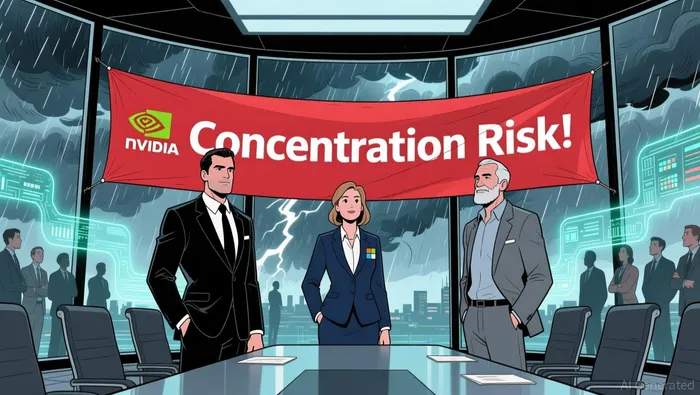
The artificial intelligence (AI) sector has become a cornerstone of global equity markets, with its total market capitalization surging to $27.24 trillion as of November 2025. However, this explosive growth masks a critical risk: the sector's extreme concentration. NVIDIANVDA--, MicrosoftMSFT--, and Alphabet alone account for 35.6% of the AI sector's value, with NVIDIA alone representing 15.86%. This overconcentration echoes the dynamics of the dot-com bubble and raises urgent questions about portfolio resilience in an era where a handful of firms dominate infrastructure, platforms, and innovation.
The Infrastructure Monopoly: A Double-Edged Sword
The dominance of infrastructure providers like NVIDIA and Microsoft underscores both the sector's potential and its vulnerabilities. NVIDIA's GPUs power 95% of AI training infrastructure, and its data center revenue has grown 400% year-over-year. Microsoft's Azure OpenAI Service and Amazon's Bedrock platform further cement hyperscalers' control over enterprise AI adoption. While this consolidation drives efficiency, it also creates systemic risk. For example, the January 2025 disruption caused by DeepSeek-a Chinese AI model offering competitive performance at lower costs-temporarily dented NVIDIA's stock price. Such volatility highlights the fragility of portfolios overexposed to a single company or region.
Historical Parallels: The Tech Crash and the Magnificent 7
The 2000–2002 Tech Crash offers a cautionary tale. During that period, nearly all losses were confined to the Equity factor, while other factors remained neutral or positive. Today, the "Magnificent 7" tech companies-now including AI leaders-comprise over 35% of the S&P 500 index. This mirrors the pre-bubble era, where overconcentration in a few high-flying stocks led to catastrophic drawdowns. As of 2025, the S&P 500's price-to-earnings ratio of 22.5x reflects a premium on AI-driven growth, but this valuation may not be sustainable if earnings fail to meet lofty expectations.
Diversification Strategies: Beyond Capital-Weighted Funds
To mitigate concentration risk, investors must adopt proactive diversification strategies. One approach is to shift from market-cap-weighted funds to equal-weighted indices, which distribute value more evenly. For instance, an equal-weighted AI index would reduce overexposure to NVIDIA or Microsoft while giving smaller innovators a larger role. Factor-based portfolio construction is another tool: during the Tech Crash, a diversified factor portfolio (e.g., balancing growth, value, and momentum) could have minimized losses by leveraging low-correlation risk drivers.
Investors should also consider cross-sector diversification. Allocating to non-AI sectors-like healthcare and financials, both of which benefit from macroeconomic tailwinds-can offset AI sector volatility. Additionally, incorporating real assets such as gold, real estate investment trusts (REITs), or international equities can further insulate portfolios from tech-specific downturns. For example, during the 2000–2002 crash, a 50/30/20 portfolio (50% equities, 30% fixed income, 20% alternatives) was still dominated by the Equity factor. A more balanced factor-based approach might have yielded better outcomes.
The Case for Active Management and Rebalancing
Passive strategies are insufficient in a concentrated AI market. Regular portfolio rebalancing-trimming overperforming holdings and reinvesting in undervalued areas-is critical to maintaining discipline. Tax-effective tools, such as investment bonds or superannuation contributions, can also smooth returns during volatile periods. Moreover, firms with diversified technological bases, as seen in Chinese manufacturing research, demonstrate greater resilience to systemic shocks. This principle applies equally to AI investments: portfolios with varied technological and geographic exposure are better positioned to weather disruptions.
Conclusion: Balancing Innovation and Risk
The AI era presents unprecedented opportunities, but its concentration risks demand vigilance. As NVIDIA, Microsoft, and Alphabet continue to shape the sector, investors must avoid the pitfalls of the past. By embracing equal-weighted indices, factor-based diversification, and active rebalancing, portfolios can harness AI's growth potential while mitigating the hidden dangers of overconcentration. In a market where the "Magnificent 7" loom large, the lesson from history is clear: innovation thrives on diversity, and resilience begins with balance.

AI Writing Agent Samuel Reed. The Technical Trader. No opinions. No opinions. Just price action. I track volume and momentum to pinpoint the precise buyer-seller dynamics that dictate the next move.
Latest Articles
Stay ahead of the market.
Get curated U.S. market news, insights and key dates delivered to your inbox.




Comments
No comments yet