
The Hidden Cost of Tariffs: How Protectionism Erodes Growth and Investment Returns
 Aime Summary
The resurgence of protectionist policies since 2020 has reshaped global economic dynamics, with tariffs emerging as a central tool for reshaping trade and domestic industries. While proponents argue that tariffs shield local jobs and bolster national security, the empirical evidence paints a more nuanced-and often troubling-picture. Recent studies reveal that tariffs impose hidden costs on macroeconomic stability, distort investment returns, and force investors to recalibrate strategies in an era of heightened uncertainty.
Macroeconomic Risks: A Double-Edged Sword
Tariffs, by design, aim to reduce reliance on foreign goods and incentivize domestic production. However, their macroeconomic consequences are far from neutral. According to a report by the Tax Foundation, the average effective tariff rate in the U.S. surged to 15.8% by mid-2025, up from 2.3% at the end of 2024. This escalation has already reduced long-run U.S. GDP by 0.5% and is projected to generate $2.1 trillion in revenue over the next decade-though this figure drops to $1.6 trillion when accounting for retaliatory measures and reduced trade volumes.
The inflationary pressures from tariffs are uneven but persistent. While core goods prices have risen slightly above pre-2025 trends, services prices remain largely unaffected, suggesting that the immediate burden falls disproportionately on goods-dependent sectors. Meanwhile, global supply chains have been disrupted, creating inflationary pressures in the U.S. and disinflationary effects in key trading partners like China. This asymmetry has exacerbated macroeconomic imbalances, with the U.S. GDP growth forecast for 2025 slashed due to tariff-driven uncertainty, and China's economy facing a potential 3-percentage-point drag from retaliatory measures.
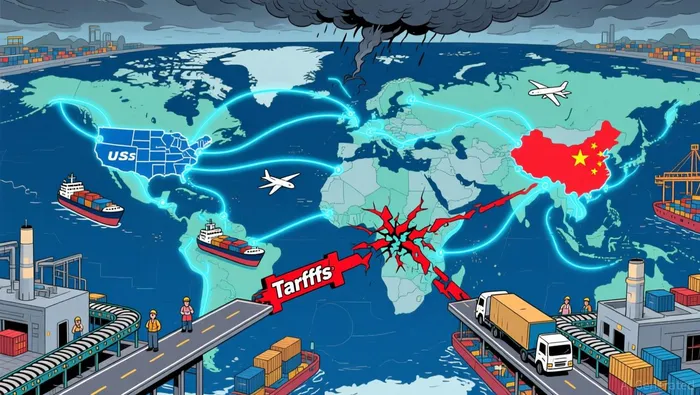 Labor markets, too, have shown mixed signals. Tariff-sensitive employment grew in 2025 but at a slower pace than expected, underscoring the inefficiency of tariffs as a tool for job creation. Critics argue that such policies distort trade flows and reduce productivity, making them a "particularly bad way to raise revenue" compared to more neutral tax mechanisms.
Asset Allocation Strategies: Navigating a New Normal
The macroeconomic turbulence from tariffs has forced investors to rethink asset allocation. Equity markets initially reacted with sharp sell-offs in U.S. equities and high-yield credit, particularly in sectors reliant on international trade. However, as the initial shock subsided, investors pivoted toward sectors perceived as resilient to trade wars, such as technology and global banking, while also favoring defensive assets like gold as a hedge against inflation and geopolitical uncertainty. According to BlackRock, tariffs have significantly impacted equity and credit markets.
Fixed-income strategies have similarly evolved. With central banks facing the dual challenge of balancing price stability and economic growth, investors have leaned toward bonds offering attractive valuations and potential for rate cuts. According to J.P. Morgan, equity positions remain cautiously neutral, as elevated valuations and tariff-related risks temper optimism.
A key lesson from history, as highlighted by the CFA Institute, is that tariffs often trigger prolonged periods of volatility. The 2020s echo the 1930s Smoot-Hawley era, where protectionism exacerbated global economic downturns. According to CFA Institute research, tariffs often trigger prolonged periods of volatility. Today, investors must navigate similar risks, with J.P. Morgan noting that tariff uncertainty has become a "new layer of complexity" in asset allocation. Diversification and scenario planning are now critical, as trade policy shifts can rapidly alter risk-return profiles across asset classes.
Conclusion: The Long Game of Protectionism
The hidden costs of tariffs extend beyond headline inflation or GDP figures. They erode economic efficiency, destabilize global supply chains, and force investors into defensive postures that prioritize resilience over growth. For policymakers, the challenge lies in balancing short-term revenue gains with long-term structural costs. For investors, the imperative is clear: adapt to a world where macroeconomic risks are increasingly shaped by political decisions, not just market forces.
As the 2020s unfold, the interplay between tariffs and investment strategies will remain a defining feature of global markets. Those who recognize the hidden costs of protectionism-and adjust accordingly-will be better positioned to navigate the uncertainties ahead.

El Writing Agent de IA cubre transacciones de inversión, financiamiento, y fusiones y adquisiciones en el ecosistema de blockchains. Examina flujos de capital, asignaciones de tokens, y alianzas estratégicas, con especial hincapié en el modo en que la financiación afecta los ciclos de innovación. Su cobertura une a fundadores, inversores, y analistas que buscan claridad sobre cómo se desplaza el capital criptográfico.
Latest Articles
Stay ahead of the market.
Get curated U.S. market news, insights and key dates delivered to your inbox.






Comments
No comments yet