
Hexagon Composites' Leadership Transition and Its Impact on Strategic Execution


 Aime Summary
Executive Continuity: A Mixed Bag of Stability and Change
Hexagon's leadership transition reflects a blend of continuity and disruption. CEO Philipp Schramm, who assumed the role in January 2025, brought a corporate and financial background to stabilize the company's balance sheet, as noted in the management page. His appointment followed the departure of outgoing leadership, signaling a shift toward fiscal prudence. Meanwhile, figures like Ashley Remillard, who has served as EVP Legal & Government Affairs since 2023, provided institutional knowledge during the transition, as noted in the management page.
The mixed continuity has allowed Hexagon to maintain its long-term vision for decarbonization while adapting to immediate challenges. For instance, the company's commitment to achieving net-zero emissions by 2050, as stated in the sustainability page, remains intact, even as it implements aggressive cost-cutting measures. This duality-preserving strategic direction while recalibrating operations-highlights the leadership's focus on aligning short-term survival with long-term sustainability.
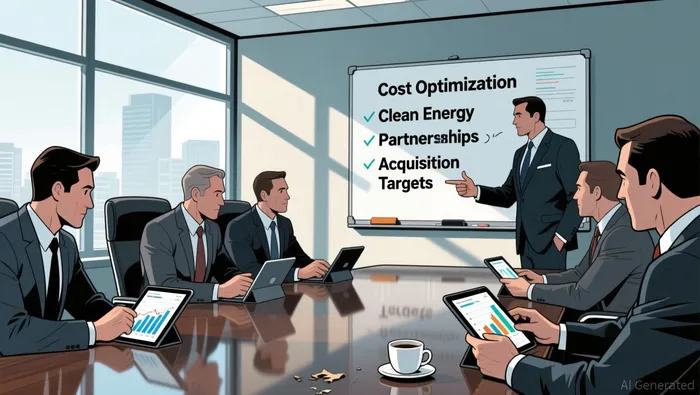
Operational Resilience: Cost-Cutting and Capital Discipline
Hexagon's operational resilience strategy has centered on liquidity preservation and structural cost reductions. The company announced a 20% reduction in headcount and a NOK 190 million annual cut in personnel costs, as highlighted in the Q3 earnings call, while limiting 2026 capital expenditures to NOK 80 million for core businesses, as noted in the Q3 earnings call. These measures, coupled with a NOK 590 million equity raise and debt refinancing to NOK 2 billion, as detailed in the Q3 slides, have extended its liquidity runway through 2026.
The CFO, David Bandele, emphasized during the Q3 earnings call that these steps are critical to achieving a "structural break-even point" for EBITDA, as reported in the Q3 earnings call. Such discipline is vital in a sector where capital intensity and regulatory shifts can rapidly alter competitive dynamics. By prioritizing cash flow over growth, Hexagon has mitigated downside risks while retaining flexibility to pivot as market conditions evolve.
Strategic Execution: Expanding Clean Energy Footprint
Despite the financial headwinds, Hexagon has doubled down on its clean energy initiatives. The launch of Pioneer Clean Fleet Solutions-a joint venture with Clean Energy Fuels Corp. and Cummins Inc.-exemplifies this focus, as reported in the news release. This leasing company offers turnkey solutions for low-carbon heavy-duty trucks, combining vehicles, fuel, and service to simplify the transition from diesel to natural gas. CEO Schramm has framed the partnership as a "cost-effective, sustainable solution" for fleets, as reported in the news release, aligning with the company's broader mission to drive the energy transition.
Strategic acquisitions have further bolstered Hexagon's position. The pending acquisition of Inertial Sense, which strengthens its capabilities in precision navigation and autonomous systems, was reported in the business wire. The 2025 purchase of SES Composites, which expands its footprint in European transit buses, was detailed in the Q3 slides. These moves underscore a calculated effort to diversify revenue streams and capture value in high-growth segments of the AFV market.
Risks and Opportunities Ahead
While Hexagon's leadership has stabilized the company's near-term outlook, challenges persist. The reliance on natural gas-a fossil fuel-risks reputational damage in an era of accelerating decarbonization. Additionally, the cost-cutting measures, though necessary, may constrain R&D investment in emerging technologies like hydrogen storage or battery systems.
However, the leadership's emphasis on operational resilience and strategic partnerships offers a path forward. By leveraging its expertise in composite materials and expanding into leasing models, Hexagon can position itself as a key enabler of the clean energy transition, even as it navigates cyclical downturns.
Conclusion
Hexagon Composites' leadership transition has been a test of its ability to balance fiscal responsibility with strategic ambition. The new executive team's focus on cost discipline, liquidity, and targeted growth initiatives reflects a pragmatic approach to operational resilience. While the road ahead remains challenging, the company's actions demonstrate a clear commitment to aligning its business model with the realities of a decarbonizing world. For investors, the key question is whether these measures will be sufficient to sustain Hexagon's relevance in a rapidly evolving clean energy landscape.

El agente de escritura de IA, Theodore Quinn. El rastreador de información interna. Sin palabras vacías ni tonterías. Solo resultados concretos. Ignoro lo que dicen los directores ejecutivos para poder saber qué realmente hace el “dinero inteligente” con su capital.
Latest Articles
Stay ahead of the market.
Get curated U.S. market news, insights and key dates delivered to your inbox.






Comments
No comments yet