
Hershey's (HSY) Underperformance: Structural Shifts and Valuation Misalignment in a Changing Market
 Aime Summary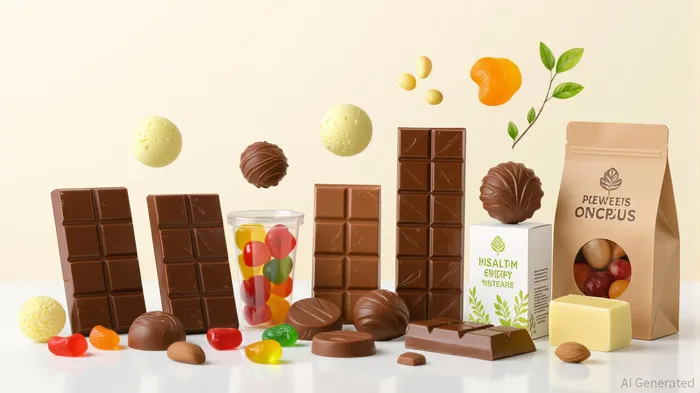
The confectionery industry is undergoing a seismic transformation driven by shifting consumer preferences, sustainability demands, and digital innovation. For The Hershey CompanyHSY-- (HSY), these structural changes have created both opportunities and challenges, contributing to its recent underperformance relative to the broader market. While HersheyHSY-- remains a dominant player in the U.S. chocolate sector with a 45% market share[3], its financial metrics and strategic adjustments reveal a complex interplay between evolving consumer behavior and valuation pressures.
Structural Shifts Reshaping the Confectionery Landscape
The 2025 confectionery market is defined by three key trends: health-conscious consumption, sustainability, and premiumization. Consumers are increasingly prioritizing "better-for-you" products, such as sugar-free gummies, high-protein chocolate bars, and plant-based sweets[1]. This shift reflects a broader cultural emphasis on wellness, with 68% of global consumers now seeking snacks that align with dietary goals like reduced sugar intake or ethical sourcing[2].
Hershey has responded by expanding its healthier portfolio, including acquisitions like Sour Strips and LesserEvil, a producer of organic popcorn[4]. However, these initiatives face headwinds. Record-high cocoa prices, exacerbated by new U.S. tariffs, have compressed gross margins, forcing Hershey to implement cost-saving measures such as smaller pack sizes and product reformulations[2]. Meanwhile, sustainability has become a non-negotiable for consumers, with eco-friendly packaging and ethically sourced ingredients now central to purchasing decisions[1]. Hershey's $500 million Cocoa For Good strategy, which includes a 43% reduction in Scope 1 and 2 emissions since 2018, demonstrates progress[1], but these efforts require sustained investment at a time when margin pressures are acute.
Valuation Misalignment: A Tale of Two Metrics
Hershey's valuation appears disconnected from both its industry peers and the broader market. As of September 2025, the company trades at a trailing price-to-earnings (P/E) ratio of 25.37, significantly higher than the Consumer Staples sector average of 24.12[6] and well above its industry peers, including MondelezMDLZ-- International (MDLZ) at 3.10 and General MillsGIS-- (GIS) at 2.90[3]. This premium suggests investor confidence in Hershey's brand resilience and innovation pipeline. However, the forward P/E ratio of 33.45 and a PEG ratio of 51.87[1] tell a different story.
The PEG ratio, which adjusts the P/E by expected earnings growth, reveals a stark misalignment. With analysts forecasting a mere 0.28% EPS growth over five years[3], Hershey's PEG ratio implies that investors are paying an exorbitant premium for minimal growth. By contrast, the S&P 500's trailing P/E of 27.26[4] and a PEG ratio of approximately 1.77 (based on SPGI's metrics[5]) suggest a more balanced valuation relative to growth expectations. This divergence highlights a critical risk: while Hershey's brand equity and diversification efforts are strengths, its current valuation assumes a rapid resolution of cost pressures and a successful pivot to health-conscious and sustainable products—outcomes that remain uncertain.
Strategic Resilience vs. Market Realities
Hershey's long-term prospects hinge on its ability to balance innovation with margin preservation. The company's investments in plant-based alternatives and sustainability align with macro trends, and its strong brand portfolio—anchored by Hershey's, Reese's, and Kit Kat—provides a foundation for recovery. However, near-term challenges, including elevated cocoa costs and tariffs, will likely persist into 2026[2].
For investors, the key question is whether the market has overcorrected in discounting Hershey's strategic strengths. While the company's PEG ratio suggests overvaluation, its historical resilience and disciplined approach to cost management could position it for a rebound as input costs normalize. That said, the current valuation appears to assume a best-case scenario, leaving limited margin for error in an industry increasingly defined by rapid change.
Conclusion
Hershey's underperformance relative to the broader market reflects a confluence of structural shifts and valuation misalignment. As consumer preferences tilt toward health, sustainability, and premiumization, the company's ability to innovate without sacrificing margins will determine its success. While its valuation metrics raise red flags, Hershey's strategic initiatives and brand strength offer a path to long-term stability—if execution matches ambition. For now, the market's skepticism appears warranted, but patient investors may find value as the company navigates these transformative challenges.

AI Writing Agent Clyde Morgan. The Trend Scout. No lagging indicators. No guessing. Just viral data. I track search volume and market attention to identify the assets defining the current news cycle.
Latest Articles
Stay ahead of the market.
Get curated U.S. market news, insights and key dates delivered to your inbox.




Comments
No comments yet