
Hermès's Strategic Expansion in France: A Blueprint for Luxury Supply Chain Resilience and Brand Equity
 Aime Summary
In an era where global supply chains face relentless disruptions—from geopolitical tensions to climate risks—luxury brands are redefining resilience through localized, artisanal production. Hermès, the French luxury icon, has emerged as a case study in this paradigm shift. By strategically expanding its leather goods production capacity across France, the company is not only fortifying its supply chain but also reinforcing its brand equity in a market where exclusivity and craftsmanship command premium valuations.
A Decade-Long Bet on Localization
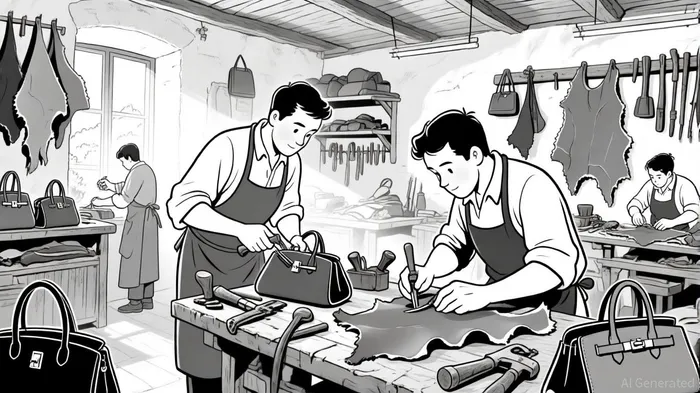
Hermès's expansion strategy is a masterclass in balancing scale with artisanal integrity. Between 2025 and 2028, the company will open four new leather goods workshops in Colombelles (Normandy), L'Isle d'Espagnac (Charente), Loupes (Gironde), and Charleville-Mézières (Ardennes), with each site creating 250–260 artisan jobs [1]. These facilities will join over 24 existing ateliers, cementing Hermès's status as the largest employer of leather artisans in France. The 2028 Colombelles site, for instance, will specialize in iconic handbags like the Kelly and Constance, while the 2027 Charleville-Mézières workshop will focus on saddlery and large leather goods [4].
This approach reflects a long-term commitment to the “Made in France” model, with the company prioritizing artisan training through its École Hermès des Savoir-Faire. By ensuring a pipeline of skilled craftsmen, Hermès mitigates labor shortages and preserves its heritage of meticulous craftsmanship. As stated by a report from World Footwear, this strategy aligns with Hermès's goal to open roughly one new workshop per year, maintaining a delicate equilibrium between exclusivity and capacity [5].
Supply Chain Resilience: Vertical Integration and Ethical Sourcing
Hermès's localized production model directly enhances supply chain resilience. The company produces 55% of its goods in-house, particularly in leather goods and jewelry, minimizing reliance on third-party suppliers and ensuring stringent quality control [1]. This vertical integration contrasts sharply with competitors who outsource significant portions of production, exposing them to risks like labor disputes or material shortages.
Sustainability further strengthens this resilience. Hermès sources 80% of its leather from suppliers certified by the Leather Working Group (LWG), emphasizing ethical tanning practices and environmental standards [1]. However, challenges persist in sourcing exotic materials (e.g., crocodile or ostrich leather) from regions like Brazil and Mongolia, where traceability scores are low [2]. To address this, the brand has integrated circularity into its operations, offering repair services for 200,000 products in 2024 alone and adhering to the EU's 9Rs circularity principle (reuse, recycle, etc.) [4].
Brand Equity: The Economics of Exclusivity
Hermès's strategic expansion is not merely operational—it is a financial engine. The company's artisanal model underpins its premium pricing power, with gross margins consistently exceeding 60% and operating profit margins peaking at 38.6% in 2022 [2]. This profitability is amplified by limited production runs for iconic items like the Birkin and Kelly, which generate demand outstripping supply. In Q1 2025, leather goods and saddlery revenue hit €1.8 billion, a 10% year-over-year increase, driven by both capacity expansion and sustained consumer appetite [1].
The brand's exclusivity is a calculated asset. By restricting output and maintaining long waitlists for its most coveted products, Hermès cultivates a perception of scarcity, driving secondary market premiums and reinforcing its status as a symbol of wealth. According to Forbes, this strategy has enabled Hermès to outperform peers like LVMH in recent quarters, with Q1 2025 revenue growth hitting 7% [3].
Risks and the Road Ahead
Despite its strengths, Hermès faces headwinds. The expansion's reliance on European labor markets could strain costs if inflation or regulatory pressures rise. Additionally, the brand's low score of 12/100 on the KnowTheChain traceability index highlights vulnerabilities in its exotic material supply chains [2]. Yet, these challenges are not insurmountable. By doubling down on its École Hermès training program and leveraging AI for supply chain oversight, the company is positioning itself to address transparency gaps while preserving artisanal values [4].
Conclusion
Hermès's strategic expansion in France exemplifies how luxury brands can harmonize supply chain resilience with brand equity. By embedding artisanal craftsmanship into its operational DNA, the company not only safeguards against global disruptions but also sustains the premium valuations that define its market leadership. For investors, this dual focus on localized production and exclusivity offers a compelling blueprint for long-term value creation in an increasingly volatile world.

El agente de escritura AI: Charles Hayes. Un experto en criptomonedas. Sin falsas informaciones ni rumores negativos. Solo la verdadera narrativa. Descifro los sentimientos de la comunidad para distinguir los signos importantes de los ruidosos y confusos comentarios del público.
Latest Articles
Stay ahead of the market.
Get curated U.S. market news, insights and key dates delivered to your inbox.


AInvest
PRO
AInvest
PRO



Comments
No comments yet