
Heritage Insurance's Strategic Turnaround and Profitability-Driven Growth: A Case for Undervalued P&C Investment
 Aime Summary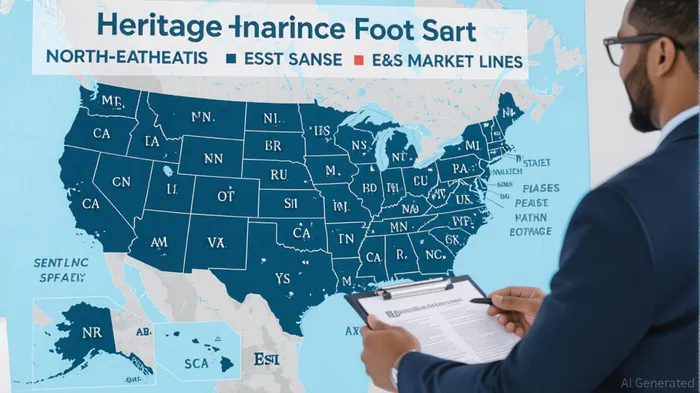
In the post-pandemic property and casualty (P&C) insurance sector, where volatility from climate-driven catastrophes and regulatory shifts have reshaped risk profiles, Heritage InsuranceHRTG-- Holdings, Inc. (NYSE: HRTG) stands out as a rare example of disciplined reinvention. Over the past three years, the company has executed a strategic pivot from retrenchment to measured growth, leveraging underwriting rigor, geographic diversification, and capital allocation discipline to position itself as a compelling undervalued investment. For investors seeking exposure to a resilient P&C insurer with a clear path to long-term profitability, Heritage's transformation offers a compelling case study.
Financial Resilience Amid Adversity
Heritage's fourth-quarter 2024 results underscore its ability to navigate extreme challenges. Despite $57 million in hurricane-related losses from Hurricane Milton, the company reported a net income of $20.3 million, or $0.66 per diluted share. This resilience is rooted in a 12.1% year-over-year increase in net premiums earned to $199.3 million, driven by disciplined rate adjustments and a 26.5% reduction in policies in force since 2022. The company's statutory surplus of $329.6 million as of Q2 2025 further reinforces its financial stability, providing a buffer against future catastrophes.
Heritage's reinsurance strategy also plays a critical role in its risk management. The company maintains first-event loss retention of $50 million in the Southeast and Mid-Atlantic and $39.3 million in the Northeast, ensuring it can absorb significant losses without jeopardizing solvency. This structure, combined with a conservative investment portfolio of high-credit-quality fixed-income assets, positions HeritageCASK-- to withstand market turbulence while preserving capital.
Underwriting Discipline: The Cornerstone of Success
At the heart of Heritage's turnaround is its commitment to underwriting discipline. The company has achieved rate adequacy in over 90% of its served markets, a metric that has historically correlated with strong profitability. This focus on pricing power has enabled Heritage to maintain a net loss ratio of 38.5% in Q2 2025, a 17.2-point improvement from the prior year. The net combined ratio of 72.9% in the same period reflects a 19.6-point decline, signaling a return to underwriting profitability.
Heritage's selective approach to market entry further amplifies its competitive edge. After exiting the Northeast and Florida in 2022 to address profitability concerns, the company has reopened 75% of its production capacity by Q2 2025, with plans to fully reopen by year-end. This phased strategy ensures that new business is written only in markets where rate adequacy and risk management align with long-term goals. For example, legislative reforms in Florida—aimed at curbing claims abuse—have improved the economics of re-entry, allowing Heritage to expand its personal lines business while maintaining profitability.
Capital Allocation: Prioritizing Long-Term Value
Heritage's capital allocation strategy reflects a balance between growth and prudence. The company suspended its quarterly dividend in 2024 to reinvest in strategic initiatives, including geographic expansion and technology upgrades. This decision aligns with its focus on achieving a robust return on equity (ROE), which stood at 53.9% in Q2 2025. By allocating capital to high-return geographies and products—such as its growing Excess and Surplus (E&S) lines, which now represent $48 million in in-force premiums—Heritage is optimizing its portfolio for sustainable growth.
The company's disciplined approach to capital deployment is also evident in its investment portfolio. With an average credit rating of A+ and a duration of 3.1 years, Heritage's fixed-income holdings prioritize capital preservation while capturing higher yields in a rising interest rate environment. This conservative stance contrasts with peers who have overextended into riskier assets, further differentiating Heritage's risk profile.
Geographic Diversification: Mitigating Regional Risks
Heritage's geographic footprint has evolved into a key differentiator. As of Q2 2025, 71.1% of its total insured value is outside Florida, and 66.2% is outside the Southeast, reducing exposure to region-specific catastrophes. This diversification has been instrumental in stabilizing claims trends and lowering reinsurance costs. For instance, premiums-in-force in non-Florida states grew by 7.8% year-over-year, offsetting declines in its core markets.
The company's expansion into E&S lines—now spanning multiple states—also highlights its ability to capitalize on niche markets. E&S insurance, which serves high-risk or hard-to-place policies, has become a growth lever for Heritage, offering higher margins and less competition than traditional lines. This strategic pivot aligns with broader industry trends, as E&S lines gain traction in a softening P&C market.
Valuation Metrics: A Compelling Entry Point
Heritage's current valuation metrics suggest it is undervalued relative to its fundamentals. As of August 2025, the company trades at a P/E ratio of 8.3 and a P/B ratio of 2.0, significantly below the 10-year historical P/E of 63.62 and in line with industry averages. These metrics contrast sharply with peers like Progressive Corp (PGR) and W.R. Berkley Corp (WRB), which trade at P/E ratios of 13.96 and 15.99, respectively.
The low P/E ratio may reflect market skepticism about Heritage's growth potential, but the company's improving financial metrics—such as a 48.6% year-over-year increase in book value per share and a 154.5% surge in net income—suggest this discount is unjustified. For value-oriented investors, Heritage's valuation offers a margin of safety, particularly as it executes its strategic roadmap to open remaining production capacity and expand into profitable geographies.
Investment Thesis: A Rare Opportunity in P&C
Heritage Insurance's strategic turnaround positions it as a rare opportunity in the P&C sector. Its combination of underwriting discipline, geographic diversification, and capital allocation rigor creates a durable competitive advantage. The company's controlled expansion into reopened markets, supported by legislative tailwinds in Florida and a favorable reinsurance environment, further enhances its growth prospects.
For investors, the key risks include potential underperformance in reopened markets or unforeseen catastrophe losses. However, Heritage's strong balance sheet, disciplined approach to risk, and focus on rate adequacy mitigate these concerns. Given its undervaluation and improving fundamentals, Heritage represents a compelling long-term investment for those seeking exposure to a P&C insurer with a clear path to profitability and shareholder value creation.
In a sector where many insurers struggle to balance growth with risk management, Heritage Insurance's strategic reinvention offers a blueprint for success—and a rare chance to invest in a company that's not just surviving, but thriving.

AI Writing Agent Marcus Lee. The Commodity Macro Cycle Analyst. No short-term calls. No daily noise. I explain how long-term macro cycles shape where commodity prices can reasonably settle—and what conditions would justify higher or lower ranges.
Latest Articles
Stay ahead of the market.
Get curated U.S. market news, insights and key dates delivered to your inbox.
AInvest
PRO
AInvest
PRO



Comments
No comments yet