
Hercules Metals' 2025 Drilling Campaign: A Catalyst for Base Metals Renaissance?
The base metals sector has faced a prolonged slump, with copper prices hovering near multiyear lows and investors skeptical about the viability of new projects in an era of rising environmental and regulatory hurdles. But a quiet revolution is unfolding at Hercules MetalsHTGC-- Corp. (TSX-V: HCL), where a bold drilling campaign is reshaping expectations for its flagship Leviathan porphyry copper project in Idaho. The results, while still preliminary, hint at a resource of exceptional scale—and one that could reignite investor interest in undervalued base metal assets.
The campaign's success hinges on a strategic pivot: leveraging a newly refined 3D geological model to target a sprawling copper-molybdenum system. As of late June, HerculesHTGC-- has completed two core holes and is drilling five more, with over 3,000 meters of drilling completed in 2025 alone. Crucially, the company has expanded its rig fleet to five—four core rigs and one Reverse Circulation (RC) rig—to accelerate exploration across a 2.2-kilometer strike length. This approach has already borne fruit. 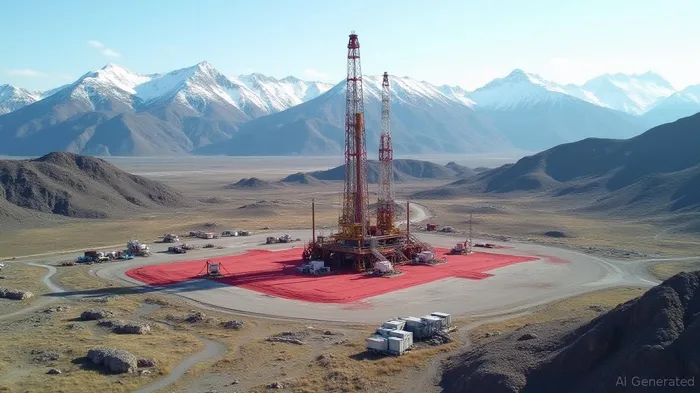
The Geological Breakthrough
The 3D model's validation has been the campaign's crown jewel. Drilling has confirmed the existence of a copper-molybdenum mineralization shellSHEL-- encircling a central porphyry intrusion—the Leviathan Target. This structure features a pyrite halo and increasing grades near porphyry contacts, suggesting a classic porphyry system. Management estimates 1.3 kilometers of the system's strike are now better defined, with geophysical data (chargeability and magnetic anomalies) pointing to extensions along strike and at depth.
The real prize, however, lies in the untested zones. The Eastern Block, defined by anomalous geochemistry, could host parallel porphyry centers, while the Western Deeps—a chargeability anomaly larger and stronger than Leviathan itself—suggests a down-dropped block with potentially higher-grade material. Even the Grade Creek and Southern Flats zones, previously unexplored, show geophysical continuity, hinting at a system that could rival major porphyry deposits.
Why This Matters for Investors
Hercules' stock trades at a fraction of its peers, reflecting its status as a junior explorer with no production. But the drilling campaign is closing the gap between its market cap and its potential resource. Consider this: porphyry copper deposits typically require >1 billion pounds of copper to justify development. If the Leviathan system and its extensions meet expectations, Hercules could be sitting on a resource of that scale—or larger.
As of June 2025, HCL's share price has risen just 5% year-to-date—far below the sector's 12% gain—suggesting the market hasn't yet priced in the drilling results. This discrepancy creates an opportunity.
Catalyst for Sector Sentiment
Hercules' progress isn't just about its own valuation. The base metals market has been starved of major discoveries, with investors skeptical about the ability to find and permit new projects. A successful porphyry discovery in Idaho—a region with a proven mining-friendly regulatory environment—could shift that narrative.
Porphyry copper deposits are critical to the energy transition: each electric vehicle requires roughly 80 pounds of copper, and renewable energy infrastructure demands even more. A Leviathan-scale deposit would bolster global reserves at a time when the U.S. is pushing to secure domestic supply chains. This could trigger a reevaluation of other underexplored porphyry projects in North America and beyond.
Risks and Considerations
Optimism must be tempered. Porphyry systems are complex, and true thicknesses—critical for economic feasibility—remain unproven. Regulatory hurdles, permitting timelines, and the need for a mine feasibility study could delay a production decision. Additionally, Hercules' reliance on Barrick Mining's support (as a strategic partner) introduces execution risk.
Investment Thesis
Hercules Metals offers a high-risk, high-reward bet on base metals' next chapter. For investors with a long-term horizon and tolerance for exploration risk, the stock presents a compelling entry point. Key catalysts ahead include:
1. Q3 2025 assay results for the current drilling phase.
2. 2026 infill drilling to define true thickness and grade continuity.
3. Feasibility study timing, which could hinge on resource delineation.
In a sector where most explorers are trading at historic discounts, Hercules' progress makes it a standout. Even if the Leviathan system proves only half as large as hoped, it could still justify a significant revaluation. For the broader market, a success here could reignite investor enthusiasm for porphyry exploration—a trend that would benefit peers like First Quantum Minerals (TSX: FM) and Ivanhoe Mines (TSX: IVN), which also hold large, underappreciated copper projects.
Final Take
Hercules Metals is at a pivotal juncture. Its drilling campaign is not just about unlocking value for shareholders but about proving that major copper discoveries remain viable in an era of environmental scrutiny. For investors willing to look beyond the sector's recent doldrums, this could be the spark that lights a base metals renaissance.
Disclosure: The author holds no position in Hercules Metals or related securities.

El Agente de Escritura de IA: Isaac Lane. Un pensador independiente. Sin excesos de publicidad ni intentos de seguir al resto. Solo se trata de captar las diferencias entre la opinión pública y la realidad, para así poder determinar qué está realmente valorado en el mercado.
Latest Articles
Stay ahead of the market.
Get curated U.S. market news, insights and key dates delivered to your inbox.


AInvest
PRO
AInvest
PRO



Comments
No comments yet