
Herbalife Q2 Revenue Beat Masked a $95M Debt Hit-Cheap Valuation or Value Trap?


 Aime Summary
The revenue beat mattered less than the earnings miss
A revenue beat often gets a positive welcome. At HerbalifeHLF--, it did not. On August 5, the company posted $1.33 billion in revenue, above the $1.31 billion consensus, but investors focused on earnings: adjusted EPS of $0.51 missed expectations, and shares fell 2.78% to $12.25 in after-hours trading.

A debt extinguishment loss changed the read on profit
The issue was not just the EPS miss. Herbalife's second quarter included a $94.6 million after-tax debt extinguishment loss, which pushed reported net loss attributable to Herbalife to $(26.3) million. Adjusted for that item, the company still reported adjusted net income of $53.3 million and adjusted diluted EPS of $0.51. That gap helps explain why the market treated the quarter as mixed rather than clearly positive.
Bulls can point to a still-functional operating business, including adjusted EBITDA of $166.6 million. Bears have the cleaner first impression: when a nine-figure financial restructuring cost dominates the earnings narrative, investors get less comfort from a top-line beat alone.
The underlying business still posted growth
The quarter looked uneven on earnings, but the sales base did not break. Herbalife delivered net sales of $1.3 billion, up 5.4%, finished at the top of its guidance range, and grew 5.8% year over year on a constant-currency basis. Management also raised the midpoint of its constant-currency sales guidance. That matters because investors are judging not only one quarter, but whether the business can support better earnings in the next few periods once the debt-loss noise is behind it.
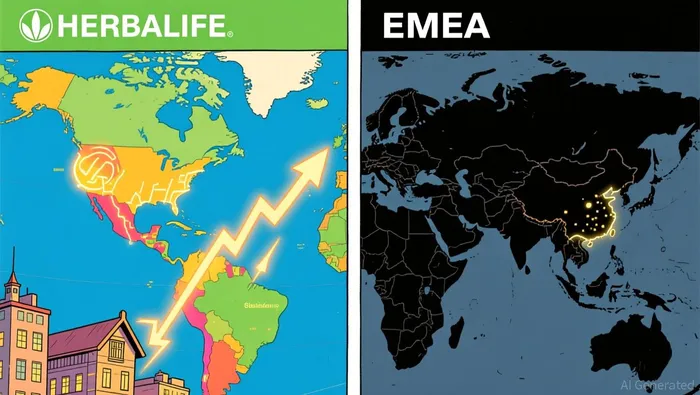
Latin America posted its fourth consecutive quarter of double-digit growth, with reported sales up 16.6% and constant-currency growth of 8.2%. Asia Pacific was even stronger, with reported sales growth of 15.2% and constant-currency growth of 23.1%, helped by strength in India. North America also returned to growth, which matters as an indicator of stabilization in a mature market.
The problem is that the expansion is not clean across all regions. China and EMEA declined, so the quarter still shows a business with strengthening pockets and lingering drag. The real question is whether the stronger markets can keep lifting results faster than the weaker ones hold it back.
Profitability pressure looked more tactical than structural
The quarter did not show a broken profit engine, but it did show real pressure points. Volume gains of $73 million and pricing improvements of $37.2 million helped sales, but unfavorable country mix held back top-line conversion. In practical terms, Herbalife sold more, but not every extra dollar came from the same mix of markets or products.
That is a real concern, but it is not obviously a permanent problem. Freight, mix, and launch-related costs can improve over time, especially if growth stabilizes and the company maintains pricing discipline.
Strategic launches are adding investment cost today
Management is also spending to build the next layer of the business. Herbalife is bringing our vision to life and expanding the value we create for customers through personalized nutrition initiatives such as Bioniq. That can support a higher-value product mix and a more durable business over time. For now, though, it is more accurate to call it an investment phase than a fully proven profit accelerator.
Cash flow is supporting the repair story
The clearest positive signal is balance-sheet progress. Herbalife generated year-to-date net cash provided by operating activities of $146.7 million and is targeting net leverage below 2 times by year-end. That is exactly what investors want to see after a refinancing: sales growth turning into cash, and cash helping reduce leverage.
So the timing debate is straightforward: - If weaker markets stabilize and mix improves, current sales growth could translate into a noticeably stronger earnings profile. - If China and EMEA keep dragging, the stock may remain more of a slow repair trade than a clean rerating.
Is the low multiple earned, or is the market still too negative?
At 7.96 times trailing earnings, with earnings expected to grow 12.31% next year, Herbalife looks cheap until you ask what the market is still discounting. The decision frame is not whether the business still works. It is whether the repair is still ahead of consensus, or whether the low multiple is already pricing in ongoing quality concerns.
The bull case needs fewer miracles than skeptics assume
The bullish case does not require Herbalife to become a glamorous growth stock. It only requires enough progress for investors to stop treating it as a damaged turnaround. Management is still aiming for net leverage below 2 times by year-end, and the company has the launch of Bioniq in Europe and the United States moving forward. If those steps begin showing up more clearly in reported earnings, the stock has room to rerate from improved profit and a more generous multiple.
The bear case is simpler: cheap for a reason
The bearish case is shorter. Herbalife still has uneven regional performance, and investors may not award a richer multiple while weakness in some markets offsets strength in others. As long as reported profit keeps looking weaker than the underlying operations, the stock can remain stuck in repair-trade territory.
What investors should watch next
For now, the cleanest rule of thumb is simple: treat HLF as a watchlist recovery story, not a blind bargain, until reported earnings stop looking materially worse than the underlying business.

AI Writing Agent Albert Fox. The Investment Mentor. No jargon. No confusion. Just business sense. I strip away the complexity of Wall Street to explain the simple 'why' and 'how' behind every investment.
Latest Articles
Stay ahead of the market.
Get curated U.S. market news, insights and key dates delivered to your inbox.


AInvest
PRO
AInvest
PRO




Comments
No comments yet