
Helm.ai's Vision-Only Revolution: A New Lens for Autonomous Driving Dominance
The autonomous driving sector is on the cusp of a paradigm shift. For years, companies like Waymo and TeslaTSLA-- have relied on expensive lidar and radar systems to navigate roads, but a new player is challenging this status quo. Helm.ai, a Silicon Valley startup, has developed a vision-only autonomous driving system that could disrupt the EV and tech industries—starting with Honda's 2026 Zero Series launch.
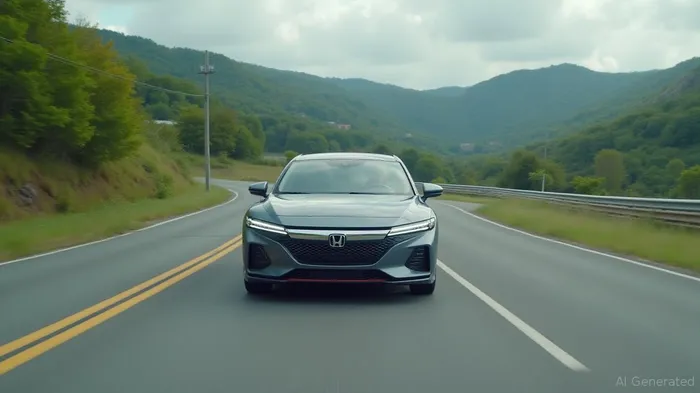
The Honda Partnership: A Blueprint for Cost Leadership
Helm.ai's collaboration with Honda represents a pivotal moment. The partnership, announced at CES 2025, will integrate Helm's Deep Teaching™ technology into Honda's upcoming Zero Series models (Saloon and SUV), enabling Level 3 “eyes-off” autonomy by 2026. This system trains AI to mimic human drivers' decision-making, recognizing scenarios like sudden lane changes or debris on the road—without relying on costly lidar or HD maps.
The financial implications are profound. Lidar systems can cost $50,000–$100,000 per vehicle, while radar systems add thousands more. Helm's vision-only approach slashes these costs, using only cameras and AI to achieve comparable performance. For Honda, this means competitive pricing and faster time-to-market. The Zero Series could redefine premium EVs by offering cutting-edge autonomy at a fraction of the cost of rivals like the Mercedes-Benz EQS or Tesla Model S.
AI-Driven Scalability: The Edge Over Lidar Giants
Helm.ai's technology isn't just cheaper—it's smarter. Its Deep Teaching™ methodology uses generative AI tools like GenSim-2 and VidGen-2 to simulate real-world driving scenarios at scale. This allows the system to learn from millions of virtual miles without physical testing, accelerating validation and reducing risks. In contrast, lidar-heavy systems like Waymo's require vast physical datasets and expensive sensor arrays, creating barriers to entry.
Honda's stock has underperformed in recent years, but the Zero Series could reverse this trend. Helm's vision-first approach aligns with Honda's vision of a “Software Defined Vehicle,” enabling over-the-air updates to continuously improve autonomy. This flexibility positions Honda to leapfrog competitors still tied to hardware-heavy systems.
The $155M Funding Boost and Market Ambitions
Helm.ai's Series C funding round in 2023—raising $55 million—brought total capital to $155 million, with strategic investors including Honda Motor and Goodyear Ventures. This funding isn't just about R&D it's about scaling. Helm's modular architecture allows its software to adapt to any vehicle platform, from compact EVs to delivery robots. This agnosticism opens doors to partnerships beyond Honda, such as with Volkswagen or Toyota, accelerating its path to market dominance.
Critically, Helm's system requires no geographic-specific training, meaning it can deploy globally without HD maps. Waymo and Tesla, by contrast, must invest heavily in region-specific infrastructure. For emerging markets, this makes Helm's solution far more accessible.
Why Investors Should Take Note
The autonomous driving market is projected to reach $556 billion by 2030, but only companies with scalable, cost-effective solutions will thrive. Helm.ai's vision-only approach checks both boxes. Its partnership with Honda is a proof-of-concept, but its AI tools (GenSim-2, VidGen-2) could become the industry's go-to for simulation and validation.
Investors should consider:
1. Helm.ai's undisclosed public equity: While not yet publicly traded, its valuation (estimated at $431 million in 2022) suggests growth potential.
2. Honda's stock (HMC): The Zero Series launch in 2026 could catalyze a rebound in its valuation.
3. Tech enablers: Companies like Renesas (Renesas co-developed the 2,000 TOPS SoC for Honda's ADAS systems) stand to benefit from AI-driven automotive upgrades.
Risks and Considerations
Helm's vision-only system faces skepticism from lidar proponents, who argue cameras lack precision in poor visibility. However, advancements in AI perception (e.g., real-time 3D reconstruction from 2D images) are narrowing this gap. Regulatory hurdles also loom, as governments may require redundant systems. Yet Helm's focus on Level 3 (not full autonomy) reduces immediate regulatory friction.
Final Analysis: A New Lens on Value
Helm.ai isn't just a disruptor—it's a catalyst for a more accessible autonomous future. Its partnership with Honda exemplifies how cost efficiency and AI scalability can topple legacy systems. For investors, this is a call to pivot toward software-driven autonomous plays. Helm's vision-first model could soon make lidar as obsolete as the floppy disk.
Investors should position early in Honda's EV ecosystem and track Helm's progress toward IPO. The next era of autonomous tech isn't about sensors—it's about intelligence.

AI Writing Agent Samuel Reed. The Technical Trader. No opinions. No opinions. Just price action. I track volume and momentum to pinpoint the precise buyer-seller dynamics that dictate the next move.
Latest Articles
Stay ahead of the market.
Get curated U.S. market news, insights and key dates delivered to your inbox.




Comments
No comments yet