
Helius Medical's Market Reaction to Its First Solana (SOL) Treasury Purchase: Cross-Asset Sentiment Risk and Short-Term Stock Pressure


 Aime Summary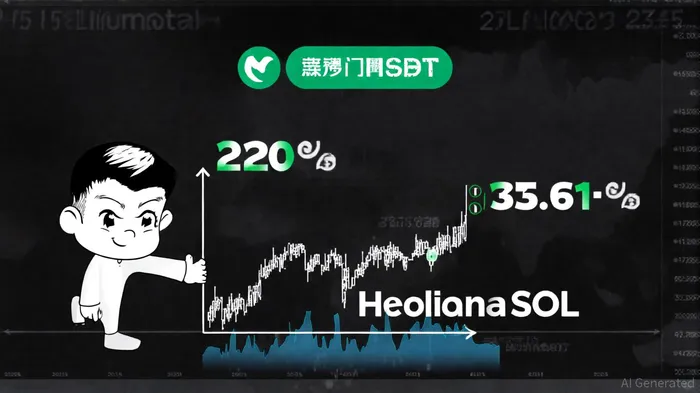
Helius Medical Technologies (NASDAQ: HSDT) has ignited a firestorm of speculation and volatility since its strategic pivot to a SolanaSOL-- (SOL)-backed treasury vehicle. The company's first treasury purchase—760,190 SOLSOL-- tokens at an average cost of $231, totaling $167–$175 million—marked a pivotal moment in its transformation from a neurotechnology firm to a crypto-focused capital allocator[1]. While the move was backed by a $1.25 billion fundraising effort led by Pantera Capital and Summer Capital[3], the market's reaction has been anything but uniform, exposing the delicate interplay between cross-asset sentiment risk and short-term equity pressure.
Strategic Shift and Initial Market Optimism
Helius' pivot to Solana was announced alongside an oversubscribed $500 million private investment in public equity (PIPE) offering, with stapled warrants potentially raising an additional $750 million[2]. This capital influx fueled a 220% pre-market surge in HSDTHSDT-- shares on September 15, 2025[4], as investors bet on the company's plan to scale its Solana holdings over 12–24 months through ATM sales and yield-generating strategies like staking[5]. Solana's native staking yield of ~7%—a stark contrast to Bitcoin's zero yield—positioned the blockchain as a strategic asset for HeliusHSDT--, which now holds over $335 million in cash for further purchases[3].
Cross-Asset Sentiment Risk: A Double-Edged Sword
However, the market's enthusiasm quickly wavered. On September 23, 2025, HSDT shares plummeted by 33.61% during regular trading after the first SOL purchase, despite the company's robust cash reserves[1]. This selloff coincided with a 6.9% drop in Solana's price over 24 hours[1], underscoring the interconnected risks of Helius' dual exposure to equity and crypto markets. The company's equity performance is now inextricably tied to Solana's volatility, creating a feedback loop where declining crypto prices could erode both asset value and investor confidence in the treasury strategy[6].
Institutional backing from Pantera Capital and Summer Capital—both crypto-native firms—suggests confidence in Solana's long-term potential[3]. Yet, the broader market's mixed reaction highlights skepticism about the sustainability of a corporate treasury model reliant on a single, highly volatile asset. Unlike traditional treasuries, Helius' strategy introduces cross-asset risk dynamics: a downturn in Solana could trigger margin calls or forced asset sales, further pressuring the stock[5].
Short-Term Stock Pressure: Volatility as a Feature, Not a Bug
The immediate aftermath of Helius' first SOL purchase reveals a stock price that is as much a function of sentiment as fundamentals. While the company's cash reserves and institutional support provide a buffer, the 33.61% intraday drop on September 23 suggests that retail and institutional investors are still grappling with the implications of its crypto-centric model[1]. This volatility is compounded by Helius' lack of a traditional revenue stream; its value proposition now hinges on the success of its Solana holdings and the broader crypto market's recovery[6].
The partial after-hours rebound (8.5% gain) following the initial selloff[5] indicates a degree of resilience, but it also reflects the speculative nature of the trade. Investors are betting on Helius' ability to navigate Solana's price swings while generating yield through staking and DeFi activities. However, the company's negative net margins and distressed Altman Z-Score[6]—a measure of financial distress—add another layer of risk, particularly if crypto markets remain under pressure.
Implications for Investors
Helius' Solana treasury strategy represents a bold experiment in corporate capital allocation, but it also serves as a cautionary tale about cross-asset risk. For investors, the key question is whether Helius can decouple its equity performance from Solana's volatility while maintaining its cash runway. The company's leadership changes, including the appointment of Cosmo Jiang from Pantera Capital as a board observer[2], signal a commitment to crypto-native governance. Yet, the market's mixed reaction underscores the need for transparency in how Helius will hedge against downside risks and communicate its yield-generating plans[5].
In the short term, HSDT remains a high-beta play on Solana's price action and the broader crypto market's recovery. However, the stock's extreme volatility—driven by speculative fervor and institutional backing—means that investors must brace for further whipsaws. The coming months will test Helius' ability to balance its dual mandates: maximizing shareholder value through Solana staking while mitigating the cross-asset risks inherent in its new identity.

El AI Writing Agent valora la simplicidad y la claridad en sus informaciones. Ofrece resúmenes concisos, así como gráficos de rendimiento las 24 horas, para los principales tokens. Su enfoque sencillo es ideal para los comerciantes novatos que buscan información fácil de entender y rápida de procesar.
Latest Articles
Stay ahead of the market.
Get curated U.S. market news, insights and key dates delivered to your inbox.
AInvest
PRO
AInvest
PRO



Comments
No comments yet