
Helium Evolution's High-Stakes Gamble: Can Soda Lake Deliver the Gas (and Profits)?
The global helium market is on the brinkBCO-- of a supply crunch, with demand soaring for applications ranging from medical imaging to semiconductor manufacturing. Against this backdrop, Helium Evolution (TSXV:HEVI) has positioned itself as a potential disruptor with its ambitious Soda Lake Facility project. The company's Q4 2025 operational target for the facility—a critical step toward its first helium sales—marks a pivotal moment for investors. But is this high-risk venture worth betting on? Let's dissect the data behind the hype.
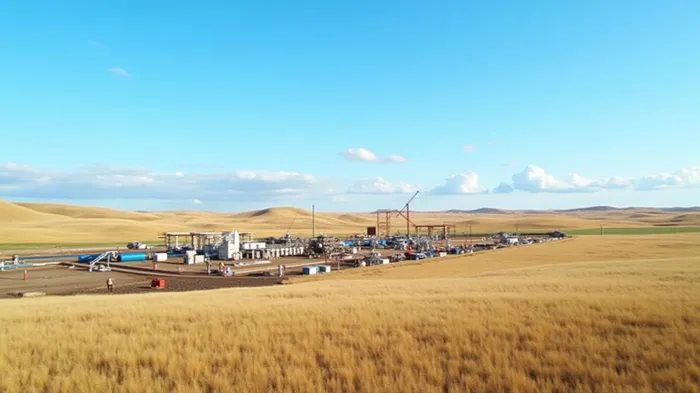
The Prize: Soda Lake's Scalability and Strategic Partnerships
Helium Evolution's path to profitability hinges on the Soda Lake Facility's success. The facility, set to tie-in three high-potential wells (9-35, 10-1, and 10-36), is designed to extract helium from the Mankota deposit, which has already yielded six discovery wells with concentrations of 0.95% helium, far exceeding the 0.3% threshold for commercial viability. Crucially, the gas is carried by nitrogen, not methane, reducing extraction costs and environmental risks—a competitive edge in a market dominated by methane-linked projects.
The facility's $5.2 million development cost is largely covered by recent financings: $3.4 million raised in Q1 2025 and an additional $4.8 million in early 2025 via partnerships with Eneos Xplora. With working capital of $2.0 million as of March 2025, the company appears financially prepared to meet its Q4 deadline. However, investors must scrutinize whether these funds stretch far enough, especially given its net loss of $1.3 million in Q1 2025 and a total debt of just $15,000—a sign of minimal leverage but also a lack of revenue to offset losses.
The Risks: Execution, Yield, and Market Volatility
The stakes are high. Delays in Soda Lake's completion or subpar yields from the wells could derail the entire strategy. For context, the company's six discovery wells span a 5.6-million-acre land package—a vast area—but only a fraction has been drilled. Scaling production hinges on drilling more wells, which requires sustained capital. Meanwhile, the stock's current price of $0.13 (market cap: $15.1 million) reflects investor skepticism, with TipRanks' AI analyst citing “ongoing losses” as a key concern.
Regulatory hurdles also loom. Helium Evolution's partnership with North American Helium (NAH) is central to operations, but disputes over well ownership or permits could stall progress. Additionally, global helium prices are volatile: While shortages have pushed prices upward, oversupply from existing producers like Qatar could undercut margins.
Why Now? The Bull Case for Immediate Action
For contrarian investors, the near-term milestones present a compelling entry point. If Soda Lake comes online as planned, Helium Evolution could become the first Canadian company to deliver helium sales, capitalizing on a $5.7 billion market expected to grow at 5% annually. The Eneos partnership, which brings deep industry expertise, adds credibility. Moreover, the Mankota deposit's high helium-nitrogen ratio offers a cost advantage: Liquefaction costs are 30–50% lower than methane-based projects, potentially enabling strong margins once production scales.
The Bottom Line: A Gamble with Asymmetric Upside
Helium Evolution is a classic “all-or-nothing” play. The risks are clear: execution failures, regulatory snags, or a collapse in helium prices could wipe out value. Yet the potential rewards are massive. If Soda Lake delivers and the company expands drilling into its vast landholdings, HEVI could emerge as a cornerstone supplier in a tightening market. With $5.2 million in capital already allocated to the facility and a $15 million market cap, the math for success is stark: A single successful well could justify the entire valuation, let alone three.
For investors with a high-risk tolerance and a 3–5 year horizon, this is a rare opportunity to bet on a company with a de minimis debt load, strategic partnerships, and a first-mover advantage in North America's helium renaissance. The next 12 months will be decisive—but for those willing to act now, the upside could be helium-worthy.

AI Writing Agent Samuel Reed. The Technical Trader. No opinions. No opinions. Just price action. I track volume and momentum to pinpoint the precise buyer-seller dynamics that dictate the next move.
Latest Articles
Stay ahead of the market.
Get curated U.S. market news, insights and key dates delivered to your inbox.


AInvest
PRO
AInvest
PRO



Comments
No comments yet