
Heineken's Struggling Beer Volumes: A Test of Resilience in a Fragmented Global Beer Market
 Aime Summary
The global beer industry is no stranger to volatility. From shifting consumer preferences to trade policy shocks, the sector has seen its fair share of turbulence in recent years. Yet, one company's recent struggles—Heineken NV's 0.4% decline in beer sales volumes in Q2 2024—have sparked renewed debates about the long-term resilience of global beer stocks in an increasingly fragmented market. While the decline may seem modest, it underscores a broader challenge: how can multinational brewers maintain growth when regional disruptions, trade wars, and evolving consumer habits collide?
The European Retail Disputes: A Short-Term Drag, Not a Death Knell
Heineken's Q2 performance was hit by prolonged price negotiations with regional buying groups in Western Europe, particularly in France, the Netherlands, and Spain. These disputes delayed product availability during the summer heat wave, a critical period for beer sales. The company's localized production model, which accounts for 95% of its beer being produced and consumed in the same region, should have insulated it from such shocks. But the European retail landscape is now a patchwork of conflicting interests, with retailers prioritizing margin compression over brand loyalty.
Yet, Heineken's management remains confident, maintaining its full-year operating profit guidance of 4–8% growth. This optimism isn't baseless. The company has offset European headwinds with strong performances in Vietnam, India, and Mexico, where demand for premium and mid-strength beers is surging. Moreover, its localized production model—unlike the import-heavy strategies of rivals like AB InBev—limits exposure to U.S. tariffs, which have crippled global beer exporters.
Fragmented Markets: A Double-Edged Sword
The global beer market is more fragmented than ever. Trade policy shifts, such as the 25% U.S. tariff on imported beer (plus a 10% “Liberation Day” surcharge and 20% EU reciprocal duty), have created a mosaic of cost structures and regulatory hurdles. For companies like Heineken, this means navigating a labyrinth of regional dynamics:
- Premiumization: Heineken's premium beer segment grew 8.8% in 2024, outpacing the industry average. This aligns with a global trend where consumers are willing to pay for quality over price.
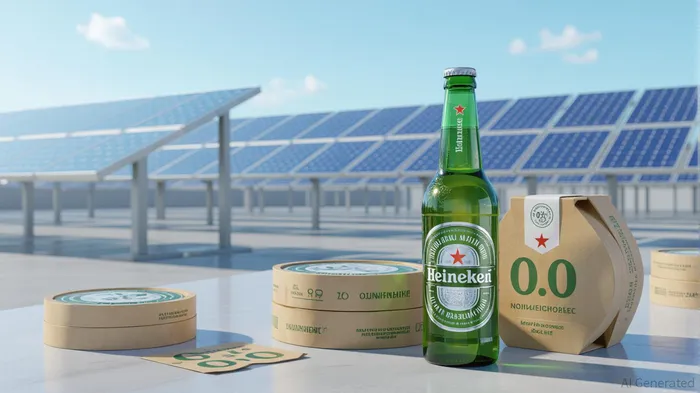
- Non-Alcoholic Beer: Sales of Heineken 0.0 surged by 30% in 2024, capturing 20% of its non-alcoholic market. The “sober-curious” movement and health-conscious consumers are reshaping demand.
- Sustainability: The company's “Brew a Better World” program has saved €400 million in 2025 through energy efficiency and circular packaging. These savings are reinvested into innovation, creating a flywheel of cost reduction and growth.
Compare this to rivals like Carlsberg and AB InBev, which are also diversifying into non-alcoholic and low-ABV segments but face steeper costs from U.S. aluminum tariffs. Heineken's localized production model acts as a buffer, reducing exposure to global supply chain shocks.
The Long-Term Play: Resilience Through Diversification
Heineken's recent investments highlight its long-term vision. A €1.5 billion share buyback program in early 2025 signaled confidence in its cash flow, while acquisitions of UK pubs and a minority stake in TENZING, a UK energy drink company, diversify its revenue streams. These moves insulate the company from beer-specific volatility and tap into adjacent categories with growth potential.
The broader market is projected to grow at a 5.8% CAGR from 2025 to 2030, reaching $1.06 trillion by 2030. This growth is driven by rising disposable incomes, tourism, and the shift toward premium and non-alcoholic products. Heineken's focus on these trends positions it as a winner in a fragmented market.
Investment Implications: A Buy for the Patient
While Heineken's Q2 results were a drag, the company's strategic strengths—localized production, premiumization, sustainability, and diversification—suggest long-term resilience. The European retail disputes are a temporary setback, not a structural flaw. For investors, the key is to distinguish between short-term noise and long-term value.
Heineken's stock currently trades at a forward P/E of 18.5x, below its five-year average of 22x, reflecting market skepticism over European headwinds. However, its strong cash flow generation and strategic reinvestment into high-growth segments (e.g., non-alcoholic beer, energy drinks) justify a higher valuation. Analysts have raised price targets to €92–€95, implying a 12–15% upside from current levels.
Conclusion: The Beer Industry's Next Frontier
The global beer market is no longer a one-size-fits-all industry. Fragmentation, driven by trade policy, consumer preferences, and sustainability demands, is the new normal. Companies that adapt—like Heineken—are rewarded with resilience and growth. While the European retail disputes are a near-term hurdle, they also serve as a stress test for the company's long-term strategy. For investors with a five- to ten-year horizon, Heineken's focus on premiumization, sustainability, and diversification makes it a compelling play in a sector that's far from saturated.
In a world where the only constant is change, Heineken's ability to navigate complexity may prove more valuable than its beer.

Stay ahead of the market.
Get curated U.S. market news, insights and key dates delivered to your inbox.


AInvest
PRO
AInvest
PRO



Comments
No comments yet