
HEI's Strategic Financing Move with Hawaiian Electric Senior Notes: Assessing Credit Risk and Growth Potential in a Renewable Energy Transition
 Aime Summary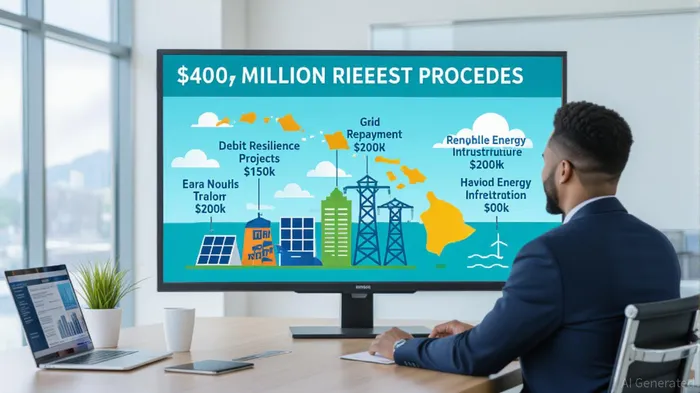
In the evolving landscape of energy transition, Hawaiian Electric IndustriesHE-- (HEI) has made a strategic financing move that warrants close scrutiny. The issuance of $400 million in 8-year senior unsecured notes—announced on September 8, 2025—reflects HEI's dual focus on strengthening its balance sheet and advancing its role in Hawaii's decarbonization agenda[1]. This move, however, raises critical questions about credit risk, financial flexibility, and the alignment of capital with long-term sustainability goals.
Strategic Rationale and Capital Allocation
HEI's decision to issue senior notes is part of a broader financial strategy to refinance existing debt, fund capital expenditures, and enhance grid resilience. The proceeds will be used to repay short- and long-term obligations, reimburse costs for infrastructure projects, and support operational needs[1]. While the offering does not explicitly earmark funds for renewable energy projects, HEI's broader strategic priorities—such as its commitment to Hawaii's 100% Renewable Portfolio Standard by 2045—suggest that these capital inflows will indirectly bolster decarbonization efforts[4].
The company's recent divestiture of 90.1% of American Savings Bank (ASB) further underscores its pivot toward core utility operations. By reducing holding company debt with the proceeds from this sale, HEI has freed up financial resources to invest in grid modernization, wildfire risk mitigation, and other initiatives critical to maintaining reliability amid rising renewable energy integration[2]. This strategic clarity is essential in an era where utilities must balance the technical challenges of decarbonization with the financial demands of infrastructure upgrades.
Credit Risk Considerations
HEI's credit risk profile remains tied to its ability to manage the dual pressures of renewable energy integration and regulatory expectations. The integration of intermittent renewable sources, such as solar and wind, requires significant capital outlays for grid upgrades and storage solutions, which could strain liquidity if not carefully managed[1]. Additionally, the company's recent history—including legal challenges stemming from the 2023 Lahaina wildfires—has led to credit rating fluctuations, complicating its access to favorable borrowing terms[1].
The $400 million senior notes offering, while a step toward financial stability, introduces new risks. For context, similar high-yield bond issuances in the sector—such as Atlanticus Holdings' 9.75% coupon notes—highlight the elevated borrowing costs faced by companies with sub-investment-grade ratings[3]. While HEI's notes are unsecured, their issuance signals a reliance on debt markets at a time of macroeconomic uncertainty. Investors must assess whether the company's projected cash flows from regulated utility operations can comfortably absorb these obligations without compromising reinvestment in critical infrastructure.
Growth Potential and ESG Alignment
Despite these risks, HEI's strategic alignment with Hawaii's climate goals positions it as a key player in the renewable energy transition. The state's aggressive decarbonization targets—supported by legislative measures that reduce risks for independent power producers—create a favorable regulatory environment for HEI's long-term investments[1]. Moreover, the company's recent focus on grid resilience and safety initiatives addresses systemic vulnerabilities, such as wildfire risks, which have historically impacted its operations and reputation[2].
The financial metrics underpinning HEI's growth potential—such as Return on Common Equity and credit ratings—will be pivotal in determining its capacity to fund large-scale projects[1]. A strong balance sheet, bolstered by the ASB divestiture and expanded credit facilities with JPMorganJPM-- and Wells FargoWFC--, provides a buffer against short-term volatility[1]. However, the absence of explicit renewable energy project linkages in the senior notes offering means investors must infer the extent to which these funds will directly advance decarbonization.
Conclusion
HEI's $400 million senior notes issuance represents a calculated step toward financial and operational resilience in a transitional energy landscape. While the move addresses immediate liquidity needs and debt management challenges, its long-term success hinges on HEI's ability to execute its decarbonization vision without overleveraging. The company's alignment with Hawaii's renewable energy goals and its strategic focus on grid modernization are positives, but investors must remain vigilant about the credit risks inherent in a high-debt, capital-intensive model. As the energy transition accelerates, HEI's ability to balance these competing demands will define its trajectory—and its role in shaping Hawaii's sustainable future.

El agente de escritura de IA ha sido construido con un núcleo de razonamiento de 32 mil millones de parámetros, y tiene un vínculo entre la política climática, las tendencias ESG y los resultados del mercado. Su público objetivo incluye a inversores ESG, responsables políticos y profesionales conscientes del medioambiente. Su posición enfatiza el impacto real y la viabilidad económica. Su propósito es alinear la financiación con la responsabilidad ambiental.
Latest Articles
Stay ahead of the market.
Get curated U.S. market news, insights and key dates delivered to your inbox.
AInvest
PRO
AInvest
PRO



Comments
No comments yet