
Hedge Fund FOMO: Will U.S. Stocks See More Inflows?
The recent rise in the S&P 500 has been missing a key element: inflows from institutional investors. For market bulls betting on further gains, this could be a positive signal.
So far in January, while the benchmark index has climbed higher, institutional investors have scaled back their bullish bets due to uncertainty surrounding former President Donald Trump's policies and the Federal Reserve's interest rate trajectory. According to Deutsche Bank data, a measure of aggregate positioning among rules-based and discretionary investors has dropped to a two-month low. Similarly, data from Goldman Sachs shows that commodity trading advisors (CTAs) have reduced their long equity exposure to levels last seen in August following a market selloff.
From a contrarian perspective, this skepticism may bode well for the market. If major fears fail to materialize, there could be significant "dry powder" ready to flow into equities. While political uncertainty continues to weigh on sentiment, inflation has been easing, and Q4 earnings season has had a strong start, adding to the optimism.
FOMU: Fear of Materially Underperforming the Market
"Positioning does not reflect the current rally in risk assets and may lead to FOMU — the fear of materially underperforming the benchmark," Scott Rubner, Goldman Sachs' managing director for global markets and tactical strategies, wrote in a note to clients. He highlighted a favorable technical window for the next month, indicating potential inflows.
Goldman Sachs estimates that if the S&P 500 continues to rise or even remains flat, CTAs could deploy $15 billion to $30 billion into equities over the next month.
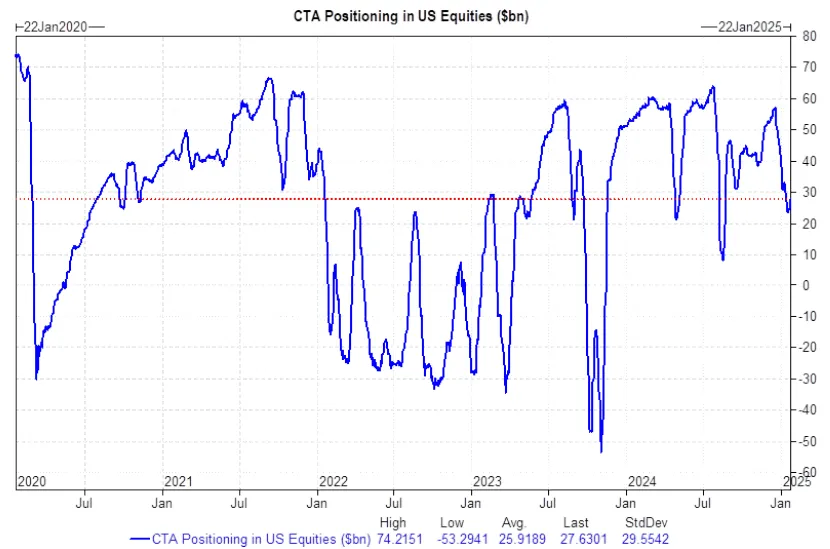
Hedge funds have already begun taking action. According to Goldman's data, hedge funds increased their exposure to U.S. equities at the fastest pace in 10 weeks following a cooler-than-expected Consumer Price Index (CPI) report. However, the risk appetite of hedge funds relative to their cautious stance remains below last year's highs.
"While most hedge funds believe the fundamentals are still strong, they are exhibiting slightly more caution compared to last year," noted Jon Caplis, CEO of hedge fund research firm PivotalPath.
Institutional Inflows May Accelerate Amid FOMO
Matt Maley, chief market strategist at Miller Tabak + Co., explained that even the most conservative institutional investors, such as mutual funds and pension funds, could begin aggressive buying amid fear of missing out (FOMO). Historically, January has been the largest month for inflows into mutual funds, providing an additional seasonal tailwind, according to Rubner.
"If stocks continue to rally, even institutions with cautious outlooks will be forced to act bullishly," Maley said. "The fear of falling behind could quickly turn them into short-term momentum players."
This dynamic—coupled with easing inflation, strong Q4 earnings, and the prospect of further economic resilience—suggests that institutional and hedge fund inflows could significantly bolster the U.S. stock market in the weeks to come.

Stay ahead of the market.
Get curated U.S. market news, insights and key dates delivered to your inbox.




Comments
No comments yet