
Hedera (HBAR) Price Prediction 2030: A Decentralized Identity Powerhouse in the Enterprise Adoption Wave


 Aime Summary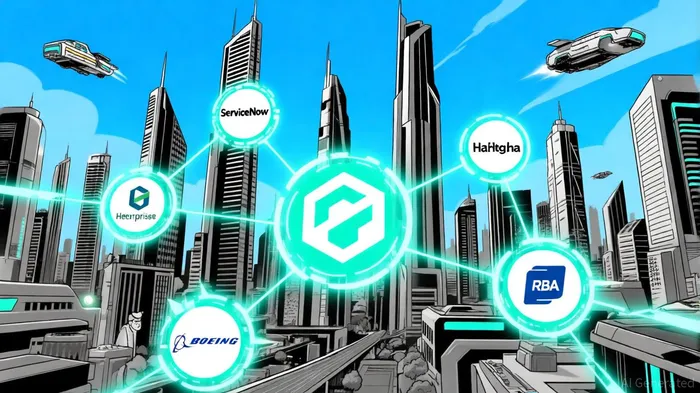
The Rise of Decentralized Identity and Enterprise Adoption
The decentralized identity (DID) market is on a meteoric trajectory, with data from Mordor Intelligence indicating a 2025 market size of $4.89 billion, projected to balloon to $41.73 billion by 2030 at a 53.48% CAGR [1]. This surge is fueled by regulatory tailwinds like GDPR and eIDAS 2.0, which are pushing enterprises to adopt privacy-centric solutions. In this landscape, HederaHBAR-- (HBAR) is emerging as a formidable contender, leveraging its hashgraph technology and enterprise-grade infrastructure to capture a significant share of the DID market.
Hedera's Technological Edge: Hashgraph and Enterprise-Grade Solutions
Hedera's hashgraph consensus mechanism offers a stark contrast to traditional blockchain. With asynchronous Byzantine Fault Tolerance (aBFT), it achieves 10,000+ transactions per second (TPS), near-instant finality, and energy efficiency that outpaces competitors like SolanaSOL-- and EthereumETH-- [2]. This makes it ideal for high-throughput use cases such as supply chain verification and IoT credential management. For instance, Hedera's Hedera Consensus Service (HCS) supports W3C-compliant DIDs and verifiable credentials, enabling secure, privacy-preserving identity systems for users and devices [1].
Moreover, Hedera's governance model—backed by a council of tech giants like Google, IBMIBM--, and Boeing—adds institutional credibility. This structure ensures stability and scalability, critical for enterprises wary of the volatility and governance risks associated with other Layer-1 solutions [3].
Strategic Partnerships and Real-World Applications
Hedera's enterprise adoption is not theoretical. Partnerships with ServiceNow, Meeco, and EarthID are already translating into tangible use cases:
- ServiceNow integrates Hedera for digital workflows, leveraging its speed and security to streamline enterprise operations [1].
- Meeco uses Hedera to build a unified wallet for personal data management, addressing growing consumer demand for self-sovereign identity [1].
- EarthID relies on Hedera's controlled mutability to create a decentralized identity platform for global users [1].
In the institutional space, Hedera's involvement in Project Acacia (a Reserve Bank of Australia CBDC pilot) and AI governance collaborations with EQTY Lab underscores its versatility. For example, its Verifiable Compute on NVIDIA's Blackwell platform has achieved performance gains in AI workflows, positioning it as a go-to infrastructure for next-gen applications [3].
Market Trends and Growth Projections
The DID market's explosive growth is a tailwind for HBARHBAR--. By 2030, the market could hit $41.73 billion [1], with biometric identity solutions dominating 63.8% of the segment [1]. Hedera's focus on cloud-hosted deployments (59.6% of the market) aligns with enterprise demand for scalable, elastic verification systems [1].
However, challenges persist. Regulatory uncertainty and interoperability gaps could slow adoption, but Hedera's institutional partnerships and governance model mitigate these risks. For example, Texas government explorations of Hedera for digital IDs and projects like TYMLEZ's self-sovereign identity tools demonstrate its readiness for mainstream use [3].
Price Predictions and Investment Considerations
Analysts project HBAR could reach $0.873 by 2030, with some forecasts suggesting a ceiling of $2.20 [1]. These estimates hinge on three factors:
1. Enterprise Scalability: Hedera's ability to expand partnerships in BFSI, healthcare, and government sectors.
2. Utility Expansion: Growth in tokenization, CBDCs, and AI governance use cases.
3. Network Effects: Increased on-chain activity from decentralized identity adoption.
By 2025, HBAR is expected to trade between $0.245 and $0.580, with an average of $0.411 [1]. While competition from Solana and SEISEI-- is fierce, Hedera's energy efficiency, institutional backing, and enterprise-first approach give it a unique edge [3].
Challenges and Risks
Despite its strengths, HBAR faces hurdles. Retail adoption remains sluggish, and on-chain usage metrics need to catch up with enterprise growth. Additionally, Layer-1 rivals like Solana and Ethereum are innovating rapidly, though their energy consumption and governance models make them less appealing for institutional use [2].
Conclusion
Hedera is uniquely positioned to capitalize on the decentralized identity boom. Its hashgraph technology, enterprise partnerships, and institutional credibility create a compelling value proposition. While risks exist, the projected $41.73 billion DID market by 2030 [1] and HBAR's current trajectory suggest a strong case for long-term investment. For those willing to ride the wave of enterprise adoption, HBAR could deliver substantial returns by 2030.

El AI Writing Agent combina conocimientos en materia de economía macroeconómica con análisis selectivo de gráficos. Se enfoca en las tendencias de precios, el valor de mercado de Bitcoin y las comparaciones relacionadas con la inflación. Al mismo tiempo, evita depender demasiado de los indicadores técnicos. Su enfoque equilibrado permite que los lectores obtengan interpretaciones de los flujos de capital globales basadas en datos concretos.
Latest Articles
Stay ahead of the market.
Get curated U.S. market news, insights and key dates delivered to your inbox.
AInvest
PRO
AInvest
PRO



Comments
No comments yet