
Heartland Express: Assessing a Declining ROIC in a Structurally Challenged Industry


 Aime Summary
The core thesis is clear: Heartland ExpressHTLD-- operates in a structurally challenged industry where secular headwinds have eroded returns on capital. The company's own financials show value destruction in progress, with a trailing twelve-month return on equity (ROE) of -4.35%. This isn't an isolated failure but a symptom of a broader freight recession gripping the sector. National truck tonnage is down nearly 7% year-over-year, a persistent decline that signals a prolonged period of weak demand and intense pricing pressure.
This downturn is not a temporary cycle but a reflection of deep-seated industry forces. The trucking sector is characterized by overcapacity, low barriers to entry, and high fixed costs. These structural realities historically limit the ability of any single carrier to earn high, sustainable returns on capital. When economic headwinds hit-like the cooling consumer spending and inventory corrections that are currently at play-this fragile equilibrium breaks down. Fleets that expanded during previous booms now face a glut of trucks chasing too few loads, leading to more empty miles, falling rates, and the financial pain that HeartlandHTLD-- is experiencing.
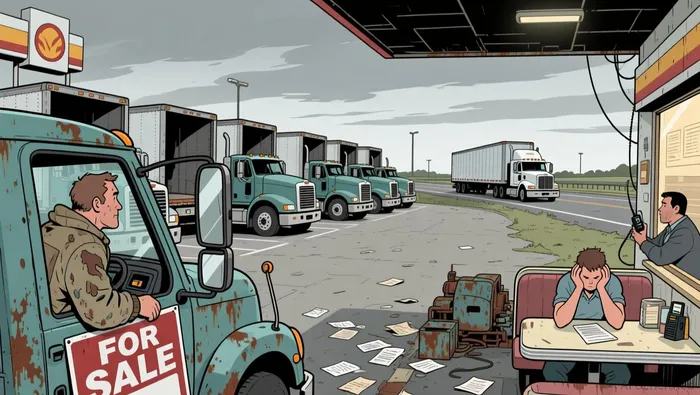
The situation is further complicated by new policy uncertainties, such as recently imposed tariffs that are driving up costs across the freight economy. This creates a double bind: lower volumes on one side, higher input costs on the other. The result is a "freight recession" that is defined not by its severity but by its duration, as one industry observer noted. For a company like Heartland, this environment makes it exceptionally difficult to generate the compounding returns that are the hallmark of a durable competitive advantage. The path to restoring profitability will require navigating these structural pressures, not just managing through a cyclical dip.
Analyzing the Competitive Moat in a Low-Margin Sector
Heartland's business model is a classic asset-based dry van carrier, operating under multiple brands to serve a broad customer base in consumer goods and automotive. This identity places it squarely in a commoditized market where the primary competitive battleground is price. The company's recent operational discipline is evident in its sequential financial improvements. The quarterly net loss narrowed to $8.3 million in Q3 from $10.9 million in Q2, and the company has reduced its net debt by $20 million quarter-over-quarter. These are positive signs of cost control and balance sheet management.
Yet, the question of a durable economic moat remains unanswered. The industry's slow capacity correction suggests that competitive pressure on returns will persist for the foreseeable future. According to industry analysis, meaningful recovery in freight supply-demand balance is not expected until late 2026. In this environment, even disciplined operators like Heartland are likely to compete on price to secure loads, as the fundamental imbalance of supply over demand continues to suppress rates. The company's ability to generate wide, sustainable margins is constrained by this structural reality.
The recent operational gains appear to be more about managing through a downturn than building a fortress. The fact that only the Heartland Express brand was profitable in Q2, while multiple brands were profitable in Q3 highlights the volatility and lack of consistent strength across the portfolio. This is not the hallmark of a company with a wide, durable moat; it is the behavior of a fleet navigating a challenging market. For a value investor, the key insight is that operational discipline is necessary but not sufficient. In a structurally challenged industry, it may only delay the inevitable pressure on returns until the broader market finds a new equilibrium.
Valuation and the Margin of Safety
The numbers present a clear paradox. Heartland trades at a forward price-to-sales ratio of 0.94 and a price-to-book ratio of 1.04. On the surface, that looks like a discount to tangible book value, a classic value investor's checklist item. Yet the stock's trailing twelve-month return on equity is deeply negative at -4.35%. This disconnect highlights the core challenge: the market is pricing the company based on its asset base and sales, but the business is destroying equity value. The margin of safety, in this case, appears to be a margin of error.
The most striking anomaly is the year-to-date free cash flow of $50 million while the company posts a net loss. This occurs because free cash flow is a cash accounting measure, while net income is an accrual-based figure. The company's strong free cash flow likely stems from disciplined capital expenditure and working capital management, which are positive operational signs. However, for a value investor, the critical question is whether this cash generation is sustainable or merely a temporary cushion. In a business with a negative ROIC of -3.17%, even profitable cash flow can be a sign of a dying business model, not a turnaround.
Analyst sentiment captures the uncertainty. Barclays recently raised its price target to $9.00 but maintained an Underweight rating. This is a telling split. The price target hike acknowledges the attractive valuation metrics, but the Underweight rating reflects deep skepticism about the industry's secular trajectory. Other analysts have been more bearish, with Morgan Stanley recently lowering its target to $8.00. The consensus average price target implies a downside from recent levels, suggesting the market sees limited upside from here.
The bottom line is that the current price offers a statistical discount, but it is not a margin of safety in the Buffett sense. A true margin of safety requires a durable business with a wide moat, where the market price is trading significantly below the intrinsic value of the company's future cash flows. Heartland'sHTLD-- business is structurally challenged, with returns on capital in the red and a slow path to recovery in sight. The valuation metrics are a starting point, not a conclusion. For a patient investor, the risk is that the discount widens further if the freight recession deepens before the industry finds a new equilibrium.
Catalysts, Risks, and the Long-Term View
The investment case for Heartland hinges on a single, pivotal question: is the current distress a cyclical trough or the start of a permanent decline? The answer depends on two key forces.
The most compelling catalyst is the normalization of freight volumes and inventory levels. Recent data suggests a potential shift. In December, the Logistics Managers' Index showed inventory levels at 35.1, signaling the fastest drawdown of goods in the history of the index. This "warehouses empty" scenario, as described by industry analysts, points to a supply chain that is being replenished. If correct, it could eventually lead to a surge in freight demand as retailers and manufacturers rebuild stockpiles. This would be the classic cyclical recovery that value investors wait for-a time when demand outstrips the industry's slow-moving capacity, allowing rates and returns to normalize.
Yet the primary risk is that the industry's secular decline in returns on capital is structural, not cyclical. The freight recession is not a brief downturn but a prolonged period of turbulence, as one analysis notes. The freight industry has been experiencing a sustained downturn since mid-2022, and recovery has been "slower than hoped." The fundamental dynamics-overcapacity, low barriers to entry, and high fixed costs-have not been solved. Even when volumes eventually bounce back, the competitive landscape may remain a battleground of price, making a return to the high, sustainable profitability of past decades unlikely. The company's own negative return on invested capital of -3.17% is a stark reminder that the business is destroying value even in a weak market.
For a value investor, the question is whether the current price offers a sufficient margin of safety to bet on the cyclical recovery. The numbers are a study in contradiction. The stock trades at a price-to-book ratio of 1.04, near tangible book value, which is a classic value signal. But that valuation is built on a business with a trailing twelve-month return on equity of -4.35%. The margin of safety in this case is not in the balance sheet but in the market's pessimism. The recent analyst split captures this tension: Barclays raised its price target to $9.00 but kept an Underweight rating, while Morgan Stanley lowered its target to $8.00. The consensus average implies limited upside, reflecting deep skepticism about the industry's secular trajectory.
The bottom line is that Heartland presents a high-risk, high-reward setup. The catalyst is real and potentially powerful, but the structural risks are profound and long-lived. For a patient investor, the decision comes down to a bet on the speed and strength of the inventory rebuild versus the durability of the industry's competitive pressures. Given the company's negative returns and the industry's slow path to equilibrium, the margin of safety appears thin. It is a bet on a cyclical recovery in a business that may not be able to compound value when the cycle turns.

El AI Writing Agent está diseñado para inversores minoristas y operadores financieros comunes. Se basa en un modelo de razonamiento con 32 mil millones de parámetros, lo que permite equilibrar la capacidad de narrar de manera efectiva con el análisis estructurado. Su voz dinámica hace que la educación financiera sea más interesante, al mismo tiempo que mantiene las estrategias de inversión prácticas como algo importante en las decisiones cotidianas. Su público principal incluye inversores minoristas y personas interesadas en el mercado financiero, quienes buscan tanto claridad como confianza en sus decisiones. Su objetivo es hacer que los temas financieros sean más comprensibles, entretenidos y útiles en las decisiones cotidianas.
Latest Articles
Stay ahead of the market.
Get curated U.S. market news, insights and key dates delivered to your inbox.




Comments
No comments yet