
Healthcare Marketplace in 2025: Expiring Subsidies and Market Shifts for Investors


 Aime Summary
The healthcare landscape in 2025 has been defined by a mix of policy uncertainty, market volatility, and shifting consumer behavior. With the expiration of enhanced premium tax credits (ePTCs) under the American Rescue Plan looming at the end of the year, millions of Americans are bracing for a sharp rise in health insurance premiums. This policy cliff has sent ripples through the healthcare marketplace, impacting everything from enrollment rates to investor sentiment. Meanwhile, behind the scenes, pharmaceutical companies are on a M&A spree, and healthcare systems are increasingly turning to AI and data analytics to drive efficiency and personalized care. For investors, this is a complex and dynamic environment — one that demands close attention to both policy and market signals.
The Expiring ePTCs and Their Impact on Consumers
The ePTCs, which brought down premiums for 21.8 million Americans in 2025, are set to expire on December 31, 2025. Without congressional action, experts warn that premiums could double in 2026, leaving 2.2 million Americans without coverage. For many, this means the difference between having affordable healthcare and choosing between essential services like prescriptions, doctor visits, or even food and housing. 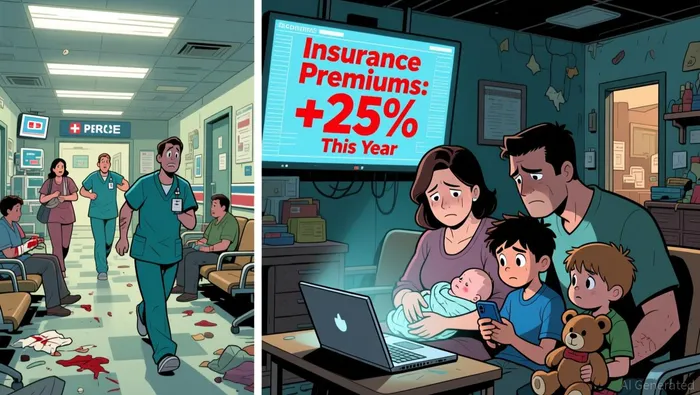 The KFF Marketplace Enrollees Survey reveals that 54% of Marketplace enrollees expect their health insurance costs to rise 'a lot more than usual' in 2026. Another 26% expect a 'little more than usual' increase. For example, a Wisconsin couple's premium for a gold-level plan is projected to climb from $2 to $1,600 per month — a price many can't afford. For some, this may mean forgoing coverage altogether.
Political and Legislative Stalemates
Congress has so far failed to find a path forward on extending the ePTCs. House Speaker Mike Johnson's proposed Republican healthcare plan excludes a subsidy extension and focuses instead on expanding association health plans and employer-sponsored insurance. Cost-sharing reductions for lower-income individuals are included, but they won't take effect until 2027 — too late for most who rely on 2025's support. Meanwhile, centrist Republicans and Democrats have been pushing discharge petitions to force a vote on temporary extensions, but these efforts have stalled. In Massachusetts, a recent hearing highlighted how these federal policy shifts could lead to 300,000 residents losing coverage over the next decade. With the clock ticking and no clear solution in sight, the uncertainty is growing — and so are the risks for both consumers and insurers.
Marketplace Trends and Investor Implications
Amid the policy uncertainty, the healthcare marketplace has seen several key trends. Pharmaceutical M&A has surged in 2025, with $24.6 billion in major deals as companies seek to bolster their pipelines and prepare for patent expirations. Key players hold a staggering $1.3 trillion in capital, indicating a strong appetite for strategic acquisitions. At the same time, health systems are increasingly adopting AI and data analytics to personalize care and reduce costs. These technologies are helping providers manage patient populations more effectively, but they also require significant investment. For investors, the sector is split between near-term risks — such as enrollment declines and premium hikes — and long-term opportunities, particularly in innovation-driven areas like digital health and prescription drug management as reported in the CMS hearing recap.
Looking Ahead: Uncertainty and Opportunity
While the immediate focus remains on the ePTC expiration and its fallout, the broader healthcare market is evolving in ways that could shape the next decade. The Centers for Medicare & Medicaid Services (CMS) projects that health spending will grow at 5.8% per year from 2023 to 2033, with prescription drug spending rising at 5.6%. Medicare is expected to account for 33% of drug spending by 2033, while private insurers cover 41%. Even with the Inflation Reduction Act's cost-containment measures, out-of-pocket costs for prescription drugs are expected to stay high. For investors, this points to both challenges — particularly for insurers facing enrollment volatility — and opportunities, especially in companies that can navigate these trends through innovation and efficiency. In the end, the healthcare marketplace in 2025 is a study in contrasts: policy-driven instability, market resilience, and the enduring need for affordable, accessible care according to market analysis.

Delivering real-time insights and analysis on emerging financial trends and market movements.
Latest Articles
Stay ahead of the market.
Get curated U.S. market news, insights and key dates delivered to your inbox.


AInvest
PRO
AInvest
PRO



Comments
No comments yet