
Healthcare.gov Enrollment Surge and Market Implications: Policy Shifts Reshape Healthcare Stocks and ETFs


 Aime Summary
The (ACA) marketplace has long been a barometer of U.S. 's intersection with market dynamics.
As tracking data shows, , driven largely by returning consumers. However, this growth masks underlying fragility:
, signaling a shift in risk pools and affordability challenges. These trends, compounded by impending policy changes, are creating a volatile environment for healthcare stocks and (ETFs), with ripple effects extending across insurers, , and institutional investors.
Enrollment Trends: A Tale of Two Markets
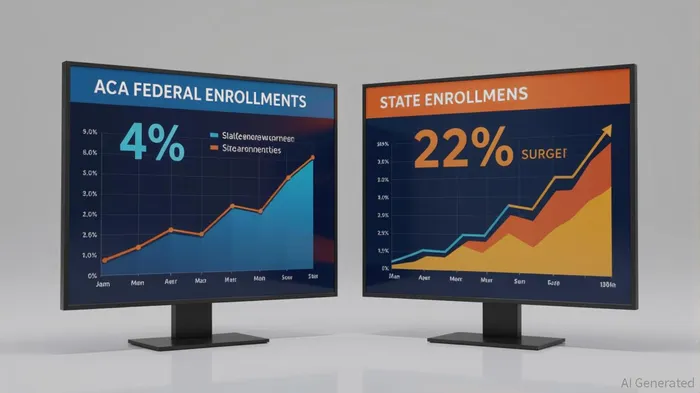 The ACA's dual-track structure-federally facilitated and state-based exchanges-has diverged sharply in 2025. State-run exchanges have outpaced Healthcare.gov, with plan selections
, . Florida and Texas, the two largest markets,
underscore the growing preference for state-level innovation and . Meanwhile, automated re-enrollment mechanisms have mitigated some churn, with
on state exchanges.
Yet these gains are shadowed by looming policy headwinds. The expiration of enhanced premium tax credits at year-end 2025 threatens to destabilize the risk pools underpinning these enrollments.
Without subsidies, , . ,
driven by inflation, labor shortages and the rising cost of therapies like .
Market Implications: Stocks and ETFs in the Crosshairs
The healthcare sector's response to these policy shifts has been mixed.
Insurers with significant ACA exposure have seen stock prices rise on hopes of tax credit extensions. Conversely, companies like Oscar HealthOSCR-- (OSCR) face uncertainty:
, , highlighting the sector's profitability challenges.
ETFs tracking the healthcare sector, including the (Health Care Select Sector SPDR) and IVL (iShares U.S. Healthcare Providers ETF), have also experienced volatility. While XLVXLV-- has benefited from improved regulatory clarity on drug pricing and biotech innovation, the expiration of ACA subsidies could introduce headwinds. For instance, IVL's performance is closely tied to insurers' ability to manage risk pools amid rising premiums. With
in 2026, ETFs with heavy exposure to individual market insurers may face downward pressure.
Policy Uncertainty and Investor Sentiment
Expert analysis underscores the sector's sensitivity to regulatory shifts.
A 2025 Deloitte report notes that nearly 60% of healthcare executives remain optimistic about revenue growth, citing digital transformation and consumer-centric strategies. However, this optimism is tempered by near-term risks.
The expiration of subsidies , . Such macroeconomic ripple effects could dampen investor sentiment, particularly for ETFs with broad healthcare exposure.
Moreover,
the Trump administration's expansion of catastrophic plans and their eligibility for (HSAs) may further fragment risk pools. While this could stabilize some insurers' margins, it risks exacerbating the "death spiral" dynamic,
where healthier enrollees opt for cheaper, , leaving insurers with costlier, sicker populations.
Conclusion: Navigating the Policy Crossroads
The ACA's 2026 policy landscape presents a paradox: structural reforms aimed at affordability are colliding with market realities of rising costs and political gridlock. For investors, the key lies in balancing short-term volatility with long-term resilience. Insurers with robust financial buffers and diversified risk strategies may outperform, while ETFs with exposure to biotech innovation or could offer relative stability.
However, the expiration of enhanced tax credits remains a critical wildcard.
As the Senate's inaction demonstrates, policy uncertainty will likely persist into 2026. In this environment, a nuanced approach-hedging against premium inflation while capitalizing on sector-specific strengths-will be essential for navigating the ACA's next chapter.

Stay ahead of the market.
Get curated U.S. market news, insights and key dates delivered to your inbox.
AInvest
PRO
AInvest
PRO



Comments
No comments yet