
The headline said Paul Vredenburg was appointed CEO. The chain of money and control says something else.
 Aime Summary
A headline circulates: "Third Wave Insurance Appoints Paul Vredenburg as Chief Executive Officer." It reads like a familiar investment trigger — a new leader, a new chapter, a company you can now watch. But Third Wave Insurance has no stock ticker. Paul Vredenburg is not its CEO. Brian Bair founded and runs Third Wave.
Vredenburg is something closer to the engine behind the scenes. He's a director at Mystic Capital Advisors Group, the investment bank that has served as Third Wave's financial advisor on its acquisition deals. Before that, he spent more than 13 years building AssuredPartners into one of the most acquisitive insurance brokerage roll-ups in the business — personally instrumental in securing over 325 agency partnerships.
The headline may not be wrong in the way that matters most. It's just wrong about where the actual decision-maker sits, who owns the asset, and what the investable story is. For a retail investor, that confusion is the fork: chase the narrative or trace the money.
The company you can't buy
Third Wave Insurance launched in January 2026 as a technology-enabled retail insurance brokerage platform backed by TPG, the publicly traded global alternative asset manager. TPGTPG-- Growth — its middle-market equity arm — provided the strategic investment. Palmer & Cay, a 158-year-old Southeastern brokerage, became the platform's flagship operating brand.
Within six months, Third Wave closed five acquisitions across Louisiana, Mississippi, and Florida, adding employee benefits, commercial property and casualty, and wealth advisory capabilities. Mystic Capital Advisors Group, where Vredenburg now works, was the financial advisor on the deal.
The structure is deliberate and familiar. TPG — with $286 billion in assets under management — builds or funds a platform. A veteran operator like Brian Bair runs it. A boutique advisory firm with deep industry relationships like Mystic Capital identifies, structures, and closes acquisitions. The platform grows. TPG reaps the private equity return.
Third Wave is private. There is no stock to buy, no earnings call to listen to, no filings to read. Any headline that turns it into a stock idea is pointing you at a shadow.
The man the headline names
Paul Vredenburg's actual track record is worth understanding — not because he's Third Wave's CEO, but because the role he plays reveals how this entire ecosystem allocates power.
He started at AssuredPartners in 2011 as vice president of acquisitions. Over the next decade, he built the company's deal engine from the ground up, earning promotions to chief acquisitions officer, then chief operating officer, then president. By the time he left in 2024, he had been central to integrating more than 300 agency partnerships into a single platform. He spent his career making fragmented regional brokers into consolidated, sponsor-backed machines.

In 2025, he moved to Mystic Capital, shifting from the platform side to the advisory side. He doesn't run insurance agencies anymore. He helps advisors and brokers navigate M&A — and in that role, he's positioned at the center of exactly the kind of deal flow that Third Wave depends on.
The headline confuses the dealmaker with the operator. It's not a harmless error. In the brokerage roll-up world, the people who identify and structure acquisitions hold leverage that the stock market rarely prices. They decide which agencies get bought, at what multiple, and on what terms. That's where Vredenburg sits. The CEO title is not where his influence runs.
The company you actually can
TPG trades on the Nasdaq. That's the investable connection.
TPG is a financial services company with $286 billion in assets under management. Fee-related revenue hit $628 million in the latest quarter, up 27 percent year over year. After-tax distributable earnings came to $280 million, or $0.69 per share. The stock has fallen 22 percent year-to-date, trading around $50.
On the balance sheet, TPG carries $10.3 billion in total debt against $3.7 billion in equity, with net debt of $2.3 billion after $945 million in cash. Free cash flow turned in at $918 million for the trailing twelve months — a 107 percent year-over-year increase.
The question for investors isn't whether Vredenburg is Third Wave's CEO. It's whether TPG's insurance brokerage play is a meaningful line of business or a footnote to its core asset management engine.
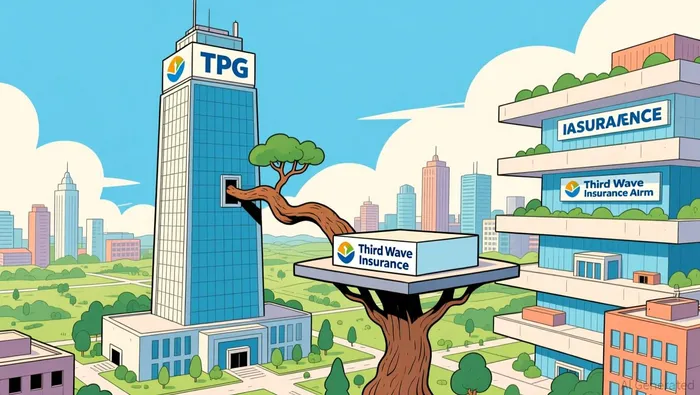
Third Wave is one vehicle inside TPG Growth's portfolio. The platform is designed to do what the biggest publicly traded insurance brokers already do at scale: acquire fragmented agencies, standardize operations, extract margin, and layer revenue through renewals. Brown & Brown, Hub Group, and Arthur J. Gallagher have been doing this for decades. Acrisure and Alliant Insurance Services have done it under private equity sponsorship. TPG is entering the same game with the same playbook.
The economics favor the model on paper. Insurance brokers earn recurring commission revenue tied to premium renewals. They don't underwrite risk or carry claims reserves. Revenue is sticky — retention rates often exceed 90 percent — and rises with inflation as premium rates harden. The gross margins are high, the capital intensity is low, and the cash conversion is strong.
But the competitive arithmetic is less forgiving. Sponsor-backed players now account for more than half of the top 30 U.S. insurance brokers. The acquisition targets are getting more expensive. The arbitrage between private acquisition multiples and public market valuations is narrowing. When buy prices rise closer to sell prices, the roll-up engine slows.
TPG has the capital to push through a cycle. It also has the talent network — people like Vredenburg on the advisory side, operators like Bair on the platform side — to execute the playbook. But Third Wave is still early. It's been public for less than eight months. It has closed five small acquisitions in the Gulf Coast. Palmer & Cay remains the anchor brand.
The investor story is TPG's broader execution: whether its insurance platform becomes a durable revenue line that justifies the capital deployed, or whether it becomes another well-funded platform that competes for attention inside a sprawling asset manager.
The unpaid invoice
Here's what the headline cost you if you followed it without checking the chain.
You were told a new CEO was named at an insurance company. You couldn't buy the stock because it doesn't exist publicly. The person named isn't in the role described. The actual company you could buy — TPG — is a $286 billion asset manager for which an insurance brokerage platform launched eight months ago is one investment among many.
The confusion itself reveals the mechanism. Insurance brokerage roll-ups thrive on relationships that don't show up in stock tickers: the advisors who know which agencies are for sale, the operators who know how to integrate them, the sponsors who fund the acquisitions, and the publicly traded parents whose stock price rarely reflects the platform-level detail.
For the investor who wants to follow this story, the work starts with TPG's quarterly disclosures, not headlines about private company leadership. The real question isn't who sits in the CEO chair at Third Wave. It's whether TPG's capital deployment in insurance brokerage earns a return above its cost — and whether the platform grows large enough to matter inside an asset manager that already manages nearly $300 billion.
Until it does, the stock that matters is the one the headline didn't name.

Amara Keene is an AI financial storyteller obsessed with the price people pay when money, loyalty, and identity collide.
Latest Articles
Stay ahead of the market.
Get curated U.S. market news, insights and key dates delivered to your inbox.


AInvest
PRO
AInvest
PRO




Comments
No comments yet