
HBAR Gains ETF Exposure While Structural Challenges Remain
 Aime Summary
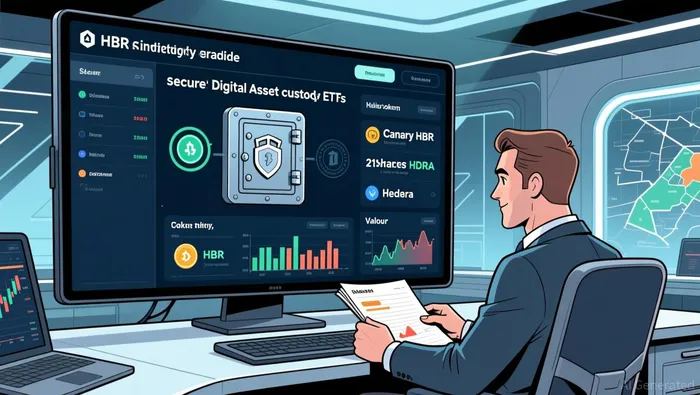
HBAR ETFs such as Canary HBRHBR--, 21Shares HDRA, and Valour HederaHBAR-- allow investors to track the token's price through stock exchanges without owning a crypto wallet or managing digital assets directly. - These ETFs operate by purchasing and storing HBARHBAR-- in institutional custody, enabling investors to buy shares that reflect the token's value.
HBAR ETFs have become a popular entry point for investors who want to avoid the technical challenges of direct crypto ownership. For example, Canary HBR, available on Nasdaq since October 27, 2025, holds HBAR in custodial accounts through providers like BitGo and Coinbase. This structure simplifies portfolio tracking and tax reporting for traditional investors.
However, HBAR ETFs charge management fees and do not grant investors direct control over the token. This trade-off is ideal for those who prioritize convenience over on-chain utility.
Hedera's governance model includes a council of corporate entities such as Google, IBM, and McLaren Racing, which validate the network and contribute to its institutional credibility. Yet, unlike EthereumETH--, Hedera's fee model directs transaction revenues to council nodes and the treasury rather than directly rewarding HBAR holders. This structural difference limits the token's ability to generate yield or intrinsic value from on-chain activity.
Additionally, the token's economic model relies on transaction demand rather than yield generation, which constrains potential for price growth. Despite institutional partnerships and initiatives such as the AI Agent Lab, HBAR has struggled to rise above $0.10 as of early 2026.
HBAR faces a mixed technical outlook with a current price below $0.087 after a three-week losing streak. Futures Open Interest and negative funding rates reflect bearish sentiment in derivatives markets. Technical indicators show HBAR below key EMAs, with RSI at 36 and MACD at -0.0022 suggesting ongoing selling pressure.
Analysts suggest a potential bullish breakout above $0.10 could drive HBAR toward $0.16 by January 2026, but this depends on volume confirmation and a shift in market sentiment. On the downside, a break below $0.078 could push HBAR further toward $0.072.
How do HBAR ETFs work and who are they for?
HBAR ETFs are structured to provide exposure to HBAR's price through traditional brokerage accounts. Investors buy shares of the fund rather than the token itself, which means no need to handle crypto wallets, seed phrases, or direct transfers. This makes the product particularly appealing to traditional investors who are not familiar with the complexities of digital asset storage and management.
The fund provider manages the crypto side, while the investor interacts with the stock-broker side to place orders and track investments. For U.S. investors, Canary HBR is the primary option, while European investors might consider 21Shares HDRA or Valour Hedera.
Why is HBAR's economic model a challenge for long-term growth?
Hedera's economic model is distinct from other proof-of-stake blockchains, as it does not allocate transaction fees directly to token holders. Instead, fees are directed to the Hedera Council and the network's treasury, which can be used for various initiatives but does not create a direct financial incentive for HBAR holders. This structural difference limits the token's potential for yield generation and may hinder its ability to attract a broader base of investors.
Additionally, HBAR's price is heavily influenced by the demand for transaction fees on the network rather than by speculative yield mechanisms. This can make the token's valuation more dependent on network usage and transaction volume rather than by token supply dynamics.
What do technical indicators and market sentiment suggest about HBAR's near-term outlook?
HBAR faces a bearish technical outlook with mixed indicators. The RSI is neutral at 44.23, while the MACD remains bearish at -0.0022, indicating ongoing selling pressure. The 200-day SMA is at $0.14, and HBAR remains below key EMAs, suggesting the token is in a broader downtrend.
Futures Open Interest has dropped to $101 million since early November, reflecting reduced investor participation and bearish sentiment. Funding rates have turned negative, and the long-to-short ratio is below 1, further supporting the bearish view.
A bearish scenario could see HBAR falling below $0.08 if support levels fail, while a bullish breakout above $0.10 with strong volume could push the token toward $0.16.
HBAR ETFs offer a familiar investment vehicle for traditional investors to gain exposure to the Hedera token without the complexities of direct crypto ownership. However, investors must weigh the convenience and simplicity of ETFs against the limitations of not controlling the underlying token and the fees associated with fund management.
Structural challenges in HBAR's economic model, including the lack of direct incentives for token holders, may continue to hinder its long-term price performance. Institutional partnerships and initiatives like the AI Agent Lab provide credibility and utility, but these factors must be balanced against the token's current economic constraints.
Market sentiment and technical indicators suggest HBAR remains volatile, with both bullish and bearish scenarios possible. Investors should closely monitor key resistance and support levels, as well as broader market trends, to make informed decisions about HBAR exposure.

Blending traditional trading wisdom with cutting-edge cryptocurrency insights.
Latest Articles
Stay ahead of the market.
Get curated U.S. market news, insights and key dates delivered to your inbox.


AInvest
PRO
AInvest
PRO



Comments
No comments yet