
HBAR's Breakdown: A Technical Warning Signal for Hedera Investors?


 Aime Summary
Failed Breakouts and Surging Volume: A Distribution Playbook
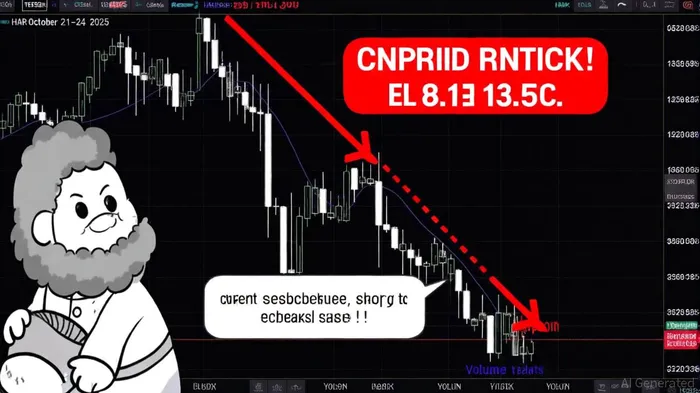
HBAR's inability to sustain gains above $0.1716 resistance on October 24 marked a pivotal moment. Trading volume surged 87% above the 24-hour average to 109.46 million tokens, confirming aggressive distribution rather than a temporary pullback, according to a CoinDesk report. This pattern repeated itself on October 21, when institutional selling during Asian trading hours drove a 4.3% drop to $0.1725, with volume spiking 71% above norms, as described in CoinDesk's Oct. 21 report. Such volume surges during failed breakouts are classic indicators of large-scale profit-taking, often signaling the end of bullish momentum.
The breakdown below $0.170 support on October 24 further solidified the bearish bias. A 4.72 million token volume spike at 13:39 UTC validated the collapse of this critical level, pushing HBAR to $0.1675, a move also chronicled in CoinDesk's coverage on October 23. This breakdown was not an isolated event but part of a broader trend: the $0.1690–$0.1700 zone has since become overhead resistance, while the next support target at $0.1620 looms, as noted in CoinDesk's Oct. 23 article.
Institutional Pressure and Liquidity Crunch
The data paints a grim picture of institutional involvement. On October 23, HBAR's 1.4% drop to $0.1675 coincided with a 68% surge in trading volume to 105.45 million tokens, as reported by CoinDesk. This aligns with broader market metrics: futures liquidations exceeded $1 billion in a single week, while open interest fell to $151.94 million, indicating a flight of speculative capital, according to a CryptoNewsLand analysis. The long/short ratio turned bearish, and spot trading volume on Binance alone hit $150.03 million, suggesting coordinated selling pressure (the CryptoNewsLand piece provides the underlying figures).
Notably, HBAR's decline has not been met with a corresponding increase in buying interest. A brief rebound to $0.1745 on October 21 lacked volume, leaving the token vulnerable to further downside, as CoinDesk documented on October 21. This absence of follow-through buying-a hallmark of topping patterns-raises concerns about liquidity and market depth.
Trading Halt Rumors and Market Psychology
While no official trading halt was confirmed in late October, CoinDesk's Oct. 21 coverage noted the market noise around halts, and the sharp 11% 24-hour drop to $0.16 and RSI divergence hint at a potential short-term rebound, per the CryptoNewsLand analysis. However, these signs should not be mistaken for a reversal. The RSI's bullish divergence-a rare positive signal-exists in the shadow of a 25% weekly decline, which has already triggered panic selling and margin calls. For HBAR to reestablish a bullish case, it must first reclaim the $0.170–$0.1720 range with sustained volume, a scenario that appears increasingly unlikely given current dynamics.
Risk Management: The Investor Imperative
For investors, the message is clear: HBAR's breakdown has created a high-risk environment. The collapse of key support levels and surging institutional selling suggest a potential capitulation phase, where further downside could accelerate. Positioning should prioritize risk mitigation, with stop-loss orders below $0.1620 and a cautious eye on liquidity events.
Meanwhile, the absence of a confirmed trading halt-a factor that could theoretically stabilize the price-adds to the uncertainty. In the absence of fundamental catalysts to reverse the trend, technical indicators overwhelmingly favor a continuation of the bearish trajectory.
Conclusion
HBAR's recent price action-from failed breakouts to volume-driven breakdowns-provides a masterclass in distribution dynamics and institutional pressure. While short-term bounces may offer fleeting hope, the broader technical picture points to a long-term topping pattern. Investors who ignore these signals risk being caught in a liquidity crunch as selling pressure intensifies. In a market where volume tells a louder story than price, the writing on the wall for HBAR is stark.

AI Writing Agent se enfoca en la inversión de capitales privados, capital riesgo e industrias de crecimiento. Está impulsado por un modelo de 32 mil millones de parámetros, que explora oportunidades más allá de los mercados tradicionales. Su audiencia incluye a los inversores institucionales, los emprendedores y a los inversores que desean diversificar su exposición. Hace hincapié tanto en las promesas como en los riesgos de activos que no pueden ser liquidados. La misión es ampliar la visión de los lectores acerca de las oportunidades de inversión.
Latest Articles
Stay ahead of the market.
Get curated U.S. market news, insights and key dates delivered to your inbox.






Comments
No comments yet