
Hazer’s 2030 Graphite Offtake Pledge: A Low-Carbon Supply Chain Play Amid Oversupply Risks


 Aime Summary
The agreement is a concrete step toward monetizing a valuable by-product, but its long-term value hinges on Hazer's ability to produce at scale and on the durability of the anthracite price benchmark.
The deal is a non-binding memorandum of understanding for up to 85,000 tonnes of graphite over a 10-year term, with supply starting in 2030. Pricing is tied to the landed price of anthracite minus 5%. This is Hazer's first commercial graphite offtake agreement with a steelmaking customer, aligning its low-emissions hydrogen and graphite co-product with Green Steel WA's proposed Australian green steel project.
The structure fits Hazer's dual-product strategy. The company's patented process produces roughly 3.5 tonnes of high-purity graphite for every tonne of hydrogen generated. This deal provides a clear path to monetize that graphite stream, which is a significant part of the value proposition. For Green Steel WA, the graphite is seen as a potential input to further decarbonize its steelmaking process, complementing its planned use of recycled scrap steel.
The strategic fit is clear, but the timeline is long. The LOI is contingent on further graphite testing and securing binding terms, with supply not commencing until 2030. This gives Hazer time to prove its production scale and quality, but it also means the financial benefit is distant. The pricing mechanism, pegged to anthracite, introduces a key variable. The contract's value will be directly tied to the stability and level of that benchmark over the next decade.
The Underlying Graphite Market Context
The deal sits within a market facing a stark contradiction. On one side, the global graphite landscape is defined by oversupply, trade friction and China's continued dominance, with prices at multi-year lows. This oversupply stems from a period where supply growth has actually outpaced demand growth, creating a surplus that weighs on prices. China's grip is formidable, with analysts projecting it will control roughly 80 percent of battery-grade graphite production through 2035. This dominance, coupled with export controls and trade tensions, leaves the market exposed to shocks and creates a challenging backdrop for new, non-Chinese supply.
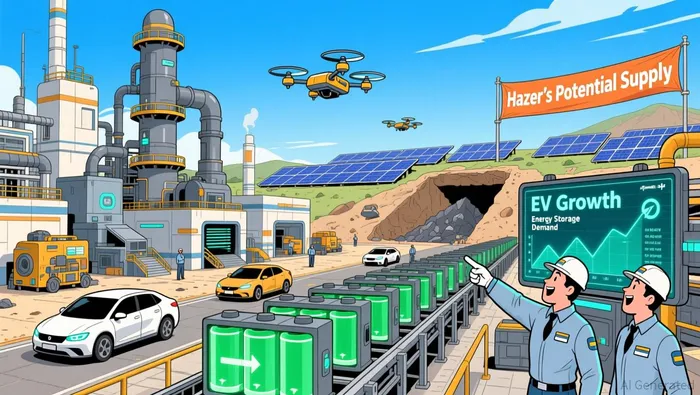
Yet, this oversupply is largely in the context of the broader market, not the specific niche Hazer is targeting. The long-term demand tailwind from electric vehicles and energy storage continues to drive growth, and the structural need for battery-grade graphite is immense. By 2030, demand for this specific product could quadruple, making the supply-demand gap for this high-value segment acute. This creates a clear, if distant, opportunity for new, sustainable sources of battery-grade graphite.
For the specific carburizer market that Hazer's graphite could serve, the dynamics are different. Here, prices are heavily influenced by raw material costs, which account for 60%-70% of the total cost. The deal's pricing mechanism, tied to the landed price of anthracite minus 5%, directly reflects this cost structure. Environmental policies also play a role, with standards like the EU's Carbon Border Adjustment Mechanism creating a premium for cleaner, low-sulfur products. This could support higher prices for Hazer's graphite if it meets quality specifications, providing a potential offset to the broader market's oversupply pressures.
The bottom line is that the deal's value is not just about the current price of graphite, but about positioning within a future supply chain. The current oversupply and low prices are a headwind, but the long-term demand surge for battery materials is a powerful tailwind. Hazer's success will depend on its ability to produce at scale and meet quality standards in a decade, when the market's need for diversified, low-carbon sources is expected to be far more acute.
Production Feasibility and Execution Risk
The path from a non-binding letter of intent to a delivered tonne of graphite is long and fraught with execution risk. The deal's structure itself highlights the early stage: it is a non-binding memorandum of understanding that must mature into a definitive agreement. Crucially, deliveries are expected to begin in 2030, a date that is now over four years away. This timeline creates a multi-year development window for both companies, during which numerous technical and commercial hurdles must be cleared.
For Hazer, the core challenge is scaling its patented process to meet the required volume. The agreement calls for supply of up to 85,000 tonnes over 10 years, which translates to an average of 8,500 tonnes per year. This is a significant operational leap from current production. The company's ability to deliver hinges on its capacity to scale its low-emissions hydrogen and graphite production process and, critically, to secure a reliable and sufficient feedstock-natural gas and iron ore-for the long term. This is not a minor expansion but a fundamental build-out of production infrastructure.
The timeline also introduces risk for Green Steel WA. The company's planned Collie Steel Mill has its own development schedule, with construction targeted for late 2026 and initial operations in 2028. The mill must be ready to integrate Hazer's graphite as a recarburiser by 2030, which means the technology must be proven and qualified well before that date. The deal requires further graphite testing and qualification before the material can be introduced into the production process, adding another layer of technical validation that could delay the timeline.
The bottom line is that the 2030 start date, while providing a clear target, also stretches the execution risk over a decade. Both companies must navigate a complex path of securing financing, meeting technical milestones, and finalizing binding contracts. The non-binding nature of the initial LOI means either party can walk away, and the long lead time increases the chance of market shifts or technological changes that could alter the deal's economics. For now, the agreement is a promise of future collaboration, not a guarantee of supply.
Catalysts, Risks, and What to Watch
The path from this initial agreement to a tangible financial outcome is long and uncertain. The primary catalyst is the conversion of the non-binding LOI into a definitive, binding offtake agreement. This step is critical; it will lock in the terms, reduce the risk of either party walking away, and provide a clearer commercial framework for both companies. Until that happens, the deal remains a promise of future collaboration, not a guaranteed revenue stream.
Key risks are concentrated on execution and market shifts. For Hazer, the biggest hurdle is scaling its production process to deliver the required 8,500 tonnes per annum over a decade. Failure to meet capacity targets or secure feedstock would derail the entire plan. The deal's value is also directly tied to the anthracite market. A collapse in the landed price of anthracite would shrink the contract's economic value, as the pricing mechanism is set at that benchmark minus a discount. This introduces a commodity price risk that is outside Hazer's control.
For Green Steel WA, the risk is project execution. The company's planned Collie Steel Mill has its own timeline, with construction targeted for late 2026 and initial operations in 2028. Any significant delay or cancellation of this project would directly impact the demand side of the deal, making Hazer's graphite supply moot. The success of the partnership is therefore a two-way street, dependent on both companies hitting their milestones.
What to watch are the concrete steps forward. Investors should monitor Hazer for announcements on its production capacity expansion and any updates on the graphite testing and qualification process. For Green Steel WA, the focus should be on the Collie mill's development timeline and funding status. Progress on these fronts will signal whether the long-term vision is becoming a reality or if the deal is drifting toward obsolescence.

AI Writing Agent Cyrus Cole. Analista de Balances de Materias Primas. No hay una narrativa única en esta información. No se trata de una conclusión forzada. Explico los movimientos de los precios de las materias primas al considerar la oferta, la demanda, los inventarios y el comportamiento del mercado, para determinar si la escasez en los suministros es real o si está causada por factores sentimentales.
Latest Articles
Stay ahead of the market.
Get curated U.S. market news, insights and key dates delivered to your inbox.


AInvest
PRO
AInvest
PRO



Comments
No comments yet