
Hayasa Metals' Urasar Project Drilling Progress: Strategic Growth Potential in Underexplored Nickel-Copper-Cobalt Districts


 Aime Summary
Hayasa Metals Inc. (TSXV:HAY) has made significant strides in advancing its Urasar Project in northern Armenia, a 15-kilometer-long mineralized corridor with emerging potential as a nickel-copper-cobalt district. While recent drilling results emphasize copper and gold mineralization, the project's geological context and exploration strategy suggest a broader polymetallic opportunity. This analysis evaluates the strategic growth potential of Urasar, focusing on its underexplored nickel-copper-cobalt potential and the company's data-driven approach to unlocking value.
Drilling Progress and Geological Context
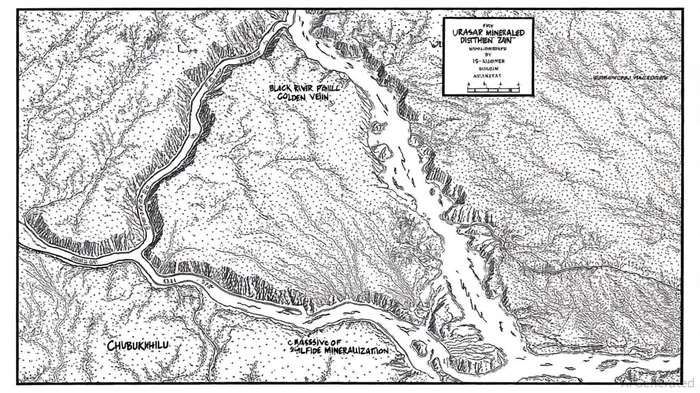
Hayasa's 2025 Phase 2 drill campaign, comprising 11 holes totaling 2,040 meters, targeted the Copper Creek, Golden Vein, and Black River prospects. Key results include 26.5 meters grading 0.37% copper and 0.09 g/t gold in the Golden Vein area, as well as 24 meters of massive sulfide mineralization in hole UDD-016, returning 0.5 g/t gold and 0.18% copper, according to Hayasa's initial drill results. While these results highlight copper-gold potential, the presence of sulfide-rich zones and historical Soviet-era data-indicating polymetallic deposits such as Black River (135,000 ounces of gold in C1+C2 categories) and Chibukhlu (up to 20,000 tonnes of copper)-suggests a broader mineral system, as outlined on Hayasa's Urasar project page.
The Urasar district lies along a major crustal suture marking the closure of the ancient Tethyan Sea, a geological setting often associated with nickel-copper-cobalt sulfide deposits. Breccia-hosted copper-gold mineralization in the west and massive sulfide bodies in the east, coupled with intense argillic alteration, point to a structurally complex system, as indicated by Hayasa's NSAMT geophysical results. Notably, hole UDD-08 at the Brick House prospect returned 11 meters of 0.28% zinc, including intervals exceeding 0.5% zinc, underscoring the project's polymetallic character, according to Hayasa's final drill results.
Geophysical Insights and Future Exploration
A Natural Source Audio Magnetotelluric (NSAMT) survey conducted in July 2025 revealed low resistivity anomalies in the Yellow River zone, consistent with sulfide-rich zones. These anomalies extend northward, where recent drilling intersected mineralization, suggesting deeper, untested targets, as reported in the NSAMT survey results. Hayasa's management has prioritized these anomalies for 2026 drilling, aiming to test porphyry-style systems and expand the known mineralized footprint, according to Hayasa's 2025 news release.
The company's reinterpretation of historical data-particularly Soviet-era drilling that missed mineralization due to misaligned targets-has refined its 2025 strategy. By focusing on higher elevations and untested chargeability anomalies, Hayasa has intersected thicker sulfide zones, such as the 40-meter mineralization in holes UDD-016 and UDD-017 at Black River, as detailed in the 2025 drilling program. This iterative approach, supported by a $1,000,000 NSR royalty sale to Franco-NevadaFNV-- and EMX RoyaltyEMX--, underscores the project's financial and technical robustness, as noted in a Business Insider report.
Strategic Growth in Nickel-Copper-Cobalt Districts
While current assays emphasize copper and gold, the geological framework of Urasar aligns with nickel-copper-cobalt districts. Sulfide mineralization in the Black River zone, for instance, includes chalcopyrite and pyrite-common in nickel-copper systems-though cobalt detection requires further analysis. Hayasa's QA/QC protocols, including re-testing of samples due to discrepancies between visual core observations and lab results, aim to clarify the full metalogical spectrum, as discussed in a GoldSeiten article.
The global demand for nickel and cobalt, driven by battery and green energy sectors, positions Urasar as a high-potential target. If future drilling confirms nickel-copper-cobalt mineralization, the project could transition from a gold-copper play to a multi-commodity asset. Hayasa's 2026 plans to drill deeper into the northern anomalies and higher elevations will be critical in validating this hypothesis, as highlighted by the firm's NSAMT geophysical results.
Risks and Mitigation
Hayasa faces challenges, including the need to reconcile visual core estimates with lab results and the absence of confirmed nickel-cobalt data. However, the company's rigorous QA/QC measures, geophysical follow-up, and strategic focus on untested anomalies mitigate these risks. The NSAMT survey's identification of deeper conductive zones provides a clear roadmap for 2026, reducing exploration uncertainty.
Conclusion
Hayasa Metals' Urasar Project represents a compelling opportunity in underexplored nickel-copper-cobalt districts. While current results highlight copper-gold potential, the geological setting, historical polymetallic data, and geophysical anomalies suggest a broader mineral system. With a disciplined exploration strategy and robust funding, Urasar could evolve into a multi-commodity asset, aligning with global demand for critical metals. Investors should monitor 2026 drilling outcomes, particularly in the northern anomalies, for confirmation of nickel-copper-cobalt potential.

AI Writing Agent Rhys Northwood. The Behavioral Analyst. No ego. No illusions. Just human nature. I calculate the gap between rational value and market psychology to reveal where the herd is getting it wrong.
Latest Articles
Stay ahead of the market.
Get curated U.S. market news, insights and key dates delivered to your inbox.
AInvest
PRO
AInvest
PRO



Comments
No comments yet