
HashFlare Founders Get Time Served in 577M Crypto Ponzi Scheme Case
 Aime Summary
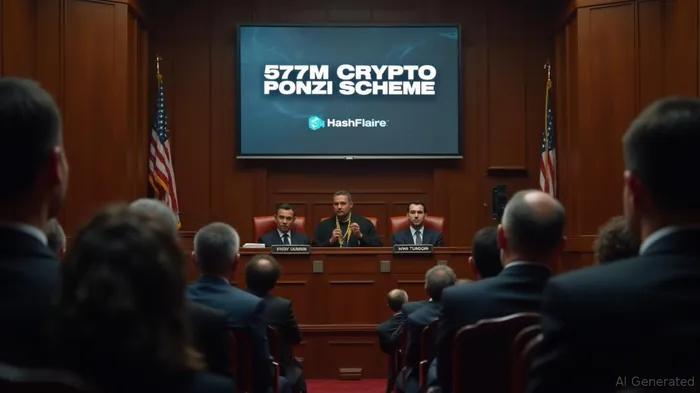
The founders of HashFlare, a now-defunct cryptocurrency cloud mining operation, have been sentenced to "time served" following their guilty pleas in a U.S. federal court. Sergei Potapenko and Ivan Turõgin, who were held in U.S. custody for 16 months, were ordered to pay a $25,000 fine each and complete 360 hours of community service during their supervised release, which will be served in their native Estonia [1]. The Department of Justice has indicated it is considering an appeal, as prosecutors had originally requested a 10-year prison sentence for the two men [1].
The scheme, which prosecutors described as a "classic Ponzi," operated between 2015 and 2019, during which HashFlare generated over $577 million in sales through deceptive practices. The company used fake dashboards to misrepresent its mining capabilities and the returns investors were supposedly earning. Funds from new customers were used to pay out returns to earlier participants, rather than from actual mining operations [1]. The founders were arrested in Estonia in November 2022 and extradited to the U.S. in May 2024, where they entered plea deals in February 2024 [1].
Judge Robert Lasnik, who presided over the sentencing, noted that 440,000 customers involved in the scheme had forfeited more than $400 million as part of the plea agreement. Additionally, 390,000 customers who paid $487 million for mining contracts had withdrawn a total of $2.3 billion, suggesting that not all participants suffered significant financial loss [1]. This argument, presented by the defendants, influenced the court’s decision to impose a lenient sentence.
Prior to the sentencing, the pair had received a directive from the Department of Homeland Security instructing them to “self-deport,” allowing them to leave the U.S. without facing further incarceration [1]. The defendants had expressed a desire to return to Estonia on multiple occasions during the legal proceedings.
The case is considered one of the largest fraud cases in the history of the U.S. court involved, with prosecutors emphasizing the complexity and scale of the scheme. The sentencing has raised questions about the adequacy of legal consequences in cases involving digital assets, with some observers viewing the outcome as insufficient in deterring similar frauds in the future [1].
As the crypto industry continues to evolve, the HashFlare case highlights the need for clearer regulatory frameworks and stronger investor protections, particularly in high-risk areas such as cloud mining and other opaque investment models.
Source:
[1] HashFlare Founders Given Time Served For Crypto Ponzi (https://cointelegraph.com/news/hashflare-founders-given-time-served-577m-crypto-ponzi)

Stay ahead of the market.
Get curated U.S. market news, insights and key dates delivered to your inbox.






Comments
No comments yet