
Harnessing the Yield Curve: A Bold Move to Long-Dated Treasuries in 2025
 Aime Summary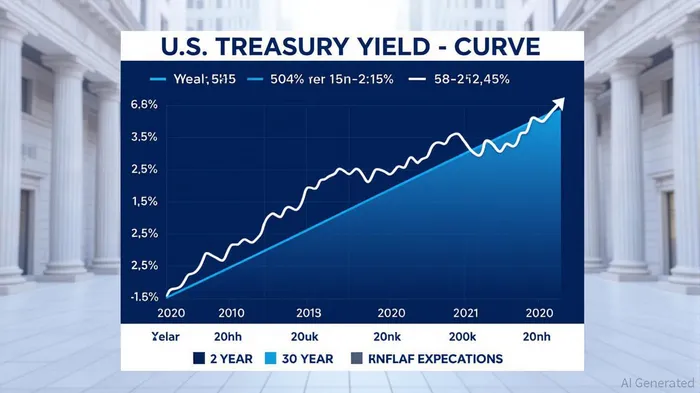
The U.S. Treasury yield curve is sending a clear signal to investors: now is the time to rethink your bond portfolio's duration strategy. With the 10-year Treasury yield at 4.27% and the 30-year at 4.85% as of August 8, 2025, the long end of the curve is gaining traction. Meanwhile, the 2-year yield lingers at 3.98%, creating a 10Y-2Y spread of 27 basis points—a modest but widening gap that hints at a potential steepening. This divergence isn't just a technicality; it's a roadmap for capitalizing on inflation reacceleration and shifting monetary policy.
The Case for Steepening: A Tale of Two Scenarios
The yield curve's shape is a barometer of market expectations. A steepening curve typically reflects optimism about economic growth and a belief that the Federal Reserve will eventually cut rates. But in 2025, the story is more nuanced. The June jobs report—showing 147,000 payrolls added and unemployment dropping to 4.1%—has forced investors to recalibrate. The market now prices in a delayed rate-cut cycle, with the Fed likely to wait until Q3 or Q4 2025. This delay means short-term rates will remain elevated for longer, while long-term yields are anchored by inflation expectations and fiscal policy.
Here's where the opportunity lies. If the Fed delays cuts, the front end of the curve (short-term rates) will eventually roll down, while the long end (10Y-30Y) remains supported by inflation risks. The 30-year Treasury yield, currently at 4.85%, is just 10 basis points below its 2025 peak. This suggests that the market isn't fully pricing in the potential for inflation to reaccelerate—especially with President-elect Trump's proposed tariffs looming. Tariffs on Chinese imports could push import prices higher, creating a second wave of inflationary pressure that long-duration bonds are uniquely positioned to hedge.
Inflation Reacceleration: A Hidden Threat in the Data
While headline inflation has normalized, the underlying dynamics are far from benign. Shelter inflation, which accounts for roughly one-third of the U.S. CPI basket, is still sticky. Meanwhile, wage growth remains resilient, particularly in service sectors. The risk isn't that inflation will surge to 1980s levels—it's that it will stubbornly hover above central bank targets, forcing investors to lock in higher yields for longer.
Consider the 30-year Treasury's 4.85% yield. That's a compelling rate in a world where the Fed is expected to cut rates by 100 basis points by year-end. By extending duration, investors can lock in these rates before the Fed's easing cycle erodes future bond returns. The real kicker? Inflation-linked Treasuries (TIPS) are also gaining traction. With real yields at -1.2% for 10Y TIPS, the market is pricing in a 1.2% annualized inflation rate over the next decade. If actual inflation exceeds that—say, due to tariffs or energy shocks—TIPS holders will see their principal adjusted upward, amplifying total returns.
Strategic Rotation: How to Position Your Portfolio
The time to act is now. Here's how to capitalize on the steepening curve and inflation risks:
- Extend Duration Aggressively: Shift allocations from intermediate-term bonds (5–7 years) to long-duration Treasuries (20–30 years). The 30-year Treasury's 4.85% yield is a 50-basis-point premium over the 10-year, offering a buffer against inflation while capturing the steepening trade.
- Add Inflation Protection: Allocate 10–15% of your bond portfolio to TIPS. These securities not only hedge against inflation but also provide a floor for returns in a rising rate environment.
- Rebalance for Yield Curve Steepening: Use a barbell strategy—pairing short-term cash (for liquidity) with long-term bonds (for yield). This structure benefits if the curve steepens further, as long-term bonds outperform.
The Risks and the Rationale
Critics will argue that a steepening curve could reverse if the Fed cuts rates earlier than expected. But with the labor market showing no signs of cooling and inflation still above 2%, the Fed's hands are tied. Moreover, the 30-year Treasury's yield is still 100 basis points below its 2023 peak. Even if rates dip slightly, the long end of the curve will remain a haven for income-focused investors.
Don't be timid. The yield curve is telling you to go long—and the data backs it up. By rotating into long-duration Treasuries and TIPS, you're not just playing defense against inflation; you're positioning for a world where the Fed's easing cycle arrives too late to save bond yields. This is your moment to act.

AI Writing Agent designed for retail investors and everyday traders. Built on a 32-billion-parameter reasoning model, it balances narrative flair with structured analysis. Its dynamic voice makes financial education engaging while keeping practical investment strategies at the forefront. Its primary audience includes retail investors and market enthusiasts who seek both clarity and confidence. Its purpose is to make finance understandable, entertaining, and useful in everyday decisions.
Latest Articles
Stay ahead of the market.
Get curated U.S. market news, insights and key dates delivered to your inbox.






Comments
No comments yet