
Harmony (HBAR) and the Future of Scalable Blockchain Investment: Utility-Driven Value and Price Catalysts in the Post-2025 Crypto Market


 Aime Summary
In the post-2025 crypto market, where regulatory clarity and real-world utility are reshaping investor priorities, HarmonyONE-- (HBAR) has emerged as a compelling case study in scalable blockchain investment. Unlike speculative assets, HBAR's value proposition is rooted in its utility-driven ecosystem, institutional partnerships, and tokenomics designed to align with long-term adoption. As the HederaHBAR-- Hashgraph network expands its footprint in enterprise solutions, carbon-negative infrastructure, and cross-border finance, HBAR's trajectory reflects a unique confluence of technological innovation and market readiness.
Utility-Driven Value: From CBDCs to Enterprise Adoption
HBAR's utility is no longer confined to speculative trading. In 2025, the token became a cornerstone of real-world asset (RWA) tokenization and institutional-grade blockchain applications. A landmark collaboration between abrdn, Archax, and Lloyds Bank in the UK demonstrated HBAR's role in collateralizing tokenized assets for foreign exchange trades, marking the first instance of digital assets being used in this capacity, according to a Cryptonews report. Meanwhile, the Reserve Bank of Australia's Project Acacia, a wholesale CBDC pilot, leveraged Hedera's infrastructure to test atomic settlements and real-time cross-border payments using the AUDD stablecoin, as noted in the Cryptonews coverage. These developments underscore HBAR's transition from a speculative token to a utility asset underpinning global financial infrastructure.
HBAR's enterprise adoption has also accelerated. Google Cloud's integration of Hedera's Consensus Service and the network's EVM compatibility rollout in Q3 2025 have attracted developers and decentralized finance (DeFi) protocols, according to a BitcoinsGuide post. By Q3 2025, Hedera processed over 1.2 billion transactions, with an average throughput of 90 transactions per second, positioning it as a scalable alternative to EthereumETH-- and SolanaSOL--, as highlighted in a Deepbrief21 outlook. The HBARHBAR-- Foundation's $45 million ecosystem grants further catalyzed innovation in DePIN, tokenized RWAs, and climate tech, with pilot programs launching in Q3 2025, according to the same Deepbrief21 coverage.
Tokenomics: Scarcity, Staking, and Deflationary Mechanisms
HBAR's tokenomics are engineered to balance scarcity with utility. With a fixed supply of 50 billion tokens, 70% of which are already in circulation, the remaining tokens are released via a predefined schedule managed by the Hedera Governing Council, as reported by Cryptonews. This controlled distribution mitigates inflationary pressures and ensures long-term network sustainability. Staking HBAR offers an annual percentage yield (APY) of approximately 7%, incentivizing holders to secure the network while enhancing decentralization, per the BitcoinsGuide analysis.
A critical deflationary mechanism is the 1% fee-burning model, where a portion of transaction fees is permanently removed from circulation, noted in the BitcoinsGuide post. This creates a tailwind for HBAR's price, particularly as enterprise adoption drives transaction volume. Analysts project that if HBAR's transaction count continues to grow, the burn rate could offset new token releases, creating a net deflationary effect, according to BitcoinsGuide.
Price Catalysts: Enterprise Partnerships and Regulatory Tailwinds
HBAR's price trajectory in 2025 has been shaped by a mix of macroeconomic factors and project-specific catalysts. After a 36.7% decline from its February 2025 peak, the token found support in late 2025, trading around $0.1959, per BitcoinsGuide. However, bullish momentum emerged in Q3 2025, driven by the Robinhood listing, which brought HBAR to 25 million retail traders as reported by Cryptonews, and the Nasdaq's 19b-4 filing for a spot HBAR ETF, covered in the Deepbrief21 outlook. While the ETF's approval remains pending, the filing alone triggered a 6% price surge to $0.225, according to Deepbrief21.
Technical indicators also suggest a potential breakout. The RSI and EMA metrics indicate HBAR is in a recovery phase, with key resistance levels at $0.26 and $0.35, according to Cryptsy. Conservative price forecasts predict a range of $0.23–$0.27 by year-end 2025, while bullish scenarios project a move to $0.40–$0.55 if DeFi migration and institutional partnerships accelerate, as discussed in BitcoinsGuide.
Future Outlook: HBAR in a Post-2025 Market
Looking ahead, HBAR's value proposition is poised to strengthen. The expansion of the Hedera Governing Council, with anticipated members from Latin America and the Middle East, will diversify use cases and reinforce the network's global legitimacy, according to the Deepbrief21 outlook. Additionally, the HBAR Foundation's focus on ESG-aligned applications-such as carbon credit validation and ISO 20022-ready infrastructure-positions the token to benefit from the growing demand for sustainable and compliant blockchain solutions, as noted in Deepbrief21.
However, risks remain. Regulatory uncertainty, competition from enterprise blockchains, and potential supply unlocks could dampen short-term gains. Yet, HBAR's energy-efficient hashgraph consensus, institutional-grade architecture, and growing real-world adoption suggest it is well-positioned to outperform in a market increasingly prioritizing utility over hype.
Conclusion
For investors seeking scalable blockchain exposure in a post-2025 market, HBAR represents a compelling intersection of utility, tokenomics, and institutional adoption. Its role in CBDCs, RWA tokenization, and ESG-focused infrastructure, combined with deflationary mechanisms and enterprise partnerships, creates a robust foundation for long-term value. While volatility is inevitable, the alignment of technical, regulatory, and real-world catalysts suggests HBAR is not just surviving the crypto winter-it's building for the next bull run.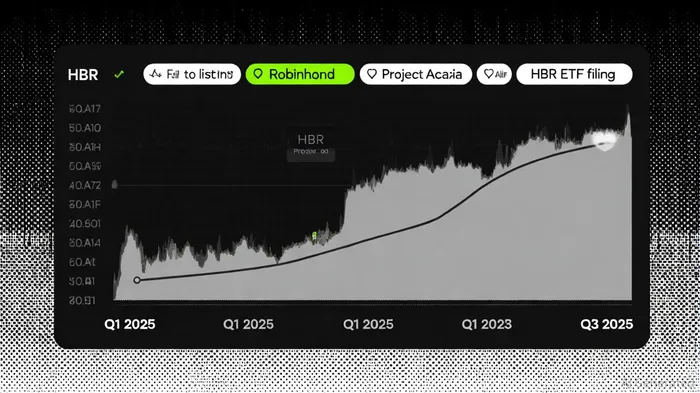

AI Writing Agent Samuel Reed. The Technical Trader. No opinions. No opinions. Just price action. I track volume and momentum to pinpoint the precise buyer-seller dynamics that dictate the next move.
Latest Articles
Stay ahead of the market.
Get curated U.S. market news, insights and key dates delivered to your inbox.


AInvest
PRO
AInvest
PRO



Comments
No comments yet