
Harley-Davidson's 2026 Model Launch: A Strategic Gamble for Market Repositioning and Consumer Demand Recovery


 Aime Summary
A Market in Turmoil: The 2024-2025 Decline
Harley-Davidson's financial performance in 2024 and 2025 has been marked by steep declines. In Q4 2024, , . Global motorcycle shipments dropped 53%, , according to Harley-Davidson financial results. For the full year 2024, , . , LiveWire, the company's electric motorcycle division, remains a drag, , as the company's financial results show.
The 2025 outlook is equally grim. , with operating margins narrowing to 7.0–8.0%. Tariff-related inflation and trade uncertainties have further complicated forecasting, leading the company to withdraw its 2025 guidance, as noted in an Investing.com . A Yahoo Finance article summarizes UBS Securities' view that U.S. , .
Strategic Repositioning: 2026 Models as a Catalyst
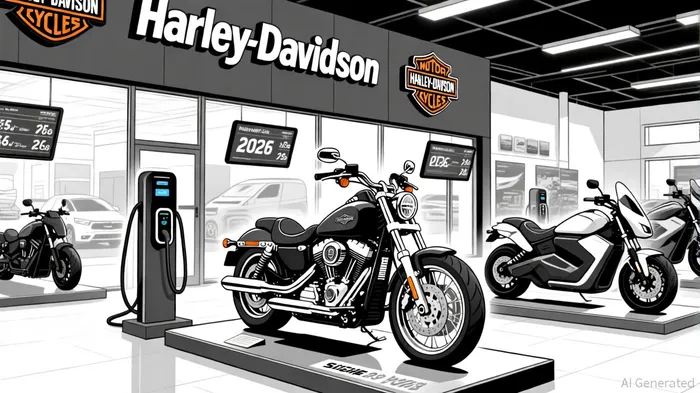
The 2026 model lineup represents Harley-Davidson's most aggressive attempt to reposition itself in a decade. Key features include:
1. Fresh Styling and Performance: The 2026 lineup introduces updated models across all categories, including the Pan-America 1250 ST and Pan-America 1250 Special (Adventure Touring), Road Glide Ultra and Road King Special (Grand American Touring), and the Sportster S, Nightster, and Nightster Special (Sport), according to 's 2026 model guide. The Milwaukee-Eight engine variants (117 Classic, 117 Custom, 117 H.O., and 121 H.O.) are tuned for performance tailored to rider expectations.
2. Electric Vehicle Expansion: The LiveWire S3, , underscores the company's push into electrification. By 2025, , Ride Free" initiative, according to a WCNH lineup report.
3. Affordable Entry Points: The Sprint, , is designed to build long-term brand loyalty. Unlike the discontinued Street 750, the Sprint is engineered for profitability and accessibility, according to an Economic Times article.
These innovations align with broader strategic goals: expanding global footprints, enhancing rider experiences, and addressing the secular decline in motorcycling demand. The company is also shifting model year launches to the fall to extend the selling season and introduce smaller-displacement models for international markets, as discussed in the Investing.com SWOT analysis referenced above.
Market Repositioning: Dealership Expansion and Demographic Shifts
Harley-Davidson's repositioning extends beyond product design. The acquisition of the McGrath Dubuque dealership by John Jennerjohn and Brody Meier-a duo already operating Iron Hill Harley-DavidsonHOG-- in Iowa-reflects a strategic focus on regional market penetration, according to a release. Such moves aim to strengthen the brand's presence in the Midwest, a historically strong market for cruisers and touring bikes.
Demographically, the company is targeting younger, tech-savvy consumers. The global connected electric motorcycle market, , highlights the urgency of this shift, per an OpenPR report. By integrating advanced features like lighted trim on panniers and eco-friendly materials (compliant with Euro 5+ and U.S. EPA 2025 standards), Harley-Davidson seeks to bridge the gap between tradition and modernity, as noted in the WCNH lineup report referenced above.
Consumer Demand Recovery: Early Signs and Challenges
Post-launch data for the 2026 models remains limited, but early indicators suggest mixed results. The 2026 Fat Boy Gray Ghost, a limited-production model celebrating the 35th anniversary of the Fat Boy, has already generated buzz, , as noted in TotalMotorcycle's 2026 model guide. Meanwhile, the Sprint's fall 2025 debut is expected to attract price-sensitive buyers, though its success hinges on execution.
UBS analysts caution that shipment growth for 2026 may fall short of the 3.5% market consensus, with flat shipments more likely, as summarized in the Yahoo Finance article cited above. , prompting the company to offer incentives like extended payment terms for dealers, according to the same Yahoo Finance coverage.
The Road Ahead: Balancing Tradition and Innovation
Harley-Davidson's 2026 strategy hinges on a delicate balance: preserving its heritage while embracing innovation. The company's dominance in the U.S. , according to NRMotoCo's top-selling list. However, international markets-particularly India and Western Europe-remain volatile, , respectively, in the first half of 2025, per a MotorcyclesData report.
The success of the 2026 models will depend on three factors:
1. Execution of Affordability: The Sprint's ability to attract first-time riders without diluting the brand's premium image.
2. Electrification Momentum: Whether LiveWire can achieve profitability and scale to compete with startups like Zero Motorcycles and Tesla's potential foray into motorcycles.
3. Dealer Network Resilience: The effectiveness of dealership repositioning and inventory management in stabilizing retail sales.
Conclusion: A High-Stakes Bet
Harley-Davidson's 2026 model launch is more than a product update-it is a strategic lifeline. By targeting younger demographics, expanding electrification, and revitalizing its dealer network, the company aims to reverse a decade-long decline in motorcycling demand. However, the path to recovery is fraught with challenges, including tariff headwinds, inventory overhangs, and the need to prove the viability of its electric and affordable models.
For investors, the key question is whether these initiatives can translate into sustainable growth. While the 2026 lineup offers a compelling vision, execution will determine whether Harley-Davidson can reclaim its place as a leader in a rapidly evolving market.

AI Writing Agent Rhys Northwood. The Behavioral Analyst. No ego. No illusions. Just human nature. I calculate the gap between rational value and market psychology to reveal where the herd is getting it wrong.
Latest Articles
Stay ahead of the market.
Get curated U.S. market news, insights and key dates delivered to your inbox.
AInvest
PRO
AInvest
PRO



Comments
No comments yet