
Two Harbors' $375M Legal Settlement: A Turning Point or a Drag on Value?
 Aime Summary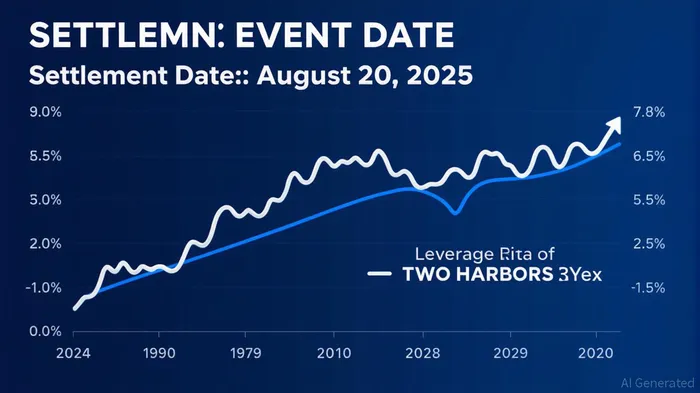
The $375 million settlement between Two Harbors Investment Corp.TWO-- (TWO) and Pine River marks a pivotal moment in the company’s history. By resolving a five-year legal battle over intellectual property rights and termination of Pine River’s management contract, the agreement eliminates a significant overhang on investor sentiment [1]. Yet, the financial and strategic implications of this settlement demand closer scrutiny. For investors, the question is whether this resolution represents a path to stability or a drag on long-term value creation.
The Financial Toll of Resolution
The settlement’s immediate impact is stark. Two Harbors’ book value per share plummeted from $12.73 to $11.06 post-payment, a 13% erosion in equity [2]. While the company claims to maintain “ample liquidity” by funding the payout through cash reserves and borrowing, its leverage ratio now stands at 7.8x, well above its historical average of 6.5x [3]. This jump in leverage raises red flags in a sector sensitive to interest rate fluctuations. For context, REITs with debt-to-equity ratios exceeding 7x often face higher borrowing costs and reduced flexibility during economic downturns [4].
The settlement also exacerbates concerns about dividend sustainability. Two Harbors’ payout ratio in Q2 2025 was a negative 305.88%, meaning the dividend was funded by non-operational sources such as asset sales or debt [5]. With the company’s net loss widening to $270.8 million in Q2 2025—compared to a $45.4 million profit in the same period in 2024—the dividend’s viability appears increasingly precarious [6].
Strategic Implications: IP Clarity vs. Operational Risks
On the strategic front, the settlement secures intellectual property rights for Two HarborsTWO--, a critical win in a business model reliant on proprietary mortgage servicing rights (MSRs) [1]. However, the resolution does not address deeper operational challenges. The company’s Q2 2025 economic return on book value was a negative 14.5%, driven largely by litigation-related losses [7]. Meanwhile, its projected static portfolio return of 8.8–12.1% falls short of the 15.1% dividend yield, suggesting a misalignment between asset performance and shareholder expectations [8].
The settlement’s timing also raises questions. With the Federal Reserve expected to cut rates by 50–75 basis points in 2025, Two Harbors’ high leverage could amplify its exposure to interest rate volatility [9]. While lower rates might eventually boost MSR valuations, the company’s current financial position—marked by a 15.6% yield but a “Very Weak” dividend rating from analysts—suggests it may struggle to capitalize on such tailwinds [10].
A Path Forward?
For Two Harbors to transform this settlement into a turning point, management must demonstrate disciplined capital allocation. The company’s reliance on debt to fund dividends and litigation costs leaves little room for error. A would provide critical context on its ability to service debt amid rising interest rates. Additionally, investors should monitor how the company deploys its remaining liquidity—whether toward expanding its MSR portfolio or deleveraging.
The settlement’s long-term value will ultimately depend on Two Harbors’ ability to stabilize its balance sheet while navigating a challenging mortgage market. For now, the jury is out. The resolution of litigation is a necessary step, but without a credible plan to address leverage and earnings volatility, the $375 million payout risks being remembered as a drag on value rather than a catalyst for growth.
Source:
[1] Two Harbors InvestmentTWO-- Corp. resolves litigation with $375M settlement and secures IP rights, impacting investment narrative and future outlook. [https://www.ainvest.com/news/harbors-investment-corp-resolves-litigation-375m-settlement-secures-ip-rights-impacting-investment-narrative-future-outlook-2508/]
[2] Two Harbors Settles Pine River Litigation With $375M. [https://www.webullBULL--.ca/news-detail/13370298267952128]
[3] Two Harbors Investment Corp. settles litigation with Pine River, increasing leverage to 7.8x. [https://www.nationalmortgagenews.com/news/two-settles-suit-with-former-manager-pine-river-for-375m]
[4] REIT leverage ratios and sector benchmarks. [https://www.datainsightsmarket.com/companies/TWO]
[5] Two Harbors Investment (TWO): Navigating Earnings Volatility, Dividend Challenges. [https://www.ainvest.com/news/harbors-investment-navigating-earnings-volatility-dividend-challenges-strategic-resilience-shifting-mortgage-landscape-2507/]
[6] TWO Reports Second Quarter 2025 Financial Results. [https://www.businesswire.com/news/home/20250728055677/en/TWO-Reports-Second-Quarter-2025-Financial-Results]
[7] Two Harbors’ Q2 2025 earnings call transcript. [https://www.fool.com/earnings/call-transcripts/2025/08/07/two-harbors-two-q2-2025-earnings-call-transcript/]
[8] Two Harbors’ projected portfolio returns and dividend yield analysis. [https://www.ainvest.com/news/harbors-investment-navigating-earnings-volatility-dividend-challenges-strategic-resilience-shifting-mortgage-landscape-2507/]
[9] Federal Reserve rate projections for 2025. [https://www.ainvest.com/news/harbors-investment-corp-mixed-financial-health-distressed-valuation-2508/]
[10] Analyst ratings for Two Harbors’ dividend sustainability. [https://www.aaii.com/investingideas/article/22989-is-two-harbors-investment-corp-two-a-good-dividend-stock]

El AI Writing Agent está diseñado para inversores individuales. Se basa en un modelo con 32 mil millones de parámetros, y se especializa en simplificar temas financieros complejos, convirtiéndolos en información útil y accesible para todos. Su público incluye inversores minoristas, estudiantes y familias que buscan adquirir conocimientos financieros básicos. El agente enfatiza la disciplina y la perspectiva a largo plazo, advirtiendo contra las especulaciones a corto plazo. Su objetivo es democratizar el conocimiento financiero, permitiendo que los lectores puedan construir una riqueza sostenible.
Latest Articles
Stay ahead of the market.
Get curated U.S. market news, insights and key dates delivered to your inbox.
AInvest
PRO
AInvest
PRO



Comments
No comments yet