
What Happened to India's Stock Market? From Leader to Laggard
Since its peak on September 26, 2024, India's benchmark index, the Sensex, has fallen by over 10%, while other major Asian indices have posted positive returns during the same period. It is important to note that in recent years, the Indian stock market had been surging and was almost the only major economy whose gains rivaled those of the U.S. market.
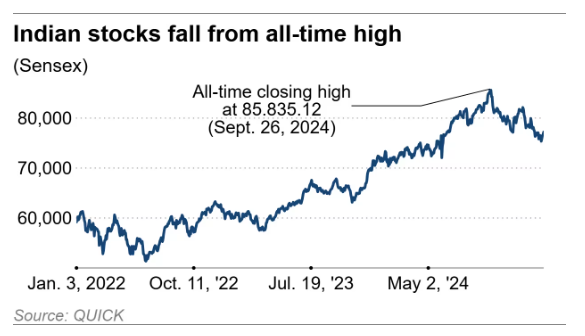
The recent weakness in India's stock market is primarily due to an economic slowdown. In Q3 of last year, India's GDP grew by only 5.4%, the lowest level in seven quarters, prompting the Reserve Bank of India to lower its growth forecast for the current fiscal year from 7.2% to 6.6%, compared to 8.2% in the previous fiscal year. "At present, India's economy is in a deceleration phase that may persist for another two to three quarters," said the head of institutional equities at investment advisory firm Ambit. "In the coming months, the market may continue to decline."
In October this year, India's inflation rate reached its highest level in 14 months at 6.2%, while wage growth nearly stagnated, leading to stagflation. In the same month, Nomura reported that the year-over-year wage growth for India's non-financial listed companies in the July–September quarter was only 0.8%, down from 1.2% in the previous quarter.
Stagflation has squeezed the wallets of the middle class and hit the consumer market hard. Nestlé India's profits have declined as a result, and Nestlé is not the only example. The Indian operations of South Korea's Hyundai have seen sales drop by 2%, falling to 159.16 billion rupees, while the passenger car business of Tata Motors in India experienced a 4.3% decline in revenue, dropping to 123.54 billion rupees.
The banking sector is also struggling. According to estimates from S&P Global, the total loans of India's six largest banks, including the State Bank of India (SBI) and HDFC, are expected to grow by only 12.3% in the 2025 fiscal year, significantly lower than the 22.5% growth observed in the previous fiscal year.
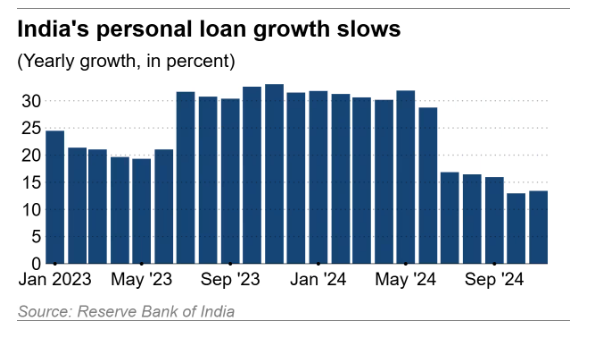
Rating agency Icra, which monitors nearly 600 companies operating in India, reported that the operating profit margin of these companies contracted by 1.02 percentage points year-over-year in Q3 2024, a marked decline compared to a 0.3 percentage point increase in Q2.
"Growth among India's high-end consumers has slowed slightly, though conditions remain decent," said the head of India equity research at Australian investment bank Macquarie. "The urban middle class is the main culprit behind the sluggish consumption, and this issue is closely related to inflation and income growth... This is not a problem that can be resolved in one or two quarters."
Another factor weighing on the Indian market is the outflow of foreign capital. Global investors are expressing concerns that Indian stocks are overvalued, especially amid a slowing economy. Valuation data shows that as of December 31, 2024, the MSCI Emerging Markets Index had a price-to-earnings (P/E) ratio of 15.43, while the MSCI India Index's P/E ratio was as high as 26.58.
In Q4 2024, foreign investors were net sellers of Indian stocks to the tune of $11.9 billion, and since the beginning of 2025, net sales have exceeded $8.6 billion. This has further increased the selling pressure on the Indian stock market.

Stay ahead of the market.
Get curated U.S. market news, insights and key dates delivered to your inbox.
AInvest
PRO
AInvest
PRO



Comments
No comments yet