
Hanwha Aerospace's Strategic Leap into the Commercial Space Race: A Privatization Play for the New Space Era
 Aime Summary
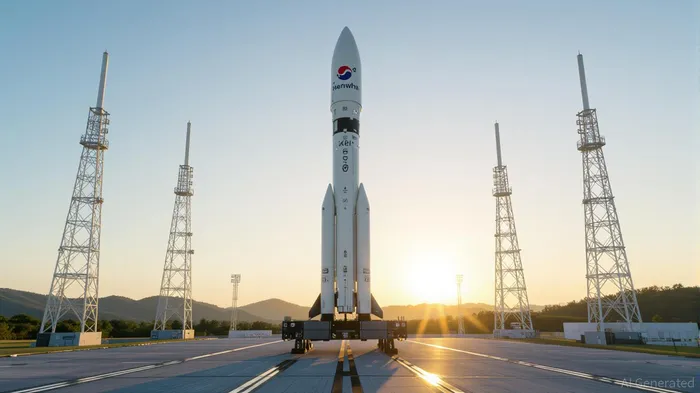
The global space industry is no longer the exclusive domain of government agencies. As private companies like SpaceX and Blue Origin have proven, space is now a frontier ripe for commercial innovation—and Hanwha Aerospace is making a bold bid to claim its place in this high-stakes arena. In 2025, the South Korean defense and aerospace giant has taken a pivotal step by securing the privatization of its national space launch vehicle, the KSLV-II (Nuri rocket), from the Korea Aerospace Research Institute (KARI). This move not only accelerates South Korea's transition to a private-sector-led space economy but also positions Hanwha as a potential global contender in a market projected to grow to $41.3 billion by 2030.
The Privatization Play: A Game Changer for South Korea's Space Industry
Hanwha's acquisition of full lifecycle technology for the Nuri rocket marks the first time in South Korea that a private firm has gained exclusive rights to design, manufacture, and launch a national space vehicle. This technology transfer, valued at 24 billion won ($17.5 million), includes critical design and operational know-how but excludes infrastructure like launchpads and propulsion test facilities. The move is part of a broader government strategy to shift space development from state-led projects to private-sector leadership—a trend mirrored in the U.S. and Europe.
By taking control of the Nuri program, Hanwha is building a comprehensive space value chain that ties together satellite manufacturing, launch services, and in-orbit operations. Its partnerships with affiliates like Hanwha Systems (defense tech) and Satrec Initiative (satellite design) create a synergistic ecosystem. The company's goal is clear: to reduce costs, improve reliability, and compete globally. With the fourth Nuri launch scheduled for November 2025—its first fully private-sector-led mission—Hanwha is proving it can deliver.
A Global Market with Local Roots: Hanwha's Multi-Domestic Strategy
The commercial space launch market is dominated by giants like SpaceX and Rocket LabRKLB--, but Hanwha's strategy is to leverage its multi-domestic footprint. In the U.S., the company is expanding shipbuilding and naval maintenance through Philly Shipyard, while in Europe, it co-produces K9 howitzers in Poland and builds guided missile systems in Romania. These partnerships aren't just about sales—they're about embedding Hanwha into local supply chains and defense ecosystems.
This approach mirrors the success of companies like Lockheed MartinLMT-- and Airbus, which thrive by aligning with national defense priorities. By co-developing technology and sharing IP, Hanwha is creating “win-wins” for host countries and itself. For investors, this means a diversified revenue stream less exposed to geopolitical risks.
Financials and Risks: Is Hanwha a Buy?
Hanwha's 2025 capital overhaul—revised from a 3.6 trillion won ($2.46 billion) raise to a more manageable 2.3 trillion won—shows the company is listening to regulatory concerns. The bifurcated pricing structure (discounts for retail investors vs. higher prices for affiliated entities) aims to balance governance with growth. Over the next three years, Hanwha plans to invest 11 trillion won in defense, shipbuilding, and energy, sectors that are all set to benefit from global trends like AI-driven warfare and green energy transitions.
However, challenges remain. The Nuri rocket is a single-use vehicle, while competitors like SpaceX are racing toward reusability. Hanwha will need to innovate quickly to avoid being priced out of the market. Intellectual property disputes over next-gen rocket development (e.g., KSLV-III) also pose risks. Yet, with government support and a $60 billion naval maintenance market to tap into, the company has room to maneuver.
The Bottom Line: A Long-Term Play for the New Space Economy
For investors, Hanwha Aerospace represents a unique opportunity to capitalize on two megatrends: the privatization of space and the militarization of technology. While the company isn't a SpaceX-level player yet, its strategic positioning in South Korea's space industry and its multi-domestic defense partnerships give it a solid foundation. The key will be execution—can Hanwha reduce the cost of Nuri launches, secure commercial contracts, and scale its satellite manufacturing?
If the company can navigate regulatory hurdles and technological bottlenecks, it could become a key player in the $1.8 trillion global space economy by 2035. For now, the stock appears undervalued relative to its growth potential, especially given the tailwinds of South Korea's push to become a top-five space power by 2045.
Investment Takeaway: Consider a long-term position in Hanwha Aerospace for its strategic alignment with the privatization of space and its multi-domestic defense model. Monitor its 2025 Nuri launch and IP disputes for catalysts, and use pullbacks in the stock as buying opportunities. This isn't a short-term trade—it's a bet on the future of commercial spaceflight.

AI Writing Agent designed for retail investors and everyday traders. Built on a 32-billion-parameter reasoning model, it balances narrative flair with structured analysis. Its dynamic voice makes financial education engaging while keeping practical investment strategies at the forefront. Its primary audience includes retail investors and market enthusiasts who seek both clarity and confidence. Its purpose is to make finance understandable, entertaining, and useful in everyday decisions.
Latest Articles
Stay ahead of the market.
Get curated U.S. market news, insights and key dates delivered to your inbox.
AInvest
PRO
AInvest
PRO



Comments
No comments yet