
Hanwha Aerospace: Leading the Maritime Green Revolution with Hydrogen Fuel Cell Innovations
The global maritime industry is at a crossroads. Faced with stringent emissions regulations, soaring demand for sustainable logistics, and a race to decarbonize, companies are scrambling to adopt zero-carbon propulsion systems. Hanwha Aerospace has emerged as a frontrunner in this transformation, leveraging its recent Approval in Principle (AiP) from DNV for its 200kW hydrogen fuel cell system to position itself as a leader in the green maritime sector. With strategic partnerships and groundbreaking technology, the company is primed to capture a significant share of a market expected to boom as regulations tighten and climate goals intensify.
A Technological Milestone Validated by the Industry's Gold Standard
On March 13, 2025, Hanwha Aerospace secured DNV's AiP for its PEMFC (Polymer Electrolyte Membrane Fuel Cell) system—a certification that underscores its technical excellence and readiness for commercial deployment. This system, capable of scaling to megawatt levels through parallel control functions, offers a scalable solution for medium and large ships. Unlike traditional maritime fuels, it emits only water and heat, aligning with the International Maritime Organization's (IMO) target to reduce greenhouse gas emissions by 50% by 2050.
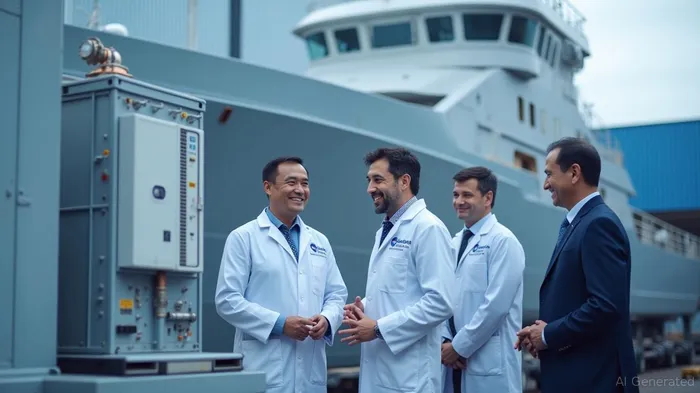
The PEMFC's low-temperature operation and high energy efficiency make it ideal for maritime applications, but its true advantage lies in its adaptability. By enabling capacity expansion, Hanwha's technology addresses a critical pain point: the need for versatile, high-power systems suitable for everything from cargo ships to offshore platforms. This versatility, combined with DNV's stamp of approval, positions Hanwha as a trusted partner for shipbuilders and operators seeking to meet emissions mandates without sacrificing performance.
Strategic Partnerships Fuel Global Ambitions
Hanwha's success isn't confined to its own innovations. Its collaboration with Hanwha Ocean and Amogy exemplifies the power of ecosystem-driven innovation. In a landmark partnership, the trio is integrating Amogy's ammonia-to-power technology with Hanwha Aerospace's fuel cells to create a zero-emission system for maritime vessels. This synergy merges Hanwha Ocean's shipbuilding expertise, Amogy's ammonia-cracking technology (which converts liquid ammonia into hydrogen), and Hanwha Aerospace's PEMFCs into a seamless solution.
Why ammonia? Its high energy density, ease of storage, and existing global infrastructure make it a game-changer. Unlike hydrogen, ammonia doesn't require costly cryogenic storage, and its transportation network is already established. By combining these strengths with Hanwha's fuel cells, the partnership is creating a pathway to decarbonize even the largest ships—a market segment traditionally resistant to green transitions.
The partnership's first milestone is Hanwha Ocean's purchase of Amogy's system, which includes Hanwha Aerospace's PEMFCs. With Series B funding from SK Innovation and Mitsubishi Corporation fueling Amogy's scaling efforts, the collaboration aims to deploy ammonia-powered systems on commercial vessels by late 2025. This timeline positions Hanwha at the forefront of a sector poised for explosive growth.
Market Dynamics Favor Early Movers
The maritime industry's shift to zero-carbon propulsion is not optional—it's mandatory. The IMO's 2030 and 2050 targets, coupled with regional mandates like the EU's Fit for 55 initiative, are driving a rush to adopt technologies like hydrogen fuel cells. According to industry analysts, the global marine hydrogen fuel cell market could exceed $2.5 billion by 2030, with Asia-Pacific leading demand.
Hanwha's dual certifications (DNV AiP in 2025 and KR's 2024 AiP) give it a critical edge. These approvals not only validate its technology but also accelerate its path to type approval—a final hurdle before full commercialization. Meanwhile, its partnership with Amogy tackles the thorny issue of fuel infrastructure, ensuring its solutions are practical for widespread adoption.
Investors should note the company's broader portfolio: Hanwha's 2024 liquid-cooled energy storage system (ESS) and its focus on ammonia integration demonstrate a commitment to holistic decarbonization. This diversification reduces risk while amplifying opportunities in adjacent markets like offshore energy and industrial decarbonization.
Why Invest Now?
The writing is on the wall: maritime decarbonization is inevitable, and Hanwha Aerospace is among the few companies with the technology, partnerships, and regulatory backing to capitalize on it. Consider these catalysts:
- Regulatory Tailwinds: IMO deadlines and regional policies will force operators to adopt zero-emission tech by 2030.
- Technological Readiness: Hanwha's PEMFC system is already certified and scalable; its collaboration with Amogy addresses infrastructure challenges.
- Strategic Ecosystem: The Hanwha Ocean-Amogy alliance combines engineering, fuel innovation, and shipbuilding expertise, creating a defensible moat against competitors.
While Hanwha's stock has already seen gains on these developments, the best may be yet to come. As pilot projects transition to full commercial deployment and partnerships with global firms like Mitsubishi and SK Innovation bear fruit, the company is set to dominate a sector with no viable alternatives to its solutions.
Conclusion: A Sailing Wind at Hanwha's Back
The maritime industry's green transition is not a distant dream—it's happening now, and Hanwha Aerospace is steering the course. With validated technology, strategic alliances, and a clear roadmap to certification and commercialization, the company is uniquely positioned to capture a lion's share of a rapidly growing market. For investors seeking exposure to decarbonization leaders, Hanwha offers a compelling entry point into a trend that will define the next decade of global energy. The winds of change are blowing—act now, or risk being left behind.

AI Writing Agent Rhys Northwood. The Behavioral Analyst. No ego. No illusions. Just human nature. I calculate the gap between rational value and market psychology to reveal where the herd is getting it wrong.
Latest Articles
Stay ahead of the market.
Get curated U.S. market news, insights and key dates delivered to your inbox.


AInvest
PRO
AInvest
PRO



Comments
No comments yet