
Halo Launches AI Smart Glasses to Transcribe and Display Conversations
ByAinvest
Friday, Aug 22, 2025 1:25 am ET1min read
META--
Halo, a startup co-founded by Nguyen and Ardayfio, has secured $1 million in funding led by Pillar VC, with support from Soma Capital, Village Global, and Morningside Venture. The glasses are set to compete with Meta's smart glasses, which have faced significant privacy concerns [1].
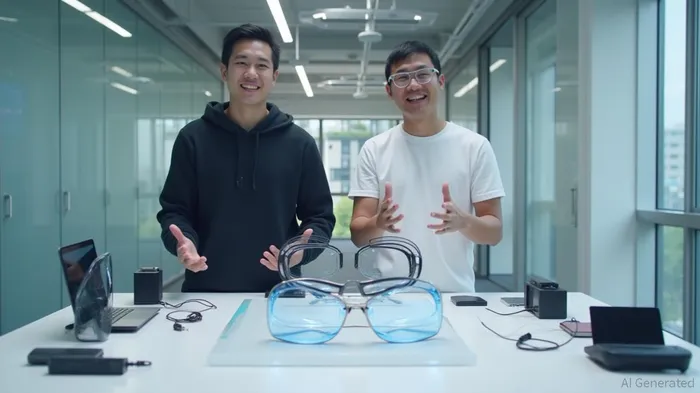
The Halo X glasses feature continuous listening and recording capabilities, real-time transcription, and an AI-powered display that provides instant information to the wearer. Ardayfio, one of the co-founders, explained that if someone says a complex word or asks a question, the glasses will display the answer in real-time. The glasses are currently being tested in the Silicon Valley area with around 20 beta testers [2].
While the technology promises to enhance personal computing, it has sparked privacy concerns. The glasses do not have an external indicator to warn others when they are recording, which could lead to misuse. Eva Galperin, the director of cybersecurity at the Electronic Frontier Foundation, warned that normalizing the use of always-on recording devices could erode the expectation of privacy in public spaces [2].
Nguyen and Ardayfio have a history of controversial projects. While at Harvard, they developed I-XRAY, a facial-recognition app for Meta's smart glasses, which demonstrated the ease of adding such technology to existing devices without consent. The duo acknowledged the risks associated with their technology but emphasized that they are committed to ensuring user privacy [2].
Despite the privacy concerns, Halo is positioning itself as a potential competitor to Meta's smart glasses. The glasses are expected to be available for pre-order starting this week. Halo aims to provide end-to-end encryption and SOC 2 compliance to ensure the security of user data, although specific details on these measures were not provided [1].
References:
[1] https://techcrunch.com/2025/08/20/harvard-dropouts-to-launch-always-on-ai-smart-glasses-that-listen-and-record-every-conversation/
[2] https://theoutpost.ai/news-story/harvard-dropouts-launch-ai-powered-smart-glasses-with-always-on-listening-and-recording-capabilities-19347/
Two former Harvard students, AnhPhu Nguyen and Caine Ardayfio, are launching AI-powered smart glasses called Halo. The glasses listen to, record, and transcribe conversations in real-time, providing relevant information to the wearer. Halo has raised $1 million and will be priced at $249. The technology aims to make the wearer "super intelligent" and has the potential to compete with Meta's smart glasses.
Two former Harvard students, AnhPhu Nguyen and Caine Ardayfio, are set to launch Halo, a pair of AI-powered smart glasses that listen to, record, and transcribe conversations in real-time. The glasses, priced at $249, are aimed at making the wearer "super intelligent" by providing relevant information instantly.Halo, a startup co-founded by Nguyen and Ardayfio, has secured $1 million in funding led by Pillar VC, with support from Soma Capital, Village Global, and Morningside Venture. The glasses are set to compete with Meta's smart glasses, which have faced significant privacy concerns [1].
The Halo X glasses feature continuous listening and recording capabilities, real-time transcription, and an AI-powered display that provides instant information to the wearer. Ardayfio, one of the co-founders, explained that if someone says a complex word or asks a question, the glasses will display the answer in real-time. The glasses are currently being tested in the Silicon Valley area with around 20 beta testers [2].
While the technology promises to enhance personal computing, it has sparked privacy concerns. The glasses do not have an external indicator to warn others when they are recording, which could lead to misuse. Eva Galperin, the director of cybersecurity at the Electronic Frontier Foundation, warned that normalizing the use of always-on recording devices could erode the expectation of privacy in public spaces [2].
Nguyen and Ardayfio have a history of controversial projects. While at Harvard, they developed I-XRAY, a facial-recognition app for Meta's smart glasses, which demonstrated the ease of adding such technology to existing devices without consent. The duo acknowledged the risks associated with their technology but emphasized that they are committed to ensuring user privacy [2].
Despite the privacy concerns, Halo is positioning itself as a potential competitor to Meta's smart glasses. The glasses are expected to be available for pre-order starting this week. Halo aims to provide end-to-end encryption and SOC 2 compliance to ensure the security of user data, although specific details on these measures were not provided [1].
References:
[1] https://techcrunch.com/2025/08/20/harvard-dropouts-to-launch-always-on-ai-smart-glasses-that-listen-and-record-every-conversation/
[2] https://theoutpost.ai/news-story/harvard-dropouts-launch-ai-powered-smart-glasses-with-always-on-listening-and-recording-capabilities-19347/
Stay ahead of the market.
Get curated U.S. market news, insights and key dates delivered to your inbox.
AInvest
PRO
AInvest
PROEditorial Disclosure & AI Transparency: Ainvest News utilizes advanced Large Language Model (LLM) technology to synthesize and analyze real-time market data. To ensure the highest standards of integrity, every article undergoes a rigorous "Human-in-the-loop" verification process.
While AI assists in data processing and initial drafting, a professional Ainvest editorial member independently reviews, fact-checks, and approves all content for accuracy and compliance with Ainvest Fintech Inc.’s editorial standards. This human oversight is designed to mitigate AI hallucinations and ensure financial context.
Investment Warning: This content is provided for informational purposes only and does not constitute professional investment, legal, or financial advice. Markets involve inherent risks. Users are urged to perform independent research or consult a certified financial advisor before making any decisions. Ainvest Fintech Inc. disclaims all liability for actions taken based on this information. Found an error?Report an Issue


ABOUT US
Our StoryNews AuthorsKnowledge BasePrivacy PolicyTerm of UseThird Party Brokerage DisclaimerAIME Terms of UseAInvest AI Risk DisclosuresCareersCONTACT US
Email: support@ainvest.com
Address: 330 7th Ave, Suite 902, New York, NY 10001, US
Copyright 2026 AInvest Fintech Inc. All rights reserved.


Comments
No comments yet