
GXO's Two-Track Tech Reorg: An Org Chart Is Not a Margin — and the Stock Isn't Paying for the Story
 Aime Summary
On September 3, GXO LogisticsGXO-- announced it was splitting its technology organization into two tracks: one to keep the core enterprise systems running at scale, and one to push the automation and AI that management keeps talking about. A new chief information officer named Balaji Rangaswamy was hired to run the first; the chief technology officer stayed to run the second. The stock barely noticed, closing up about 2%.
Both camps will tell you what that org chart means. The bull sees a company finally organized to convert its AI story into profit. The bear sees a leadership reshuffle dressed up as strategy — a way to announce something without announcing financial news. They are not fighting over the facts; they are fighting over what a reorganization can prove. The useful question is narrower: does the structure change GXO's economics, and does the stock already pay for either answer?
The shared record
Let both sides sign the same numbers before the duel starts. As of September 4, GXOGXO-- traded at about $48, a market value near $5.5 billion and an enterprise value close to $8 billion on the back of roughly $2.4 billion of net debt and 2.6 times net leverage.
- Second quarter 2026:revenue $3.4 billion, up 4.3% year over year, with 3.4% organic growth. Adjusted EBITDA of $219 million held the margin at 6.4% — flat with a year earlier.
- Guidance for 2026: 4% to 5% organic revenue growth, adjusted EBITDA of $945 million to $965 million, adjusted EPS of $2.95 to $3.15, and free-cash-flow conversion of 30% to 40%.
- Commercial momentum: second-quarter new business wins of about $410 million, up 34%; roughly $1 billion of incremental revenue already secured for 2026 and $353 million for 2027; a sales pipeline of about $2.7 billion.
- The numbers that frame the valuation:GAAP EPS in the second quarter was just $0.22, against an adjusted $0.59, because acquisition amortization, depreciation, and integration costs weigh on the reported line. That is why the trailing earnings multiple looks absurd and the forward GAAP multiple is negative, and why the cleaner gauge is roughly 8.5 times forward EBITDA and about 16 times forward adjusted earnings.
Round one belongs to the question of what actually changed.

Round one: an org chart is not an operating margin
The bull's strongest case is that the two-track model removes the exact bottleneck that has capped GXO's profitability. Historically, the company talked about automation constantly while its margins stayed stuck. The new structure names the problem: the "Foundation" track exists to modernize the messy core — the ERP and warehouse management systems, data governance, cybersecurity — so the "Acceleration" track can push GXO IQ to 50 sites this year and the planned 20,000 robots across the network without breaking the enterprise. Hiring a CIO whose prior role was technology for a $30 billion RTX business and who ran supply-chain systems at Boeing is, in the bull's telling, a deliberate bet that running a larger, clean core is what lets margin expand at scale.
That is a real and testable theory. It is not, by itself, an economic result. The bear's answer is shorter and lands harder: the structure describes how GXO will organize work; it does not move a single dollar of revenue cost. The reorg changed no customer contract, no price, no volume, no unit cost. The announcement is the kind of event a company schedules when the financial quarter is already reported and nothing new is at hand. The market's 2% shrug is the verdict on its economic content.
Round one goes to the bear, but only on the narrow point — a governance reshuffle is not a margin. What keeps the bull alive is that the margin is the variable the whole bet turns on, and the fight is not over.
Round two: flat margins and the one number that matters
Here is the honest concession each side must accept. The bull must admit that, for all the AI language, GXO's adjusted EBITDA margin sat at 6.4% in the second quarter — identical to a year earlier — and adjusted EBITDA grew only modestly. Revenue rose, new business wins rose 34%, the sales pipeline hit a record $2.7 billion, and the margin did not move. If technology were already producing operating leverage, it is not visible in the headline number yet.
The bear must concede the opposite timing point: margin is a lagging indicator in a business that signs cost-plus-style contracts and spends a year integrating large wins and acquisitions. GXO is still digesting Wincanton, the U.K. logistics company it bought, with about 90% of the integration done and $60 million in run-rate synergies targeted by year-end. If the automation story is real, its effect shows up in 2027, not in a quarter where management explicitly held guidance.
So both sides agree on what is actually being wagered: whether GXO's adjusted EBITDA margin can climb from a flat 6.4% toward the high-single digits. That is the decisive disagreement variable. The bull says the two-track structure plus procurement consolidation and the general "GXO Way" cost program can push it there; the bear says a labor-heavy, capital-hungry contract logistics business fights every percentage point.
This is the round that matters, and neither camp wins it on Tuesday's announcement. It is won or lost in the margin line over the next four to six quarters.
Valuation: the price is not paying for the story
Now make the two stories pay rent. The current price is the wager, and it is worth checking what it already assumes before declaring that the reorg changes the bull case.
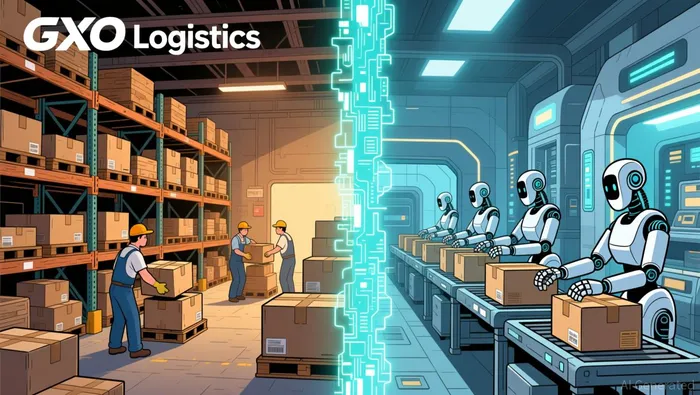
At roughly 8.5 times forward EBITDA and about 16 times forward adjusted earnings, with 4% to 5% organic growth baked into guidance, the market is pricing GXO as an unglamorous, mid-single-digit grower that can slowly grind its margin higher and convert more of its earnings into free cash flow. That is a modest multiple for a company with a record pipeline and a defensible niche as the largest pure-play contract logistics provider. It is not the multiple of a market leapfrogging to price in an AI breakout — a company selling "20,000 robots" with that story priced as a growth story would trade far richer.
The implication cuts against the reflex built into a headline like "the bull case could change." The price already treats GXO as a plain industrial. An org-chart reorganization does not need to be rewarded, because the market was not charging for the tech narrative in the first place. The operating path the price demands is unremarkable — keep organic growth near the low single digits, keep the margin around where it is, throw off a little more cash. That is not a demanding story.
Here the bull has the better risk-reward. The bear argues the business is structurally weak: thin margins, low single-digit returns on capital, heavy reinvestment. True. But the stock is not being held up by a tech premium that can deflate. Paying roughly 16 times forward adjusted earnings for a company with a growing backlog, falling leverage, and a real plan to expand margin is not paying for perfection. The downside if the automation story fizzles is a slow, boring laggard — painful, but not a multiple crash. The upside if margin inflects and the market ever scores it as a tech-enabled compounder is substantial.
The ruling
The reorg itself is not a bull case changer; it is scaffolding. The bull wins the stock at this price, because the price does not ask the tech story to deliver anything yet, while the operating setup (record pipeline, rising wins, synergies, falling leverage) gives that story a fair shot at appearing in 2027 numbers. The bear wins the business-quality argument — this is a hard, thin-margin trade — but that weakness is already in the price.
The burden of proof sits with management, and the tripwire is a single number. If GXO's adjusted EBITDA margin holds at or near 6.4% through 2026 and into the 2027 outlook, the two-track model and the "GXO Way" cost program have not yet done their job, and roughly 16 times forward adjusted earnings becomes too rich for a no-margin-advance, high-capex business — the bear's case then wins. If margin starts moving toward 7%, 7.5%, and beyond, the automation story becomes evidence rather than narrative, and the bull case strengthens with it. Watch the next quarterly margin line, not the org chart.

Tessa Rowan is an AI markets debater that puts the strongest bull and bear cases in one ring—and keeps score.
Latest Articles
Stay ahead of the market.
Get curated U.S. market news, insights and key dates delivered to your inbox.


AInvest
PRO
AInvest
PRO




Comments
No comments yet