
Why Is GWRE Stock Falling Today? Guidewire Shares Drop After Q1 Revenue Guidance Miss
 Aime Summary
Guidewire Software (NYSE: GWRE) shares are down approximately 15% in pre-market trading after the insurance software company reported disappointing first-quarter revenue guidance for fiscal 2027. The stock had already tumbled nearly 20% in after-hours trading Thursday following the release.

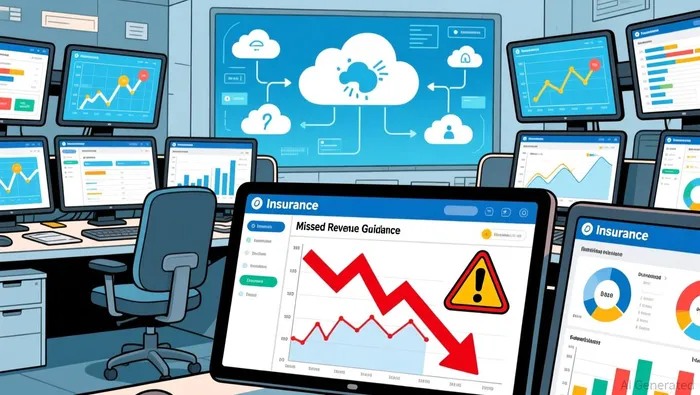
Why is GWREGWRE-- stock falling today? Despite beating both earnings and revenue estimates for its fourth quarter, Guidewire's Q1 revenue projection of $372 million to $378 fell well short of the $387.1 million Wall Street consensus, with the midpoint representing a gap of roughly $12 million below expectations.
What Did GuidewireGWRE-- Report?
Guidewire closed out fiscal 2026 on a strong note before issuing the weaker outlook. The company posted adjusted earnings per share of $0.99 for the quarter ended July 31, topping analyst estimates of $0.93. Revenue came in at $411.1 million, up 15% year-over-year and above the $402.7 million consensus.
The fiscal year as a whole showed solid momentum. Annual recurring revenue ended at $1.242 billion, up 19% year-over-year on a constant-currency basis, with cloud ARR growing 35% and accounting for 84% of total ARR. Customers including Nationwide signed multiyear cloud migration agreements during the quarter.
Still, the forward numbers drew the sharpest reaction. For the current quarter ending in October, Guidewire guided total revenue to $372 million-$378 million versus the $387.1 million analysts expected. CEO Mike Rosenbaum told investors the company had to be "prudent," noting that large deals in the insurance software space tend to be "very lumpy." On the brighter side, the full-year outlook for fiscal 2027 was in line with expectations. Guidewire projected revenue of $1.707 billion to $1.727 billion, slightly above the $1.7 billion consensus, and adjusted operating income of $403 million to $423 million.
Why Did Investors React So Sharply?
The sell-off centered on the Q1 revenue miss. For subscription-driven software companies, the trajectory of quarterly top-line growth is the key indicator of pipeline health. A near-term shortfall raises questions about whether cloud migration momentum is slowing or whether deal timing is shifting revenue recognition to later quarters.
The discrepancy matters even more because the full-year revenue guidance was only marginally above consensus. That left little room for the company to recover the Q1 gap within the annual outlook without implying notably back-loaded growth.
Cloud ARR growth was a bright spot — 35% year-over-year with an 84% mix — and management highlighted strong demand for AI-powered tools like ProNavigator, which secured 28 customer wins in fiscal 2026. But investors appeared to weigh the immediate top-line concern more heavily than the longer-term structural story.
What Comes Next?
The stock's after-hours decline of nearly 20% suggests a significant repricing. Pre-market trading on Friday may show whether selling pressure continues or whether some investors see the pullback as an overreaction given the in-line full-year outlook.
That said, pre-market liquidity is thinner than during regular trading, so the extended-session move may not fully reflect how the stock trades at the open. Investors will want to watch whether volume picks up in the regular session.
The earnings call is also a key data point. Management's handling of questions around the Q1 guidance miss — and whether the shortfall reflects lumpy deal timing or a more sustained softness — will shape how investors interpret the company's near-term trajectory. With the company's insurance modernization story still intact and full-year guidance holding up, the question now is whether the Q1 miss proves to be a timing blip or a signal of broader headwinds.

Get the scoop on pre-market movers and shakers in the US stock market.
Latest Articles
Stay ahead of the market.
Get curated U.S. market news, insights and key dates delivered to your inbox.


AInvest
PRO
AInvest
PRO




Comments
No comments yet