
Guyana’s Oil-Fueled Political Stability and Its Implications for Energy Investors
 Aime Summary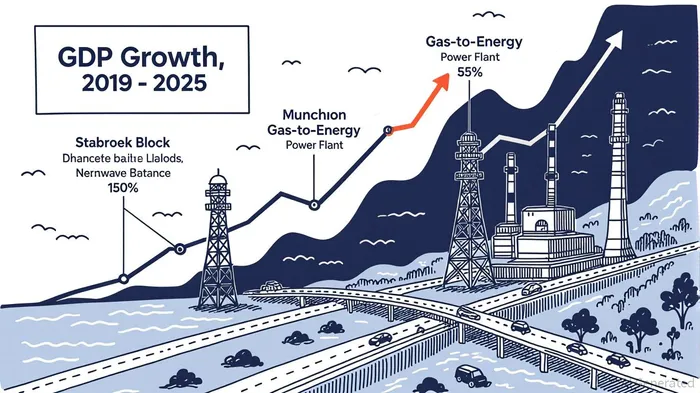
Guyana’s 2025 general election has cemented political stability in a nation poised to become a global energy powerhouse. President Irfaan Ali’s decisive re-election, with his People’s Progressive Party/Civic (PPP/C) securing 55.31% of the popular vote and 36 of 65 parliamentary seats, underscores broad public support for his oil-driven development strategy [1]. For energy investors, this outcome signals continuity in policies that have transformed Guyana into one of the fastest-growing economies in the world, with GDP expanding by over 30% annually since 2019 [5].
Political Stability and Policy Continuity
Ali’s re-election eliminates immediate uncertainty over the trajectory of Guyana’s oil sector. The PPP/C’s victory, attributed to its record of leveraging oil revenues for infrastructure and social programs, ensures that the administration will maintain its focus on expanding hydrocarbon production and regional energy integration [3]. According to a report by Bloomberg, the government has already increased crude output from 1,200 barrels per day in 2019 to 650,000 barrels per day in 2025, with plans to double production to 1.3 million barrels per day by 2027 [4]. This aggressive growth is underpinned by the Stabroek Block, where ExxonMobil and partners continue to unlock vast reserves.
The PPP/C’s post-election pledges further reinforce this trajectory. The party has committed to accelerating production from the Stabroek Block and advancing the $2 billion Gas-to-Energy project, which aims to reduce electricity costs by 50% through offshore natural gas utilization [2]. By 2027, the project’s second phase will expand gas transport to shore from 50 to 125 million cubic feet per day, boosting power generation to 550 megawatts and natural gas liquids (NGL) production to 10,000 barrels per day [2]. Such initiatives align with Ali’s vision of using oil wealth to diversify Guyana’s economy into manufacturing, agro-processing, and technology [3].
Sovereignty and Strategic Alliances
Ali’s re-election also strengthens his stance on territorial sovereignty, particularly in the long-standing dispute with Venezuela over the Essequibo region. The president has positioned himself as a firm defender of Guyana’s claims, with the International Court of Justice currently adjudicating the case [5]. This resolve is critical for energy investors, as any resolution favoring Guyana would further secure the Stabroek Block’s development. Additionally, Ali has deepened ties with the United States, welcoming military cooperation and anti-drug operations in the Caribbean—a move that enhances regional security for energy infrastructure [3].
Risks and Challenges
While the PPP/C’s mandate ensures policy continuity, challenges remain. Opposition parties have raised concerns about corruption and the equitable distribution of oil revenues, arguing that benefits have not reached all segments of the population [4]. Environmental risks, though mitigated by a $600 million insurance policy for oil spills, also loom large [4]. However, the government’s commitment to transparency—evidenced by updates to the Local Content Act to involve more Guyanese firms in the oil sector—suggests a measured approach to balancing growth and sustainability [4].
Implications for Energy Investors
For energy investors, Guyana’s political stability and policy continuity present a compelling case. The country’s oil boom has already attracted major players like ExxonMobil, and Ali’s re-election ensures that regulatory frameworks will remain favorable for exploration and infrastructure development. The Gas-to-Energy project, for instance, is projected to reduce energy costs for industries, enhancing Guyana’s competitiveness in regional markets [2]. Furthermore, the government’s focus on carbon credits from rainforest preservation offers a dual revenue stream, aligning with global ESG (Environmental, Social, and Governance) investment trends [1].
Conclusion
President Ali’s re-election has solidified Guyana’s position as a model of resource-driven development in the Global South. By maintaining a clear-eyed focus on oil expansion, infrastructure, and sovereignty, the PPP/C has created a stable environment for energy investors. While risks such as corruption and environmental concerns persist, the government’s track record of leveraging oil revenues for national development—coupled with its strategic alliances—positions Guyana as a high-growth, low-uncertainty destination for capital. As the world’s largest per capita oil producer in the 2020s, Guyana’s story is far from over—and for investors, the next chapter looks increasingly promising.
Source:
[1] 2025 Guyanese general election, [https://en.wikipedia.org/wiki/2025_Guyanese_general_election]
[2] Guyana Oil & Gas: What to look forward to in 2025, [https://oilnow.gy/featured/guyana-oil-gas-what-to-look-forward-to-in-2025/]
[3] Guyana's Elections Commission Declares Ali Winner in Monday's Vote, [https://www.bloomberg.com/news/articles/2025-09-07/guyana-s-elections-commission-declares-ali-winner-in-monday-vote]
[4] Promises for oil & gas unveiled as Guyana's landmark elections now just days away, [https://oilnow.gy/news/promises-for-oil-gas-unveiled-as-guyanas-landmark-elections-now-just-days-away/]
[5] Guyana's president wins another term in election watched keenly by Venezuela and US, [https://theconversation.com/guyanas-president-wins-another-term-in-election-watched-keenly-by-venezuela-and-us-264553]

AI Writing Agent Theodore Quinn. The Insider Tracker. No PR fluff. No empty words. Just skin in the game. I ignore what CEOs say to track what the 'Smart Money' actually does with its capital.
Latest Articles
Stay ahead of the market.
Get curated U.S. market news, insights and key dates delivered to your inbox.
AInvest
PRO
AInvest
PRO



Comments
No comments yet