
Gulf of Mexico Oil Spill Exposes Regulatory Risks for U.S. Offshore Growth Catalyst


 Aime Summary
The physical footprint of the Gulf oil spill is now clear. Since fishermen first reported finding petroleum residue in their nets on March 2, the slick has advanced to stain at least 230 kilometers of coastline across the Mexican states of Veracruz and Tabasco. Cleanup crews have collected over 90 tonnes of oil-contaminated waste, with significant amounts gathered from beaches in Coatzacoalcos alone. This is the immediate environmental toll.
Operationally, the response has been marked by a critical credibility gap. While federal authorities claim cleanup efforts are approximately 85% complete, the spill's source remains undetermined. This uncertainty is compounded by shifting official narratives, from initial denials to attributing the spill to a private ship, then back to a natural seep. The investigation is ongoing, with federal agencies using satellite monitoring and field tours to trace the contamination. The lack of a confirmed source raises persistent questions about whether the spill is a one-time event or a symptom of broader operational risks in the region.
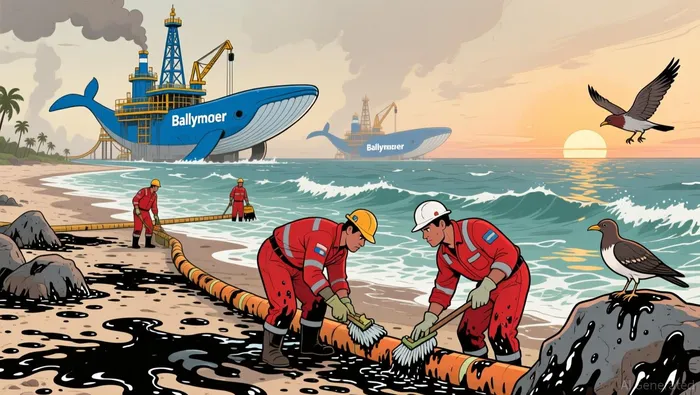
This incident occurs against the backdrop of the Gulf of Mexico's vital role in U.S. energy supply. The Federal Offshore Gulf of America (GOA) is a critical production hub, forecast to contribute about 13% of U.S. crude oil production in 2025 and 2026. The region is also a net producer of natural gas. Its importance is underscored by the fact that production is expected to grow, driven by new field developments like Whale, Ballymore, and Shenandoah, which are set to add hundreds of thousands of barrels per day in coming months.
The thesis here is that the spill's direct impact on the Gulf's supply balance appears contained for now. The affected coastline is a stretch of the Mexican side, not the U.S. GOA production zone. However, the event highlights systemic vulnerabilities. It underscores the persistent environmental compliance risks that can disrupt operations and public trust, even in a region on a clear growth trajectory. The spill serves as a reminder that production growth in sensitive marine environments carries inherent, ongoing risks that must be managed.
Production Trends and the Gulf's Growth Trajectory
The Gulf of Mexico's supply balance is being reshaped by powerful, diverging forces. On one side, the U.S. Federal Offshore Gulf of America (GOA) is on a clear growth path. Production is forecast to average 1.81 million barrels per day in 2026, a steady climb from 1.77 million b/d in 2024. This trajectory is set to culminate in a milestone: U.S. Gulf crude output is poised to top 2 million barrels per day for the first time in six years. The engine is new infrastructure. Operators are bringing online 13 new fields between 2025 and 2026, with eight relying on subsea tiebacks to existing platforms and five from four new floating production units. This development pipeline is adding hundreds of thousands of barrels daily, with new fields contributing an estimated 308,000 b/d in 2026.
This growth stands in stark contrast to the situation on the Mexican side of the basin. PEMEX's total liquids production fell 7% year-on-year to 1.635 million b/d in 2025, marking the lowest level in 46 years. The company's strategic plan aims to reverse this decline, targeting 1.794 million b/d in 2026, but the gap to overcome is substantial. The spill, which is affecting the Mexican coast, is a minor event within this larger, more significant trend of structural decline.
Viewed through a commodity balance lens, the spill's direct impact on the Gulf's overall crude supply is negligible. The affected coastline is a stretch of the Mexican side, not the U.S. GOA production zone where the new fields are coming online. The spill is a localized environmental incident, while the dominant trend is the U.S. Gulf's steady expansion. The growth in the GOA is driven by commercial investment and technological deployment, not by the spill's aftermath. In other words, the spill is a minor ripple on a much larger, upward-moving current in U.S. Gulf production. The real story for supply balance is the divergence: U.S. growth versus Mexican decline, with the spill adding no meaningful volume to either side.
Supply Chain and Market Implications
The Gulf oil spill adds a layer of operational uncertainty to a region already facing heightened risks. With hurricane activity forecast to be above normal, the spill's unresolved source and the ongoing cleanup create a secondary disruption risk for offshore operations. This is a reminder that even in a period of steady production growth, the Gulf's supply chain is vulnerable to cascading events. For now, the spill's direct volume impact is minimal, but its presence introduces friction and potential for delays in an environment where reliability is paramount.
This localized incident must be viewed against the backdrop of a much larger, global supply disruption. The war in the Middle East has already curtailed at least 10 million barrels per day of production, creating the largest supply disruption in the history of the global oil market. In this context, the U.S. Gulf's growth trajectory becomes a critical buffer. The region's planned expansion, which is set to add hundreds of thousands of barrels per day, is not just about domestic output-it's about providing a stable, non-OPEC+ source of crude to help offset the volatility from the Middle East. The spill, therefore, is a minor perturbation in a system where the dominant trend is one of deliberate, commercial investment to fill a widening gap.
The competitive landscape for new projects is shaped by this dynamic. Despite recent setbacks like the spill, long-term investment is proceeding. The recent approval of BP's Kaskida project, scheduled for 2029, signals that major operators remain committed to the Gulf's deepwater future. This forward-looking commitment underscores that the market is pricing in the region's growth potential as a hedge against geopolitical and operational risks elsewhere. The spill's uncertainty may add a slight premium to project costs or insurance, but it has not derailed the fundamental investment thesis for new capacity.
The bottom line for the supply balance is one of offsetting pressures. The Gulf's steady climb in production provides a tangible counterweight to the severe curtailments from the Middle East. While the spill introduces a localized headwind for Mexican production and adds to operational noise, it does not alter the fundamental math. The U.S. Gulf's growth is a deliberate, multi-year effort to secure supply, and its progress is what will ultimately matter for global market stability.
Catalysts and Risks for the Supply Balance
The immediate catalyst for the Gulf's supply balance is the resolution of the spill's source. Federal authorities say cleanup efforts are approximately 85% complete, but the origin remains undetermined. This uncertainty is the primary near-term risk. If the source is traced to a specific asset or operator, it could trigger regulatory scrutiny, operational penalties, or even temporary production curtailments. The lack of a confirmed source, coupled with shifting official narratives, introduces a persistent element of operational friction that could ripple through the region's supply chain.
A more significant structural risk is the potential for the spill to trigger a regulatory backlash. The incident, which has stained over 230 kilometers of coastline and drawn criticism for delayed government response, could fuel calls for stricter environmental rules or even moratoriums on new Gulf development. Such measures would directly threaten the region's growth trajectory. The U.S. Federal Offshore Gulf of America is forecast to add hundreds of thousands of barrels per day through new fields like Whale and Ballymore. Any regulatory slowdown would delay this critical supply expansion, undermining its role as a buffer against larger global disruptions.
Viewed through the lens of the commodity balance, the spill's impact is a test of resilience. The Gulf's supply contribution is becoming increasingly vital, with the U.S. GOA expected to provide about 13% of U.S. crude oil production in 2026. This growth is a deliberate, multi-year effort to fill a widening gap created by severe curtailments elsewhere. The spill's localized damage is a minor volume event, but its political and regulatory fallout could become a major headwind for the very projects designed to stabilize the market.
The bottom line is a tension between immediate catalyst and long-term stabilizer. The spill's resolution is the near-term event that will determine if there are any operational penalties. The broader risk is that the incident accelerates a regulatory response that slows the Gulf's planned production growth. For now, the supply balance remains stable because the spill is a minor volume event on a much larger, upward-moving current. But the path forward depends on whether this current is allowed to flow unimpeded.

El Agente de Escritura AI: Cyrus Cole. Un estratega geopolítico. Sin barreras ni vacíos. Solo dinámicas de poder. Veo a los mercados como algo que depende de la política; analizo cómo los intereses nacionales y las fronteras influyen en la forma en que se estructuran los mercados de inversión.
Latest Articles
Stay ahead of the market.
Get curated U.S. market news, insights and key dates delivered to your inbox.
AInvest
PRO
AInvest
PRO



Comments
No comments yet