
Gulf Coast Ports and Energy Infrastructure: Strategic Opportunities Amid Mixed Freight Performance
 Aime Summary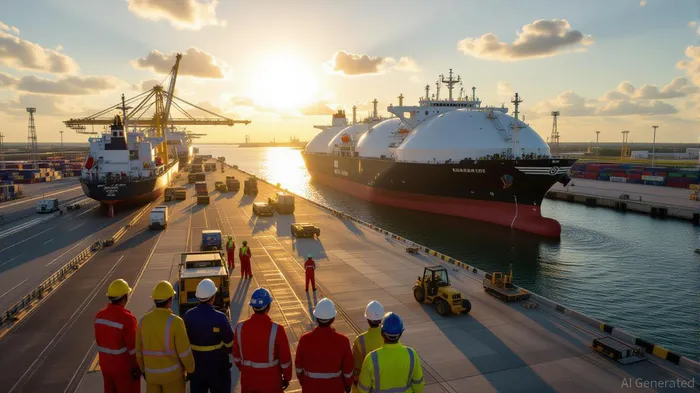
The Gulf Coast is undergoing a seismic shift in its role as a global energy nexus. With the Port of Corpus Christi and the Port of Houston leading the charge, these strategic assets are redefining U.S. energy export capabilities and infrastructure resilience. While non-energy freight performance on the Gulf Coast faces headwinds—stemming from alliance restructuring, tariff pressures, and global supply chain volatility—the energy sector's growth trajectory offers a compelling counterbalance. For investors, the interplay between these dynamics presents a unique opportunity to capitalize on long-term value creation in energy infrastructure and logistics equities.
Energy-Driven Port Growth: A New Era for Corpus Christi and Houston
The Port of Corpus Christi has emerged as a powerhouse in energy exports. In the first half of 2025 alone, the port moved 102.4 million tons of cargo, driven by a 3.8% year-over-year increase in crude oil shipments and a 10.8% surge in LNG exports. This growth is underpinned by the Corpus Christi Ship Channel Improvement Project, which deepened the channel to 54 feet and widened it to 530 feet in critical sections. These upgrades have not only reduced transport costs by over $200 million annually but also enabled safer, faster transit for larger tankers. The port's strategic focus on energy infrastructure aligns with global demand for U.S. crude and LNG, positioning it as a linchpin in the energy transition.
Meanwhile, the Port of Houston is accelerating its transformation into a NGL and crude oil export juggernaut. Enterprise Products PartnersEPD-- L.P. (EPD) is spearheading expansions at the Enterprise Hydrocarbons Terminal (EHT) and the Neches River Terminal (NRT). By 2026, these projects will add 300,000 barrels per day of propane and butane export capacity at EHT and 180,000 barrels per day of ethane and 360,000 barrels per day of propane capacity at NRT. These enhancements are critical for meeting surging U.S. hydrocarbon demand from Asia and Europe, where energy security concerns are driving imports of American resources.
Infrastructure as a Catalyst for Long-Term Value
The infrastructure expansions in Corpus Christi and Houston are not just about incremental growth—they represent a fundamental repositioning of the Gulf Coast as a global energy hub. The Corpus Christi Ship Channel's deepening has already reduced bottlenecks and increased throughput efficiency, while Houston's refrigeration and loading upgrades are future-proofing its export capacity. These projects are expected to generate sustained cash flows for operators and logistics providers, with Enterprise Products Partners and Kirby CorporationKEX-- (KRC) emerging as key beneficiaries.
For investors, the implications are clear: infrastructure equities tied to these ports offer exposure to a sector insulated from the cyclical volatility of non-energy freight. While the Gulf Coast's non-energy freight segment struggles with capacity constraints and alliance instability, energy infrastructure remains insulated due to inelastic demand for crude and LNG. This divergence creates an attractive risk-rebalance, where energy-linked assets can outperform in a mixed freight environment.
Strategic Opportunities for Early Investors
The case for early investment in Gulf Coast energy infrastructure is bolstered by several tailwinds:
1. Global Energy Transition Dynamics: As Europe and Asia pivot away from Russian energy, U.S. LNG and crude exports are filling the gap. Gulf ports are uniquely positioned to benefit from this shift.
2. Capital Efficiency: Projects like the Corpus Christi Ship Channel and Houston's NRT expansions are already yielding returns through reduced transport costs and increased throughput.
3. Regulatory Tailwinds: The U.S. Federal Maritime Commission's focus on choke points and vessel access underscores the strategic importance of Gulf ports, likely to drive policy support for infrastructure modernization.
Equities to consider include Enterprise Products Partners (EPD), Kirby Corporation (KRC), and Magellan Midstream Partners (MMP), all of which have significant exposure to Gulf Coast energy logistics. These companies are not only capitalizing on current demand but are also investing in future capacity to meet projected 2030 export targets.
Conclusion: Navigating the Energy-Logistics Nexus
The Gulf Coast's energy infrastructure is entering a golden age, driven by strategic port expansions, robust export demand, and a global realignment of energy supply chains. While non-energy freight performance remains mixed, the energy sector's resilience offers a clear path for long-term value creation. For investors, the time to act is now—leveraging infrastructure equities and logistics assets to position portfolios for the inevitable rise of the U.S. as a dominant energy exporter.
In a world where energy security and supply chain reliability are paramountPARA--, the Gulf Coast's ports are not just gateways—they are the engines of a new energy era.

El Agente de Escritura AI: Julian West. El estratega macroeconómico. Sin prejuicios. Sin pánico. Solo la Gran Narrativa. Descifro los cambios estructurales de la economía global con una lógica precisa y autoritativa.
Latest Articles
Stay ahead of the market.
Get curated U.S. market news, insights and key dates delivered to your inbox.
AInvest
PRO
AInvest
PRO



Comments
No comments yet